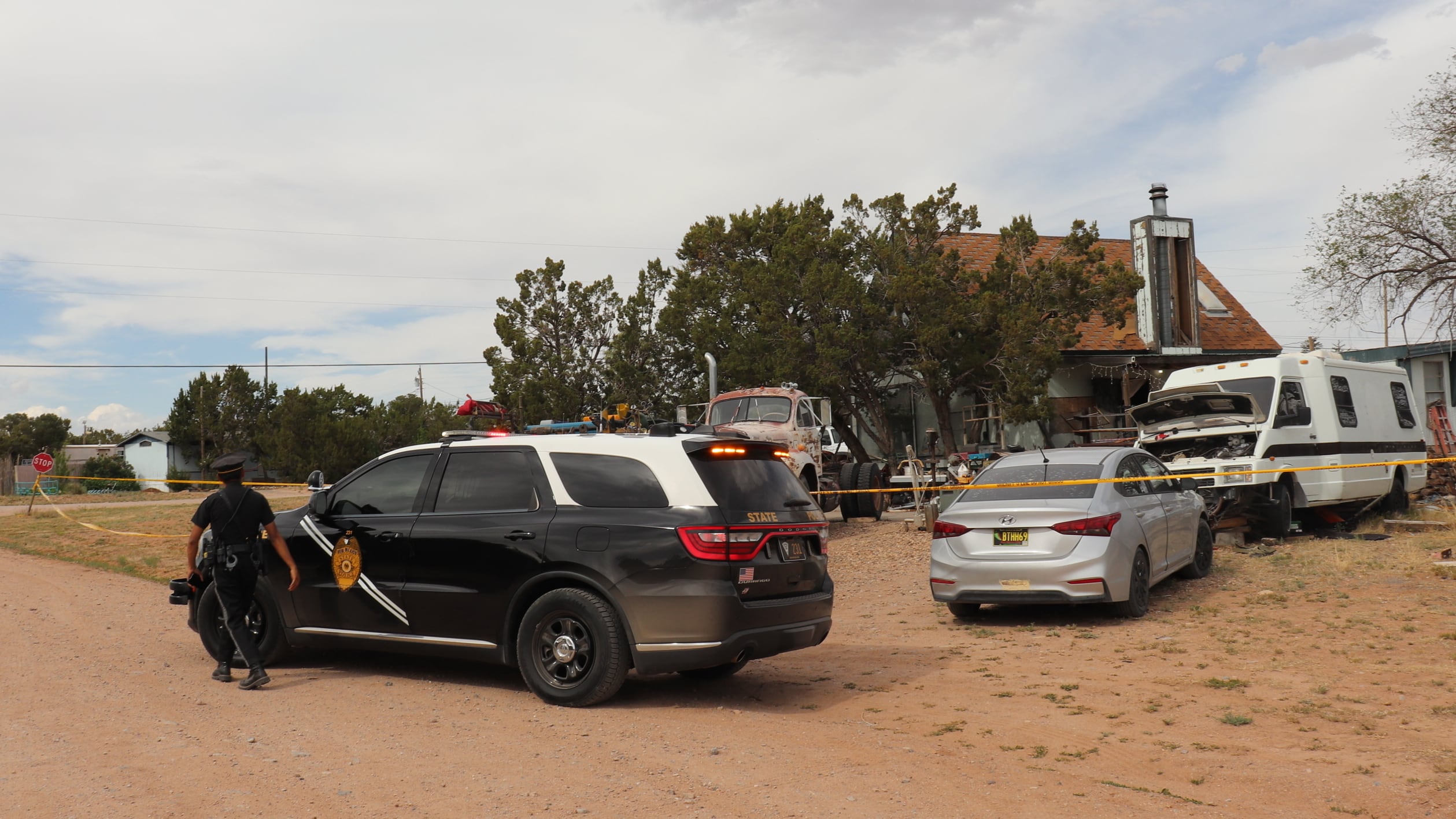
MOUNTAINAIR, N.M. — Three people are dead and more than a dozen first responders had to be quarantined and assessed Wednesday for possible exposure to an unidentified substance after being called to a suspected drug overdose at a rural New Mexico home, authorities said.
New Mexico State Police said three of the four people found unresponsive inside the home east of Albuquerque died. The fourth was being treated at a hospital in Albuquerque.
During the response, authorities said, first responders were exposed to the substance and began experiencing symptoms including nausea and dizziness.
Antonette Alguire, a firefighter with Mountainair’s volunteer fire department, helped to give CPR to a woman outside the home and watched as EMTs and firefighters started coughing, vomiting and becoming dizzy at the heliport. She said she never went inside the home and hasn’t experienced any symptoms but described it as scary.
“I guess we’re just going to have to start wearing hazmat suits into these calls and wearing oxygen,” she said. “It’s getting to that point where we just have to live in fear, even saving lives.”
Officials at University of New Mexico Hospital confirmed that 23 patients who were exposed to an unknown substance were assessed and decontaminated after being transported to the hospital. Most of those were first responders who were showing no symptoms and were later discharged.
Medical teams continued to monitor three symptomatic patients Wednesday evening, according to the hospital.
Two first responders were listed in serious condition, said Officer Wilson Silver with New Mexico State Police.
Mountainair EMS Chief Josh Lewis, who was the first to enter the residence, was hospitalized overnight for observation, Mountainair Mayor Peter Nieto said in a social media post.
Also among those experiencing symptoms were EMTs from Torrance County and nurses from the University of New Mexico hospital who came into contact with individuals on scene, he said. The mayor added that public works crew had confirmed that the health issues were not related to carbon monoxide or natural gas exposure.
Albuquerque Fire Rescue Hazmat teams were assisting at the scene in Mountainair, a rural community east of Albuquerque, in efforts to identify the substance involved.
“At this time, investigators believe the substance may be transmitted through contact and do not believe it to be airborne,” Silver said.
As law enforcement officers from multiple agencies remained on the scene late Tuesday afternoon, three bodies were placed onto gurneys and then loaded into a white van and driven away.
Yellow police tape surrounded the home, located on a dirt road in a rural subdivision. A singlewide trailer could be seen in the home’s backyard, with several cars, trucks and vans in the driveway.
While the investigation was ongoing, Silver said indications were pointing toward drugs as a possible factor in the deaths. He added that there was no threat to the public.
Residents, however, took to social media to voice their frustrations about drug use in the community and elsewhere. New Mexico had the fourth-highest rate of drug overdose deaths of any U.S. state in 2024, with 775 deaths, according to the most recent data available by the Centers for Disease Control and Prevention.
The mayor said the town’s law enforcement officers and first responders work every day to protect the community and respond to difficult situations.
“But the reality is that addiction and substance abuse are issues affecting communities all across our state and nation,” Nieto said. “There is no simple or immediate solution. Lasting change requires family support, accountability, education, and most importantly, individuals who are willing to accept help.”
Savannah Peters And Susan Montoya Bryan, The Associated Press
Montoya Bryan reported from Albuquerque, New Mexico.

