
Less than two weeks before his death, Amin Abdullah said his view of success was based not on what people thought of him in life, but whether he had a “pure soul” at the end.
“May Allahu ta’ala (God almighty) grant us Husnal Khatimah (a righteous ending to life),” Abdullah posted to Facebook on May 5.
“Brother Amin Abdullah got exactly what he desired,” said a man commenting on that Facebook post Monday, hours after the security guard was killed while protecting adults and children inside the Islamic Center of San Diego from a pair of teenage shooters.
- READ MORE: Teenage gunmen open fire on San Diego mosque, killing 3 men and then themselves
- READ MORE: San Diego mosque shooters met online and left writings expressing hate, FBI says
Abdullah was one of three beloved community members who died shielding the mosque from what police have said they’re investigating as a hate crime. Two other fixtures of the centre, Mansour Kaziha and Nadir Awad, were killed while trying to draw the attackers away from the building.
“We call them our brothers in the community, we call them our martyrs and our heroes,” Taha Hassane, imam and director of the Islamic Center, said Tuesday.
The selfless actions of the victims ultimately saved lives by preventing the two attackers from penetrating deeper into the building, investigators have said.
“All three of our victims did not die in vain,” San Diego Police Chief Scott Wahl said Tuesday. “Without distracting the attention, without delaying the actions of these two individuals, without question there would have been many more fatalities yesterday.”
Three men distracted shooters from children inside
Like many religious institutions in America, the Islamic Center had bolstered its security after receiving vitriolic messages and worrying threats. It erected a fence, installed bulletproof windows and held regular active shooter drills at its school.
And it employed armed guards, like Abdullah, who greeted mosque members with smiles but was prepared to defend against the worst.
“He was the first face of that community to anyone who came through the door,” organizers of a fundraiser for Abdullah’s family wrote, “and the last line of defense when it mattered most.”
Abdullah immediately recognized the threat as the two armed teens ran past him on Monday, Wahl said.
The security guard exchanged gunfire with the teens as he quickly radioed the school to go into lockdown. His immediate action prevented them from gaining access to classrooms just dozens of feet away, where about 140 students and their teachers were beginning to realize something was wrong, the police chief said.
“His actions, without a doubt, delayed, distracted and ultimately deterred these two individuals from gaining access to the greater areas of the mosque,” Wahl said.
Abdullah was killed in the exchange of gunfire.
The attackers were drawn away from the building by Kaziha, who was the first to call 911, and Awad, who had heard the gunfire from his home nearby.
“When he heard the shooting, he rushed to do something to protect, and he joined Mansour Kaziha. They died together,” Hassane said.
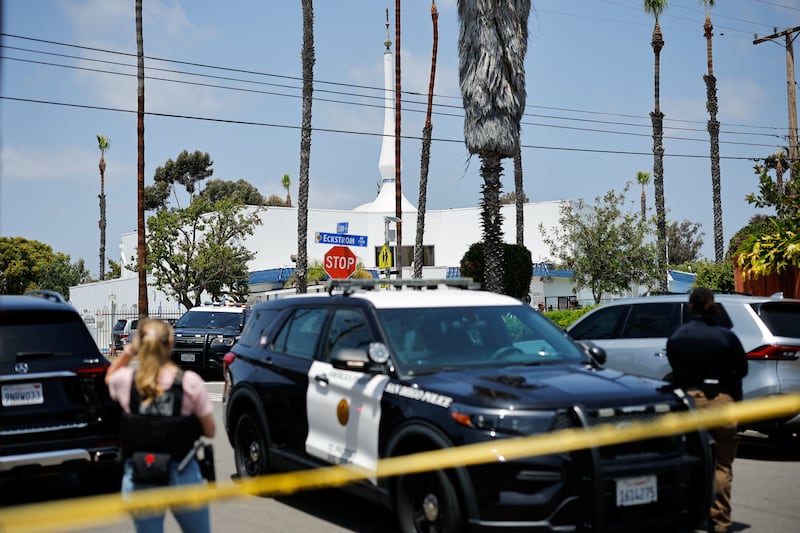
Unable to flee, the two men were cornered and killed by the shooters, who then fled as police descended on the street, Wahl said.
“They tried to do something to protect, but unfortunately they sacrificed their lives to protect the entire community inside the Islamic Center of San Diego,” Hassane said.
Guard showed both steely resolve and friendly smile
Photos of Abdullah show the image Americans have come to expect of a security guard at places of worship and learning, which have so frequently felt threatened by deadly violence. Broad-shouldered and stocky. Hands tucked into a vest covered in tactical gear. His face, always serious.
But there was another side of Abdullah, people associated with the mosque say. A video posted to Facebook on Tuesday by the Council on American-Islamic Relations showed the 51-year-old smiling broadly and extending a vigorous handshake as a worshipper entered the mosque – with an “Armed Security Officer” patch on his vest as a visible reminder of his role that ultimately saved others’ lives.
For the past four years, Sam Hamideh had seen that side of Abdullah: the kind, excited helper who greeted his family every morning at school drop-off.
“Every single time you crossed him, he always put a smile on your face,” Hamideh told CNN. “He always brought that energy of everything’s good, you know, having that strong faith in God and always being kind.”
It was kindness that sometimes surprised Hamideh. When a homeless man who appeared to be having mental health difficulties approached the Islamic Center one day, Hamideh said, Abdullah did not shoo him away. Instead, Abdullah offered the man food and water and gently tried to answer his questions about Islam.
“I said, ‘Brother, wow. The way you treated him,’” remembered Hamideh. “(Abdullah) said, ‘Let me tell you something: There are people out there, all they need is help. And if you need help, don’t you want help? So let’s be people that help if we can.’”
The security guard’s daughter, Hawaa Abdullah, said Tuesday her father was her role model, her best friend and the “absolute best dad in the world.”
Monday afternoon, in the face of the threat he had trained for, the friendly side of Brother Amin faded. The steely-eyed man from the pictures returned. The protector.
Abdullah took his job seriously, his daughter said – so seriously that he sometimes skipped eating meals out of concern “something bad would happen” if he stepped away.
“My dad was the number one advocate for safety and keeping our community safe. He stood against any form of hate,” Hawaa Abdullah said.
Hamideh learned from his wife that Abdullah was killed.
“She said they shot Brother Amin. He was the first one. And that was crushing,” he told CNN.
“I truly know in my heart from knowing that man that he was sacrificing his life and took that bullet knowing that (he would) rather take it than the kids, and that is what makes me emotional.”
Within minutes of the shooting, the Islamic Center that prides itself on being welcoming had to turn even the faithful away, as crime scene tape surrounded the block. “We are closed for the rest of the day,” Hassane said on Instagram on Monday afternoon. “Stay safe. Stay home.”
Another safe space was violated, and a kind man would not return home to his eight children Monday – during the final month of the Islamic calendar when Muslims perform Hajj, a holy pilgrimage, and prepare for Eid al-Adha.
“Having that type of person that’s willing to put their life and protect other people’s kids so they can hug their kids, but he’s got to go home to be buried by his kids – that hurts. That hurts a lot,” Hamideh said.
Guard says he converted to Islam as a young adult
Abdullah was raised as a Christian, he said in a testimony video posted to YouTube in 2019. He became drawn to Islam, he said, from a coworker at a restaurant where he was a cook after he graduated high school in 1992: “The concept of Islam, believing that there’s only one God, one Being responsible for everything, I was like, ‘Wow, this means so much.’”
Describing himself as being “kind of lazy” in his youth, Abdullah said a spiritual awakening changed his life.
“After I took the shahada and became a Muslim, my mother saw a change in me,” he said in the video, wearing a black turban and embroidered dishdasha. “Our relationship improved.”
Abdullah acknowledged his conversion initially resulted in a “clash” among some of his relatives, but he said his mother eventually became a Muslim herself. “The bottom line is half of my family is now Muslim; half are not – and that’s their choice. We still respect each other.”
He advised people to keep their focus on helping others.
“This is what we should be doing: Do something beneficial for the next person,” Abdullah said in the video. “Let this be your legacy.”
Caretaker and neighbor’s familiar faces will be missed
Anyone walking into the Islamic Center would not be surprised to see the faces of Kaziha or Awad, whose near daily presence at the mosque means their absence will be acutely felt.
As Awad distracted the attackers, his mind undoubtedly flicked to his wife, who is a teacher at the Islamic Center’s school.
The 57-year old, who lived so close to the mosque that the imam described him as a “neighbor,” went to the centre every day to join prayers, Hassane said.
He died alongside the mosque’s 78-year-old caretaker, Kaziha, who went by AbulEzz. The community elder and “pillar” of the centre had been there since he helped it break ground in 1986, Hassane said. As director, Hassane said, “I have never done anything without him.”
“Anything that goes wrong, he was the handyman, he was the cook, he was the caretaker, he was the storekeeper, he was everything. I don’t know what I’m going to do at the Islamic Center without his assistance, his daily assistance.”
Another imam at the mosque, Saad Eldegwy, said, “I cannot imagine entering the mosque without seeing him working and serving the community in all ways that he could.”
Community grieves loss of its heroes
Friends and parents who arrived outside the Islamic Center on Monday were still in a daze, facing confusion over yet another inexplicable tragedy. Those who knew the victims were united in grief.
“Every time I brought my grandkids, or I picked them up, or I come for prayers myself during the day, (Abdullah) was always present there taking care of the center, as well as for the kids, the staff, teachers,” said one man who spoke to CNN affiliate KFMB.
Memorial flowers dedicated to the shooting victims began to appear outside the Islamic Center’s gates Tuesday, including a sympathy card from a large Baptist church three miles away.
Among the people looking on quietly was a young bearded man whom a school official identified as one of Abdullah’s children. The official gave him a hug and touched his hand to his heart before the young man walked away.
“He was beloved before. He’s even more beloved now,” Edward Ahmed Mitchell of the Council on American-Islamic Relations told CNN’s Sara Sidner on Tuesday.
There comes a day after every mass shooting when things slowly return to routine. Worship services resume, and children go back to class. But for people like Sam Hamideh and his wife, who could depend on Brother Amin every day for a kind word and a broad smile, his death leaves a hole they don’t know how to fill.
“She told me that this morning specifically he said, ‘Say hello to Sam,’” Hamideh said Monday. “I didn’t know it was his goodbye.”
Andy Rose, Alisha Ebrahimji, Kyung Lah, Norma Galeana, Elizabeth Wolfe, CNN

