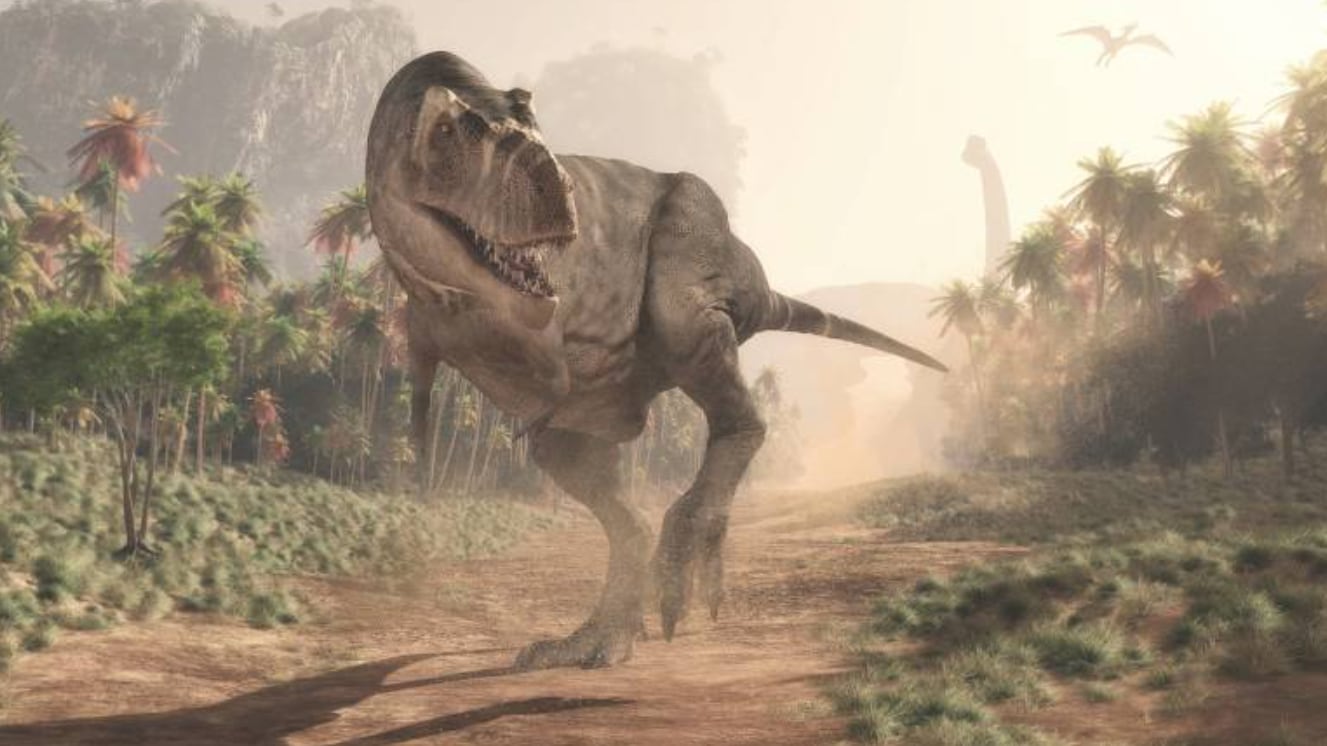
Tyrannosaurus rex and other meat-eating dinosaurs likely evolved to have tiny arms as they changed the way they attacked gigantic prey, according to a new study.
Researchers from the U.K.’s University College London (UCL) and University of Cambridge discovered that smaller arms were more “closely linked” to these dinosaurs developing massive powerful skulls and jaws rather than bigger bodies overall.
The meat-eating dinosaurs may have shifted to using their jaws and head, instead of their claws, to hunt for larger prey, according to the researchers.
“The head took over from the arms as the method of attack,” lead author Charlie Roger Scherer, a PhD student at UCL Earth Sciences, said in a press release Wednesday. “It’s a case of ‘use it or lose it’ – the arms are no longer useful and reduce in size over time.”
Scherer said the evolution of smaller arms happened in places with giant prey such as sauropods, which were plant-eaters with long necks and long tails. These dinosaurs could grow to around 100 feet in length.
The study was published in the journal Proceedings of the Royal Society B on Wednesday. Researchers reviewed data for 82 species of two-legged, mostly meat-eating dinosaurs called theropods. They discovered that the tyrannosaurids family, including Tyrannosaurus rex, were among the five groups that experienced a shortening of arms.
“While our study identifies correlations and so cannot establish cause and effect, it is highly likely that strongly built skulls came before shorter forelimbs,” Scherer said. ”It would not make evolutionary sense for it to occur the other way round, and for these predators to give up their attack mechanism without having a back-up.”
Researchers also found that some theropods with “strongly built heads and tiny arms” were actually not massive. For example, the Majungasaurus weighed 1.6 tonnes, about a fifth of the T. rex., though it was an apex predator. It lived in Madagascar 70 million years ago.

