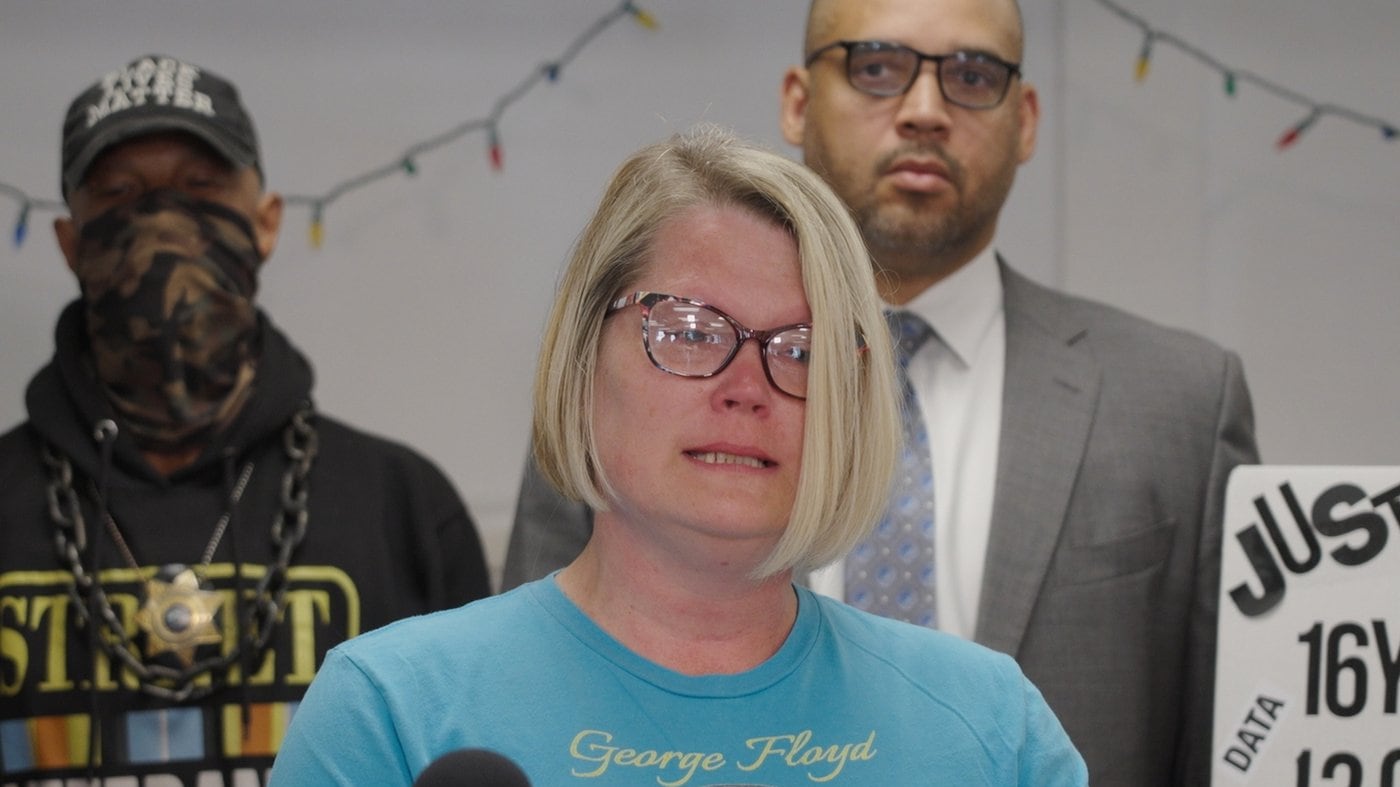
Minnesota residents with loved ones who died at the hands of police spoke out Thursday about the state Republican Party holding a public prayer for Derek Chauvin, the former police officer in prison for murdering George Floyd.
“That is the most hurtful thing you can do,” said Valerie Castile, the mother of Philando Castile, a 32-year-old school cafeteria worker who was shot and killed by a Minnesota police officer in 2016. “You give a moment of silence to a murderer? Come on.”
Castile was among several members of the community who spoke at a news conference organized by Twin Cities Coalition For Justice.
The Minnesota Republican Party nominating convention held a moment of silence last weekend for Chauvin.
When the action became public knowledge, it triggered intense backlash.
Racial justice groups, civil rights advocates and Democratic public officials swiftly condemned party officials, accusing them of blindly supporting law enforcement and disrespecting Floyd and his family.
Chauvin has been in federal prison since 2021, after he was convicted of murdering Floyd six years ago. Cellphone video of Chauvin putting his knee on Floyd’s neck for over 9 minutes despite Floyd’s pleas of “I can’t breathe” sparked the numerous racial reckoning protests that dominated the latter half of 2020.
On the one-year anniversary of Floyd’s death, people knelt in a moment of silence at the site, symbolizing the 9 minutes and 29 seconds Floyd was pinned down.
A delegate at the Minnesota GOP gathering in Duluth on Saturday proposed acknowledging Chauvin, according to reports from local news outlets. It occurred days after the sixth anniversary of Floyd’s death.
“The moment of silent prayer was a spontaneous motion brought forward from the convention floor. It was not part of the official convention program, it was not proposed by Convention Chairman Danny Nadeau, and it was not a statement from party leadership,” the Minnesota Republican Party said in a statement.
Castile said it didn’t matter if only one person participated, it was still hurtful.
“I am proud of the ones who did not do the moment of silence,” she said. “Those that did, they should be reprimanded in some fashion.”
Minnesota Attorney General Keith Ellison, who led the state’s prosecution of Chauvin, said in a statement this week he was “heartbroken and frankly shocked” by the prayer.
“This decision dishonours the memory of George Floyd and wounds his loved ones all over again. As the lead prosecutor whose team presented this case to a jury of twelve Minnesotans and then prevailed at every step of the appeals process, I am deeply troubled by what this says about the state of our politics,” Ellison said.
Ben Crump and Antonio Romanucci, the attorneys who represented Floyd’s family in a wrongful death lawsuit, were left “sickened by this lack of respect.” They also demanded the Minnesota GOP retract their moment of silence and apologize to Floyd’s family.
“The audacity of the Minnesota Republican Party to honour an individual who has both been convicted by a jury of his peers for the murder of a fellow human being, while at the same time (violating) a professional oath to protect and serve his community, is disgusting,” they said in a statement.
Reached via text message on Thursday, Floyd’s New York-based brother, Terrence Floyd, said he was “glad to see people are still fighting with us for complete justice.”
The moment of silence for Chauvin fits a pattern of flashpoints when conservatives reacted to police violence with “back the blue” initiatives. Long before 2020, when George Floyd’s murder catalyzed the largest racial justice demonstrations since the Civil Rights Movement, some officers were symbols of “law and order” or anti-Black Lives Matter sentiment.
For example in 2014, after Darren Wilson — the former Ferguson, Missouri, police officer who is white — fatally shot 18-year-old Michael Brown, who was Black, a GoFundMe website raised hundreds of thousands of dollars for the officer’s family and legal defence. The amount dwarfed the total raised for Brown’s family. Wilson ultimately did not face criminal charges or federal civil rights offenses.
Officers in the high-profile cases in which police killed Laquan McDonald in Chicago and Eric Garner in New York also drew sizable support from law enforcement unions that recast the criminal prosecution or discipline of officers as unjust and politically motivated.
Although legal outcomes vary a lot in these cases, most prominent examples of support for officers charged in killings do not result in overturned convictions.
___
Associated Press editor Aaron Morrison in New York City contributed to this report.
Terry Tang, The Associated Press

