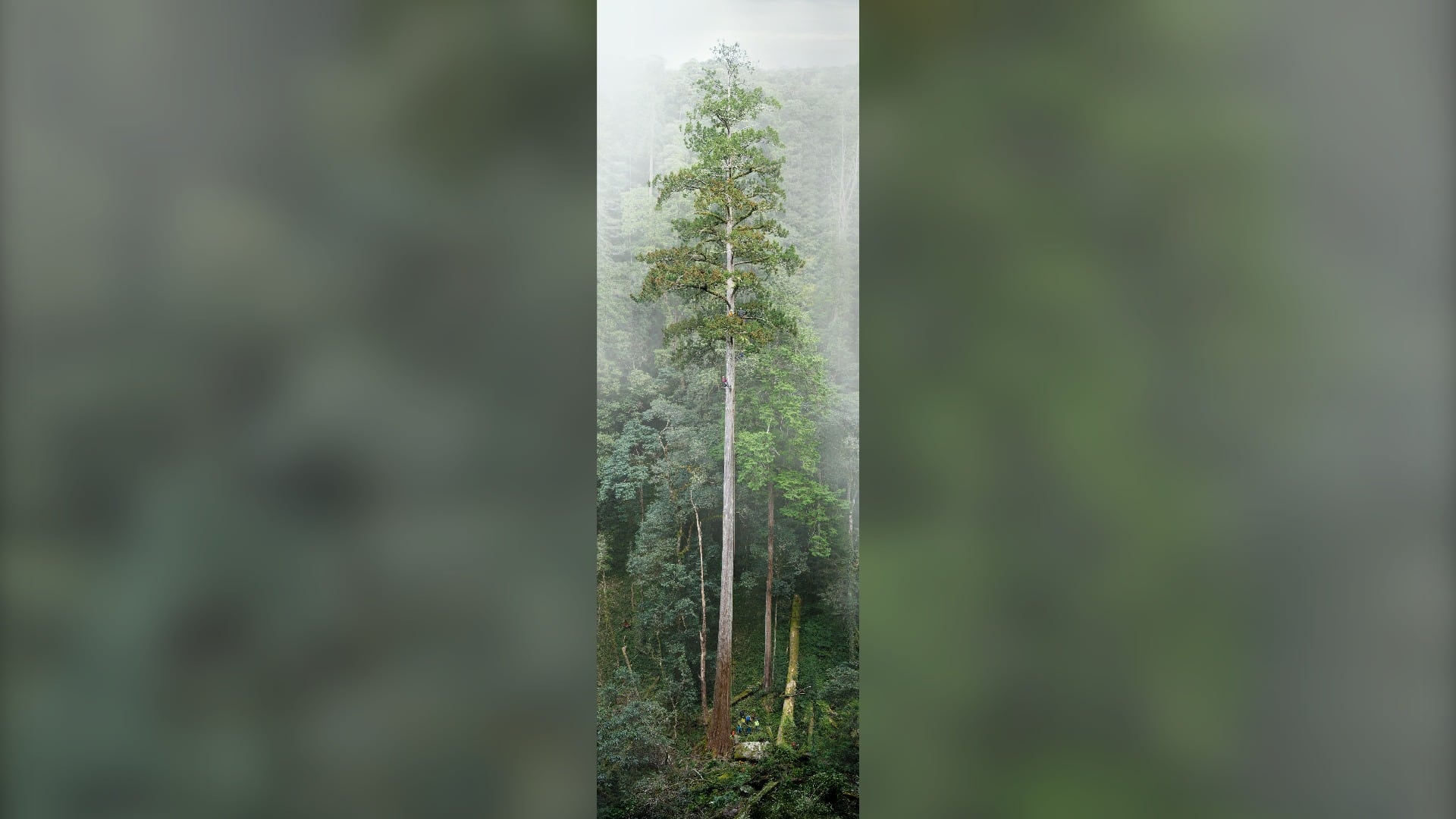
Determined researchers have found East Asia’s tallest known tree in a secluded valley near one of Taiwan’s longest rivers. The team named the massive fir tree “Heaven Sword of the Da’an River” — a nod to the legendary weapon from Jin Yong’s martial arts novels.
Researchers estimate the Heaven Sword — towering 84.1 metres tall — is about 1,000 years old. The quest to identify the Taiwania fir spanned a decade. The Indigenous Rukai people who inhabit the island’s southern mountains refer to the evergreen species, formally known as Taiwania cryptomerioides, as “the tree that hits the moon.”
For reference, the world’s tallest known living tree is Hyperion, a coast redwood in California’s Redwood National Park, that currently measures 116 metres tall.
Dramatically mountainous, Taiwan is home to a rich diversity of plant life. Forests cover about 60 per cent of the island, which has an estimated 950 million trees, according to a 2016 study.
The colossal trees that grow in many of Taiwan’s forests made searching for the Heaven Sword a formidable task.
Undaunted, a group of Taiwan tree seekers — including professional tree climbers, ecologists, geologists and remote-sensing specialists — has been working since 2014 to document the island’s tallest trees, including Taiwania firs such as the Heaven Sword.
The group undertook years of aerial scanning surveys, created the Taiwan Giant Tree Map and sought input from citizen scientists.
Ultimately, the team identified the Heaven Sword the old-fashioned way — by scaling the massive tree and dropping a tape measure from the top, according to a study published Friday in the journal Frontiers in Forests and Global Change.
The careful and creative mixture of methods employed by the team could be used to identify large trees on broader scales — a crucial task for conserving Earth’s biodiversity and safeguarding against the climate crisis, experts say.
A rare haven for giant trees
Abundant yearly rainfall and a steady climate have made Taiwan one of the rare environments on Earth capable of sustaining for hundreds and thousands of years the continuous growth of old, giant trees, said lead study author Dr. Rebecca Chia-Chun Hsu, assistant researcher at the Taiwan Forestry Research Institute.
Industrial logging between 1912 and 1991 depleted some of Taiwan’s ancient forests, but the island’s incredibly steep terrain kept old trees out of the reach of loggers, she added. Now, many of the trees grow in protected areas.
The Taiwan tree seekers first came together 12 years ago to measure and document “The Three Sisters,” a trio of giant Taiwania firs long known to locals in the expansive Cilan conservation area across northern and northwestern Taiwan. The group galvanized into action when Hsu encountered experts in lidar, or light detection and ranging, at a conference. They described the difficulties in searching for giant trees while relying solely on raw remote-sensing data.
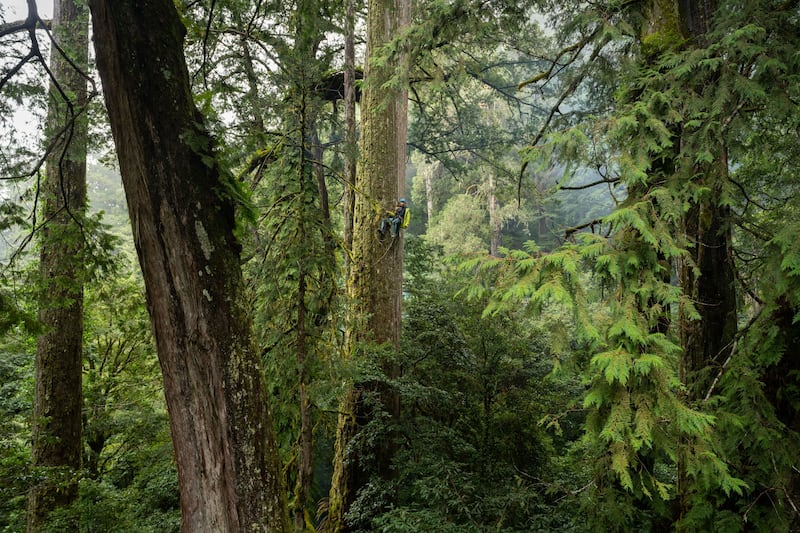
Professional tree climbers and members of Indigenous communities joined the group as it embarked on increasingly challenging expeditions, sometimes involving days of hiking to reach one site.
“The common characteristics are probably that we are all tree lovers and like adventures,” Hsu said.
The team realized that identifying the tallest trees from the ground was a nearly impossible task. The group had climbers who could scale towering trees, but the members needed a bird’s-eye view of the multitiered canopy to gain a broader perspective of Taiwan’s dense forests.
Partnering with remote-sensing experts from Taiwan’s National Cheng Kung University, the team used lidar to transmit pulses of light from aircraft, measuring how long it took for the light to bounce back to them. The technique enabled the team to create a detailed 3D map that highlighted the height of the trees.
Human eyes and thought processing also played vital roles. Taiwan’s uneven terrain can trick remote sensing, which will measure trees as taller than they are depending on nearby features, such as steep cliffs.
The group invited citizen scientists in 2020 to look at the images the team captured using lidar. The results showed that 93 per cent of the trees had been mismeasured by the algorithm — a finding that spared the researchers the grueling work of climbing countless trees that were much shorter than the data initially had suggested. At the end of 2022, the team released the Taiwan Giant Tree Map, singling out 941 trees exceeding 65 metres tall.
As Taiwan celebrated Lunar New Year in early 2023, the team zeroed in on a key target from the map: the tallest tree.
Locating the Heaven Sword
Reaching the Heaven Sword involved over 20 kilometres of swimming and rock climbing upstream, followed by two days of an arduous, uphill hike.
Then, it was time to ascend the tree.
“On-site, we use drones to investigate the target tree before climbing,” Hsu wrote in an email. “However, the most accurate way to determine a giant tree’s height is tape-drop measurement.”
When the tape measure read 84.1 meters, Hsu recalled feeling immense relief. The grueling hike in the middle of nowhere had been worth it.
Forester Michael Taylor, co-discoverer of the Hyperion tree and lidar specialist for the Columbia Land Trust in California, applauded the efforts of the team for putting in the hard work of manual measurements for confirmation. Taylor was not involved in the study.
“Very few other groups actually do that, instead over-relying on these inflated figures using automated height generation software alone without consideration of hillside leaners,” Taylor said. Hillside-leaning trees often grow in a way in which they are trying to seek additional sunlight or compensate for shifting soil.
Hsu believes every expedition has been worth the effort, even when navigating unpredictable weather and unfavourable conditions, because the group has had to forge their own paths through stunningly beautiful but isolated locales that they might not otherwise see.
“I think these amazing creatures remind us that humans are just a tiny part of the Earth,” Hsu said. “Giant trees have very long lifespans, and they have recorded and survived long-term climate changes on the planet. We shall feel humble when we know more about their secret life.”
Steve Pearce, director of The Tree Projects in Australia, witnessed the group’s reverence for the natural world firsthand when photographing Taiwan’s tall trees, including The Three Sisters and the Heaven Sword.
“The group of people that they’ve managed to assemble over time is quite a special thing because there’s a lot of collaboration between different scientific departments,” Pearce said. “There’s very few places around the world where anybody is going into this much effort to look at trees.”
Guardians of the planet
Next, the group intends to determine the types of bioclimates and terrains preferred by Taiwan’s tallest trees. The team has also selected several giant tree species for additional lidar observation to construct 3D models that will calculate their biomass.
“We found that the previous equations from forest management institutions tend to underestimate their carbon density significantly,” Hsu said.
Giant trees play an ecologically important role in forests, absorbing carbon dioxide and acting like protective guardians of their ecosystems. Taiwan’s forests of giant trees may be some of the most carbon-dense environments in the world, Hsu said.
“Beyond their carbon value, large trees contribute to the structural complexity and functional diversity of forests and provide critical habitat for other organisms,” said Lalasia Bialic-Murphy, head of the forest diversity and biodemography group at the Swiss Federal Research Institute WSL, in an email. “At the same time, forests are increasingly threatened, with recent estimates suggesting that over 30 per cent of the world’s tree species face elevated extinction risk.” Bialic-Murphy was not involved in the research.
Tall trees are some of the most vulnerable to climate change, according to the new study. They face greater sensitivity to drought and extreme weather events, such as the strong typhoons and heavy rainfall-driven landslides that plague Taiwan.
“Hotspots of giant trees can also serve as living indicators of forest history, often corresponding to forests that have had time to develop complex structure and support high levels of biodiversity,” Bialic-Murphy said.“ Identifying these hotspots is critically important for guiding forest biodiversity conservation and climate mitigation efforts.”

