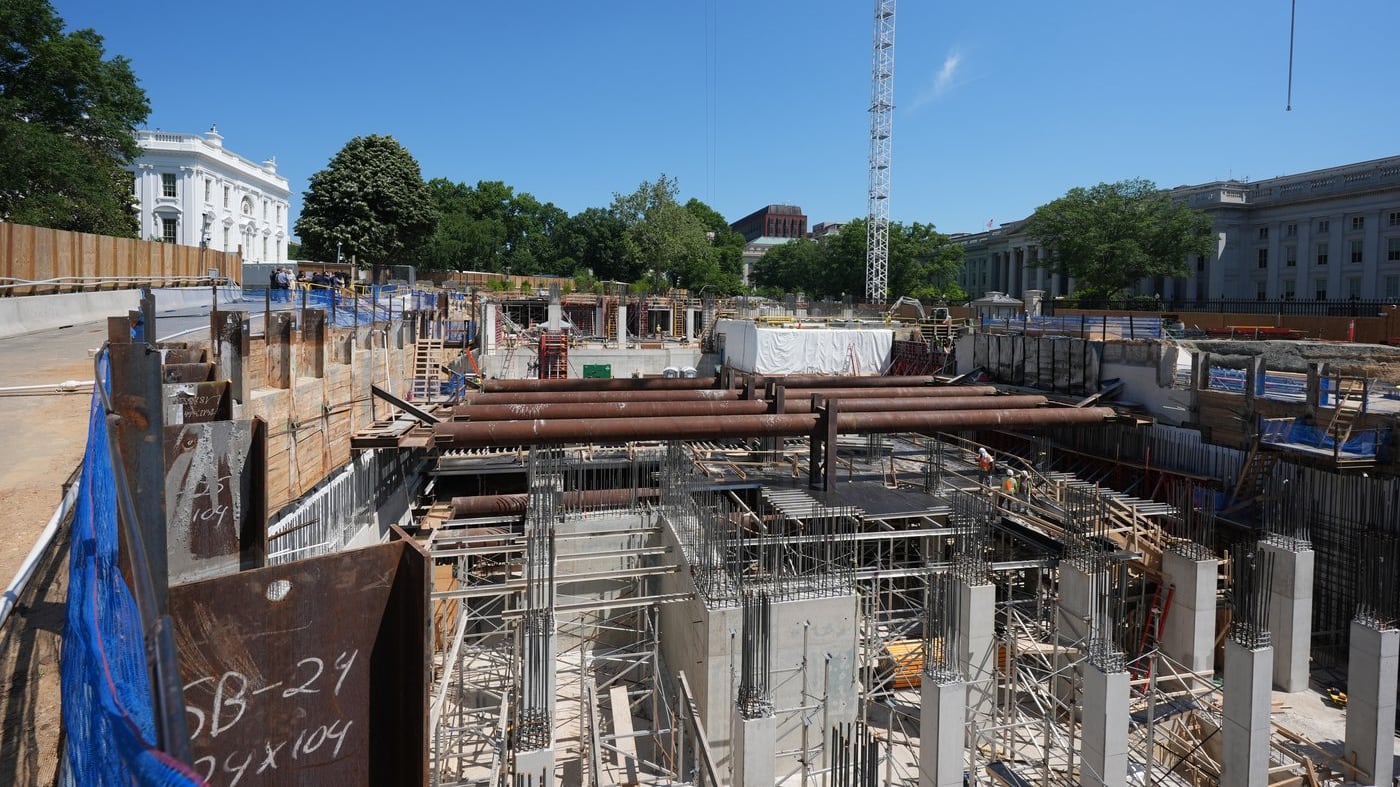
WASHINGTON - U.S. President Donald Trump’s administration asked an appeals court on Friday to allow construction of a US$400 million ballroom on the site of the White House’s demolished East Wing, pitting Trump against preservationists in a case testing the limits of presidential authority.
A lawyer for the administration, Yaakov Roth, told a three-judge panel of the U.S. Court of Appeals for the District of Columbia Circuit that the challengers seeking to block the project do not have legal standing to pursue their lawsuit.
“It’s an architectural preference on one hand and the safety and security of the President of the United States on the other hand,” Roth said. “We have evidence here that the old East Wing was not adequate to protect the safety and security of the President and others in the White House leadership of the executive branch.”
Judge Patricia Millett suggested the government’s argument amounted to “move fast and break things and nobody has standing.”
The National Trust for Historic Preservation, a nonprofit group that campaigns to protect significant American sites, sued last year after the Trump administration tore down the East Wing in October 2025 and began building a 90,000-square-foot (8,360-square-metre) ballroom without seeking authorization from Congress.
The East Wing, part of the White House complex in Washington, traditionally housed the offices of the first lady and her staff.
Trump’s ballroom plan is part of a broader push by the Republican leader to reshape central Washington’s landscape of government buildings and national monuments.
U.S. District Judge Richard Leon, appointed by Republican former U.S. President George W. Bush, twice blocked above-ground construction on Trump’s ballroom while allowing underground work to continue.
Leon said no federal statute even “comes close to giving the President” the required authority to construct the ballroom without approval by Congress.
The administration’s appeal is being heard by Democratic-appointed D.C. Circuit judges Millett and Bradley Garcia alongside Trump-appointed Judge Neomi Rao. In an order last month, the appeals court allowed construction to continue during the legal battle without ruling on the merits of the case.
The panel could issue a more significant ruling in the next few weeks, which could be appealed to the U.S. Supreme Court.
The administration has framed the ballroom project as a national security necessity, citing recent assassination attempts against Trump.
“The East Wing Project answers that critical security need, and ensures that the President can fulfill his constitutional duties in a safe and heavily secured facility,” the U.S. Justice Department told the appeals court in May.
Preservationists reject that argument. The National Trust for Historic Preservation contends that the D.C. Circuit and U.S. Supreme Court have never allowed a president to “usurp powers vested in Congress by the Constitution based on nothing more than his claim of necessity.”
The organization said in a filing that “the public has a strong interest in pausing a project that will irreparably damage what is perhaps the most significant historic site in the country.”
Trump also intends to erect a 250-foot (76-metre) arch near the National Mall, the tree-lined strip between the U.S. Capitol and the Lincoln Memorial, and renovate the Kennedy Center performing arts complex.
A federal judge last week ordered Trump to remove his name from the iconic Kennedy Center building and blocked his plans to close it for renovations.
Trump has said his planned ballroom is scheduled to open around September 2028.
Reporting by Mike Scarcella; Editing by David Bario, Sanjeev Miglani and Andrea Ricci.

