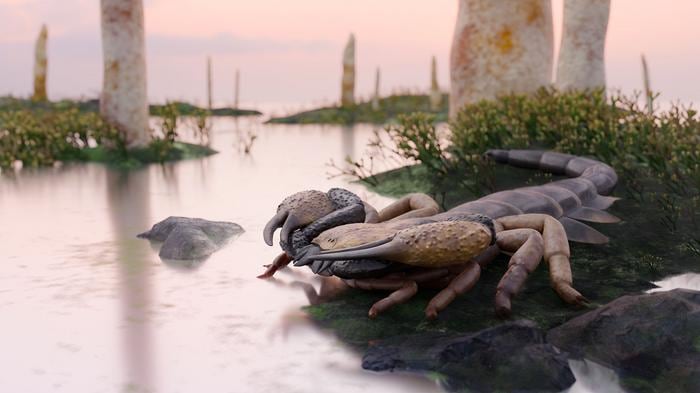
A mega scorpion with claws the size of dinner knives and a body the size of a dog was once ancient Britain’s apex predator, according to new research.
The beast would have had pincers more than 16 centimetres long, been a metre long and roamed floodplains about 415 million years ago, according to a study published Tuesday by British researchers.
“What makes (the scorpion) so interesting is that it became enormous at a time when life on land was otherwise very small,” said Russell Garwood, a study author and University of Manchester paleontologist in a press release. “But it was a world that could somehow support a giant predator.”
The scorpion, called Praearcturus gigas, lived during the Early Devonian period. Animals were only just starting to move onto land, large forests had not evolved, with fungi and small plants only recently colonizing land.
“When we think of giant arthropods, people often picture Carboniferous rainforests with giant millipedes or dragonfly-like insects from later in Earth’s history,” Richard Howard, lead study author and curator of London’s natural history museum, said in the press release. “But Praearcturus lived at least 50 million years earlier, well before the evolution of trees, when life on land was only just getting started.”
The study suggests the scorpion was an apex predator and partially aquatic, likely moving between floodplains and fresh water. The scorpion was likely able to grow so large due to a lack of competing apex predators. The lands were still new and the scorpion had nothing to fear, allowing it to grow to a tremendous size.
“Gigantism in Early Devonian scorpions may have had distinct evolutionary drivers, being potentially the first group to occupy the niche of a large terrestrial predator,” according to the study.
Greg Edgecombe, a co-author of the study and a researcher at London’s natural history museum, said the fossil shows how animals adapted to life on land. He suggested that this particular branch of scorpion evolution “may even represent a lineage that returned to the water after earlier ancestors had already begun living on land.”
The scorpion was first described in 1871, but was thought to be a crustacean, rather than an arachnid. Recent discoveries confirmed that it was a scorpion.
Howard praised modern research techniques that were able to reshape scientific understanding of the animal. Garwood shared the sentiment, saying “By bringing together material from several collections and using cutting edge imaging techniques, we’ve been able to build a clearer picture of the animal than was previously possible, which is really exciting.”

