
LEXINGTON, South Carolina — Alex Murdaugh, the disbarred South Carolina attorney accused of killing his wife and son, will face his second murder trial next spring after his murder convictions were overturned on appeal.
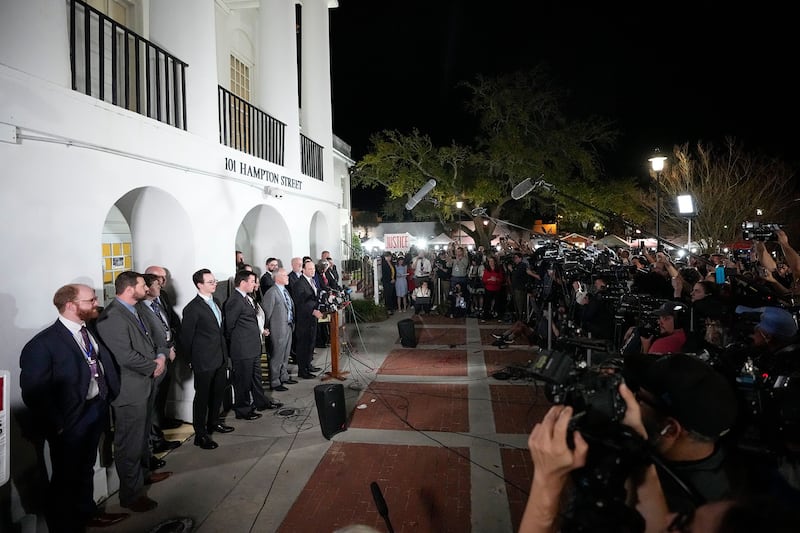
Murdaugh, 58, appeared in court Monday, shackled in an orange jumpsuit, for his first court appearance since his convictions were overturned. Circuit Court Judge Debra McCaslin ruled the new trial will begin April 5, 2027.
Murdaugh’s attorneys filed several pretrial motions last week, including requests for a change of venue, for further independent testing of DNA evidence and for Murdaugh to get access to a computer behind bars.
Separate from the murder case, Murdaugh pleaded guilty to dozens of financial crimes and remains behind bars on concurrent state and federal sentences of 27 and 40 years.
Dozens of members of the public showed up early to court hoping to snag a seat within view of the man whose sprawling saga has already had enough twists to fill multiple true-crime documentaries, dramatized shows and best-selling books.
The hearing marked the start of the road to retrial for Murdaugh, whose case stems from the June 2021 fatal shootings of Murdaugh’s wife, Maggie, and 22-year-old son, Paul, outside their family home in Islandton, a small community in South Carolina’s Lowcountry.
Murdaugh was a partner at a powerful law firm with his name on it, and his father, grandfather and great-grandfather served as the local prosecutor consecutively from 1920 to 2006.
But that prominence belied underlying issues, and the alleged killings of his wife and son were followed by accusations of misappropriated funds, his resignation, a bizarre alleged suicide-for-hire and insurance scam plot, a stint in rehab for drug addiction, dozens of financial crimes, his disbarment and, ultimately, the murder charges.
In 2023, Murdaugh was found guilty of the murders after a six-week trial that featured testimony about his years of embezzlement and theft as an attorney, video placing him at the crime scene and his dramatic admission on the stand that he had repeatedly lied to investigators. He was sentenced to life in prison.
Murdaugh’s attorneys appealed the convictions, saying the trial was tainted by the county clerk Becky Hill’s inappropriate comments to jurors implying his guilt. Hill later pleaded guilty to criminal charges connected to the case, though she has never been charged with jury tampering.
Last month, the state Supreme Court overturned the murder convictions and ordered a new trial, saying his previous trial was marred by Hill’s “improper” influence.
Defence’s pretrial motions
The defence’s pretrial motions focus on issues related to venue and evidence as well as Murdaugh’s preparation for court and appearance.
Murdaugh’s attorneys argued that their client cannot receive “the fair and impartial trial guaranteed to him” in the Fourteenth Circuit, which includes Colleton County, where his 2023 double-murder trial was held.
“The basis for this motion is that this is among the most heavily publicized criminal prosecutions in the history of this state,” wrote Murdaugh’s attorneys in the motion. “For years, Defendant, his family, and the law firm with which his family was associated for generations have been the subject of saturating, sensational and continuous media coverage.”
The attorneys noted that the Fourteenth Circuit is “where the Murdaugh name has been synonymous with the local legal system for nearly a century, where the population is small and interconnected, and where the very documentaries, books, and films that have shaped public opinion were researched, filmed, and produced.”
The attorneys also filed a motion seeking an order to require the state to produce DNA evidence for an independent laboratory review.
“DNA evidence was collected from underneath Maggie Murdaugh’s left-hand fingernails at the scene,” wrote Murdaugh’s attorneys. “SLED determined this DNA was from an unknown and unrelated male. No further analysis was attempted. This evidence, however, is crucial to the defence.”
A third motion requests that the South Carolina Department of Corrections allow Murdaugh to access a “secure laptop computer” so he can go over any material associated with his trial.
Prosecutors have not yet responded to these requests.
Finally, Murdaugh and prosecutors filed motions with unusually personal debate about his attire and appearance in court.
Murdaugh’s team initially asked that he be allowed to come to all court appearances, including pretrial hearings, wearing civilian clothes and unshackled. Given the cameras in the courtroom, his defence argued – much like lawyers have in Tyler Robinson’s case in the killing of conservative activist Charlie Kirk – that his appearance in shackles and a prison outfit could influence potential jurors.
The state pushed back in its response, arguing the presence of cameras “is no basis to ignore normal security concerns” and sharply criticized Murdaugh personally.
“This case is ultimately about the fact that Defendant thinks he is special. He is not,” prosecutors said.
In response, Murdaugh’s defence said the prosecution’s “histrionics” were “inappropriate” and said they were surprised by the prosecution’s issue with their common request. Still, his defence withdrew the motion and said they’d prefer to focus on other more important motions.
“Murdaugh has admitted his many serious financial crimes, and he accepts the consequences of those crimes — decades of imprisonment, probably for the remainder of his life without complaint,” his attorneys wrote. “If the State wants to use that for a public spectacle, so be it.”
By Dianne Gallagher, Eric Levenson, CNN

