
Archeologists in Israel have discovered a cave used by pre-Neanderthal human-like creatures who lived as long as 400,000 years ago, making it one of only a handful of sites from the little-known period accessible to scientists.
Located on the outskirts of a town called Fureidis in northern Israel, the cave was due to be affected by construction work when archeologists decided to investigate it.
Researchers in the 1970s originally thought the cave was used around 200,000 years ago, archeologist Kobi Vardi of the Israel Antiquities Authority told CNN on Thursday.
However, Vardi and his colleague Ron Shimelmitz, an associate professor in archeology at the University of Haifa, have now discovered that it was inhabited up to 400,000 years ago.
They determined this after finding flint tools, such as hand axes, scrapers and blades, that are characteristic of the Acheulo-Yabrudian culture of pre-Neanderthal hominins who lived in the area at the time.
Vardi told CNN that “it was a big surprise” to find that the cave was much older than previously thought. It would have been used by members of the Acheulo-Yabrudian culture, who inhabited the Levant, or the Near East, around 400,000-250,000 years ago.
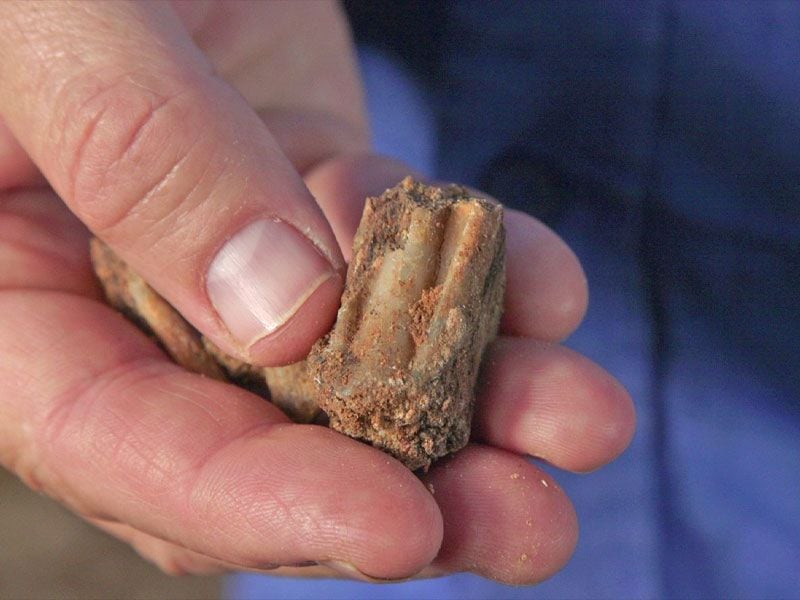
The team also found bones from animals such as fallow deer and gazelle.
This suggests large groups of hominins lived together in the caves, hunting wild animals and using fire, “suggesting complex and rich camp life,” Shimelmitz said in a statement published by Israel’s Ministry of Foreign Affairs on June 11.
However, to date no significant human remains have been found in any of the caves that have been discovered from this period.
The cave in Fureidis is “a unique site of global importance,” Shimelmitz said in the statement.
“This time capsule belongs to a unique period at the end of the Lower Paleolithic era, just before Neanderthals and modern humans became dominant and spread across many regions,” he said.
“Only a handful of sites from this important phase have been uncovered in Israel and the wider Levant, and most of them are inaccessible for research,” Shimelmitz added.
The team presented their findings to the construction company, and a road bridge was built to save the cave and keep it accessible for further investigation.
Vardi said researchers are planning extensive studies at the site that will probably take several years.
“Our big hope in the excavation of these caves is that maybe we’ll find hominin remains,” he said. “We’re very anxious to meet them.”
‘Transform our understanding’
Armando Falcucci, a lecturer in palaeolithic archeology at the University of Southampton, England, who was not involved in the study, told CNN that the find adds to our understanding of a period of human history that tends to receive limited attention.
“What makes this find valuable is that it pulls the spotlight back to a much earlier and equally pivotal window (roughly 400,000 to 200,000 years ago); a period of profound behavioural and technological change across both Africa and Eurasia in its own right, including the shift toward intensive, repeated use of caves as central places in the landscape,” he told CNN on Wednesday. He stressed that cave deposits from this period “are extremely rare in the region.”
“The evidence for intensive use of fire at this site is particularly significant,” Falcucci added. “It is during this period, and at sites of exactly this kind, that habitual, controlled use of fire becomes archeologically visible, marking a major behavioural threshold in human evolution.”
Catriona Pickard, a professor of prehistory and archaeometry, and head of archeology, at the University of Edinburgh in Scotland, who was also not involved in the research, said the findings “provide rare insights into the material culture and lifeways of early hominins, and as such, the site has the potential to transform our understanding of the Lower Palaeolithic in the Levant.”
By Jack Guy, CNN

