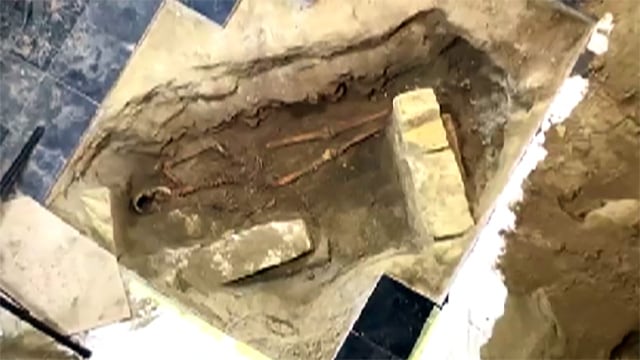
AMSTERDAM -- A skeleton found beneath a Maastricht church this year could not be conclusively identified as that of famed French musketeer Charles de Batz de Castelmore d’Artagnan, city authorities said on Thursday, with some findings raising fresh questions about the theory.
“For now, the true origin of the skeleton and the circumstances of death remain unclear. Further research may show whether a genuine piece of history has been uncovered – or not,” municipal authorities said.
Research on the remains, uncovered in the city’s St. Peter and Paul Church, had not ruled out “entirely” that the skeleton is d’Artagnan’s, they said, but had shown several “surprising elements” pointing in another direction.
According to the research, the skeleton found was that of a man with an estimated age between 44 and 66, a range that includes d’Artagnan, who was 62 when he was killed.
But the bones could not be dated to determine when the man had died.
And analysis suggested the man had eaten a fish-rich diet more typical of eastern or southern Europe than Gascony in southwestern France, where d’Artagnan was born.
“This raises the question of whether such a diet was common among Catholic musketeers from France in the 17th century,” the researchers said in the city’s statement.
Excavation complications
Researchers said the investigation was hampered by the actions of a retired archeologist who began excavating the grave under the church floor without the required permits.
Much valuable information had been “irreversibly lost” during his work, as he had likely damaged the skull of the skeleton and had not documented his work according to standards, making it impossible to date the grave, they said.
The archeologist, Wim Dijkman, was forced to stop his work when the church found out he lacked the appropriate approval, after which the excavation was taken over by a professional team on March 13.
In an interview with Dutch TV program Nieuwsuur in May, Dijkman said he had not informed authorities of his work in the church, as he sought credit for his discovery.
He also admitted he had stored several bones in a plastic box in his garden shed, and only returned them to relevant authorities when police told him to.
Further research needed
Fictionalized in Alexandre Dumas’ 1844 novel “The Three Musketeers,” d’Artagnan was a real historical figure, killed during the French siege of Maastricht in the Franco-Dutch War on June 25, 1673.
That could make the church a possible resting place for him according to historians, but he could also have been buried in a mass grave, the researchers said.
Further research is needed to determine if identification as d’Artagnan is possible, they said, including analysis of ancient DNA.
Reporting by Bart Meijer, Editing by William Maclean, Reuters

