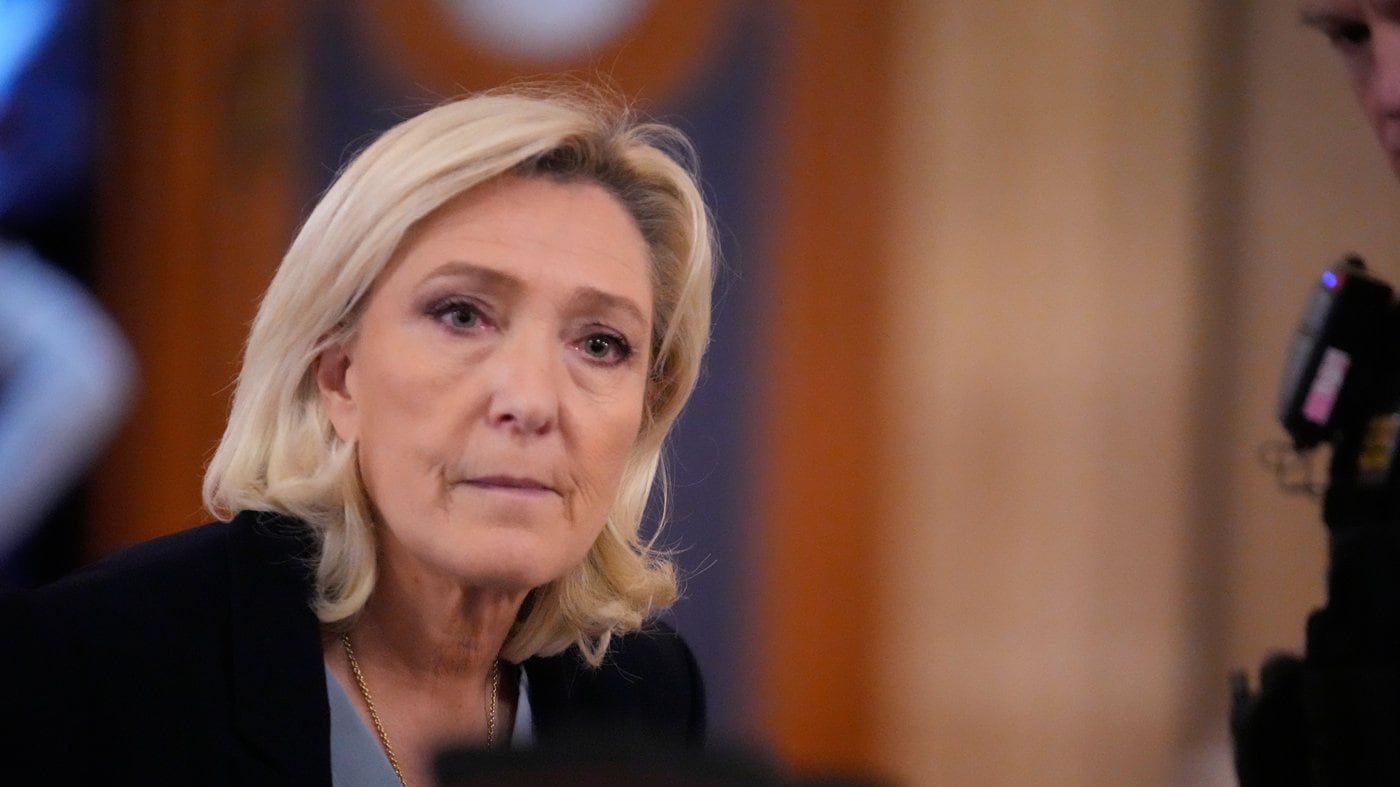
PARIS -- A Paris appeals court cleared the way Tuesday for popular far-right leader Marine Le Pen to possibly run for the French presidency next year but said she must wear an electronic bracelet, which she has said is a no-go.
The verdict declared Le Pen guilty of embezzlement but softened the ban on her holding elected office, putting the ball in her court.
She must now decide whether campaigning in 2027 with a monitoring bracelet as part of her sentence to be served at home is possible.
The verdict appears to be a partial victory for Le Pen.
It reduced her ban on elected office -- from five years handed down last year -- to 45 months, two-thirds of which are suspended.
It also cut her prison sentence from four years to three, two of which are suspended.
Still, the remaining year of prison time, to be served at home with an electronic bracelet, remains a potential hurdle and it’s not immediately clear whether she feels she can campaign with that condition.
Le Pen, 57, may share her thoughts later Tuesday, in an evening television interview.
She had appealed a March 2025 conviction that found her and other members of her National Rally party guilty of misusing European Parliament funds by paying party staff with money intended for EU parliamentary assistants between 2004 and 2016.
The lower court sentenced her to prison time, suspended pending the ruling from the appeal court, and imposed a five-year ban on holding elected office.
Le Pen has denied any wrongdoing and still hopes to mount a fourth bid for the presidency.
If she decides that she cannot run with a bracelet, her protege Jordan Bardella would replace her. Bardella, 30, is the current president of the anti-immigration, EU-skeptic National Rally.
Before the verdict, Le Pen had said that if the court imposes constraints that make campaigning difficult, she might decide not to run. That could include electronic monitoring, she had said.
“If I’m allowed to be a candidate but am effectively prevented from campaigning freely, then you understand that wouldn’t be possible,” Le Pen said in an interview last week.
Prosecutors had asked the appeals court to sentence Le Pen to four years in prison, including three suspended, in addition to a ban on holding elected office for five years.
By Sylvie Corbet

