For anyone who has ever wondered whether they could handle life on another planet, NASA is offering a chance to find out – well, sort of.
The U.S. space agency is looking to recruit four participants for its Moon and Mars Exploration Analog (MMEA), a yearlong simulation program that is designed to replicate traveling and living on the Moon and Mars, it said in a press release earlier this month.
While it may not be quite the real deal, volunteers will be in spacelike conditions, living inside confined habitats and carrying out tasks just as astronauts would, such as growing crops, looking after their health and replicating spacewalks.
The 12-month program begins no earlier than August 2027 and will be based at the Johnson Space Center in Houston.
A NASA spokesperson told CNN that the research program would help reduce any risks astronauts may face when flying to space and landing on Mars.
“Volunteer research participants contribute greatly to the knowledge base by helping NASA characterize the risks and test countermeasures to enhance human performance during long duration space exploration missions,” the spokesperson said.
NASA said the project will also study how crew members adjust to living on Mars time. A Martian day, known as a sol, is about 40 minutes longer than a day on Earth, a difference that could impact sleep and other health and performance issues.
Applicants must be a US citizen or green card holder and aged between 30 and 55, although people outside the age range may also be considered. They must also be no taller than 6 feet 2 inches (1.88 meters) and fluent in English.
Prospective participants must be willing to commit to the 14-month program at the Johnson Space Center, which includes 12 months inside two confined habitats plus a further two months for pre- and post-mission training.
They must also pass physical and psychological assessments, have no dietary restrictions and cannot have a history of sleepwalking or taking sleeping aids.
NASA said applicants must have “astronaut-like qualifications,” such as bachelor’s degrees in engineering, biological science, physical science or mathematics. Those with advanced STEM degrees can also apply and military experience will also be considered.
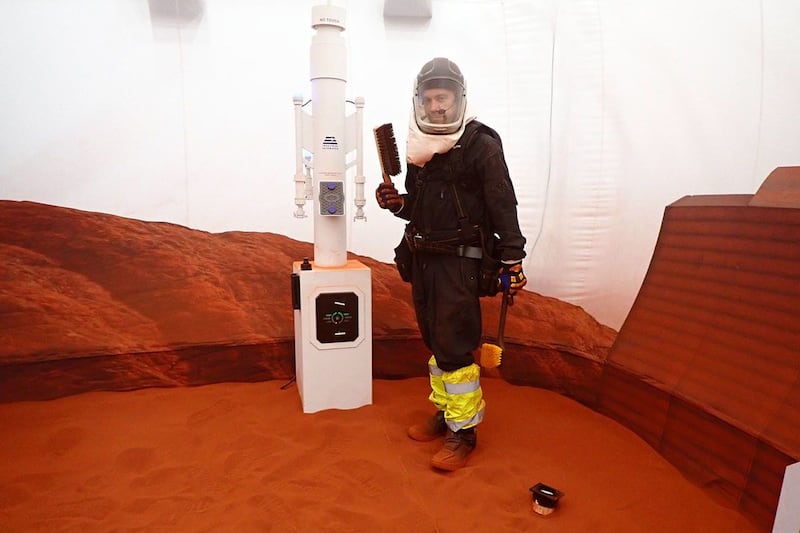
Two habitats
A NASA spokesperson told CNN the project will be split into three segments, involving two different habitats.
“The first will take place inside a mock 650-square-foot (60-square-meter) spacecraft, where the volunteers will live as though they were traveling from the Earth to the Moon or Mars,” spokesperson Kelsey Spivey told CNN.
The four crew members will each have their own small quarters, including a space to live, work and sleep and a small bathroom, though that is different from the one astronauts use.
The second leg shifts the volunteers from traveling to living on the surface of another planet.
Crew members will move into a one-story, 900-square-foot (84-square-meter) facility where they will grow their own crops, look after their health and well-being and practice how to spacewalk on a sandbox designed to mimic planetary surfaces.
The third phase will be a return to Earth in the same spacecraft used in the outward “journey,” Spivey added.
The two habitats have been used for previous research missions and are being made smaller to simulate different mission conditions.
“In previous missions, it (the habitats) was intended to simulate a well-established, larger surface habitat, but MMEA missions are designed to simulate an earlier phase of Mars surface infrastructure, which is also applicable to helping NASA answer questions about near-term Moon Base objectives,” Spivey said.
While NASA has performed 28 transit and two surface habitat simulations, this will be the first project to incorporate the two.
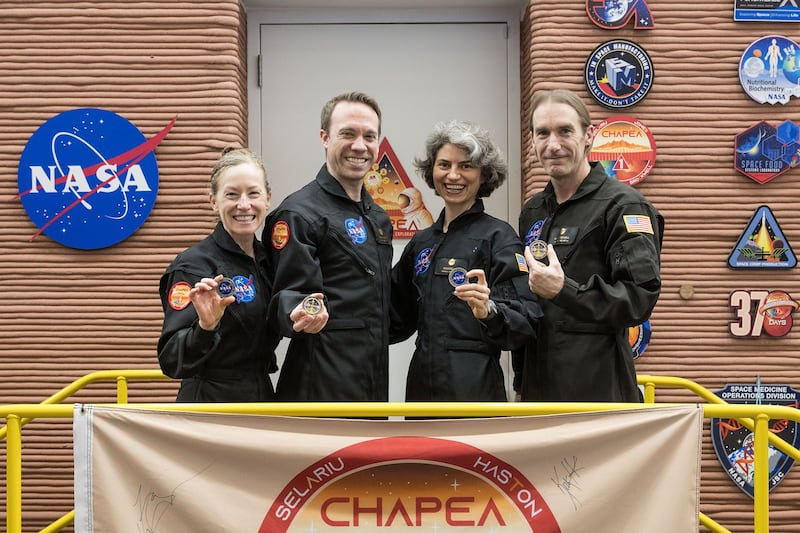
The two surface habitat simulations were run by NASA’s Crew Health and Performance Exploration Analog (CHAPEA), which focused on exploring the health and performance of volunteers living in a confined space while dealing with the anticipated challenges of life on Mars.
‘A new appreciation’
Among this crew was Nathan Jones, a doctor from Illinois, who came across an article calling for volunteers while working night shifts in 2021.
Two years later, he found himself serving as the crew’s medical officer inside the 1,700-square-foot Mars Alpha Dune, NASA’s simulated Mars habitat.
He told CNN on Monday that the experience strengthened his ambition to become an astronaut, adding that he would also be interested in going to space on a commercial flight one day.
However, the yearlong study did come with its emotional challenges for Jones, 43, the main one being missing his wife and children.
“It was hard to miss big events like birthdays, holidays, graduations, funerals and weddings,” he said.
Jones said he developed a new appreciation for the simpler things in life after the mission.
“The NASA food was good, but the menu is necessarily limited, and nothing was fresh other than a few vegetables we grew,” he said. “In the mission there was no sunshine or wind. So, I found a new appreciation for those kinds of things when the mission completed.”
Mustafa Qadri, CNN

