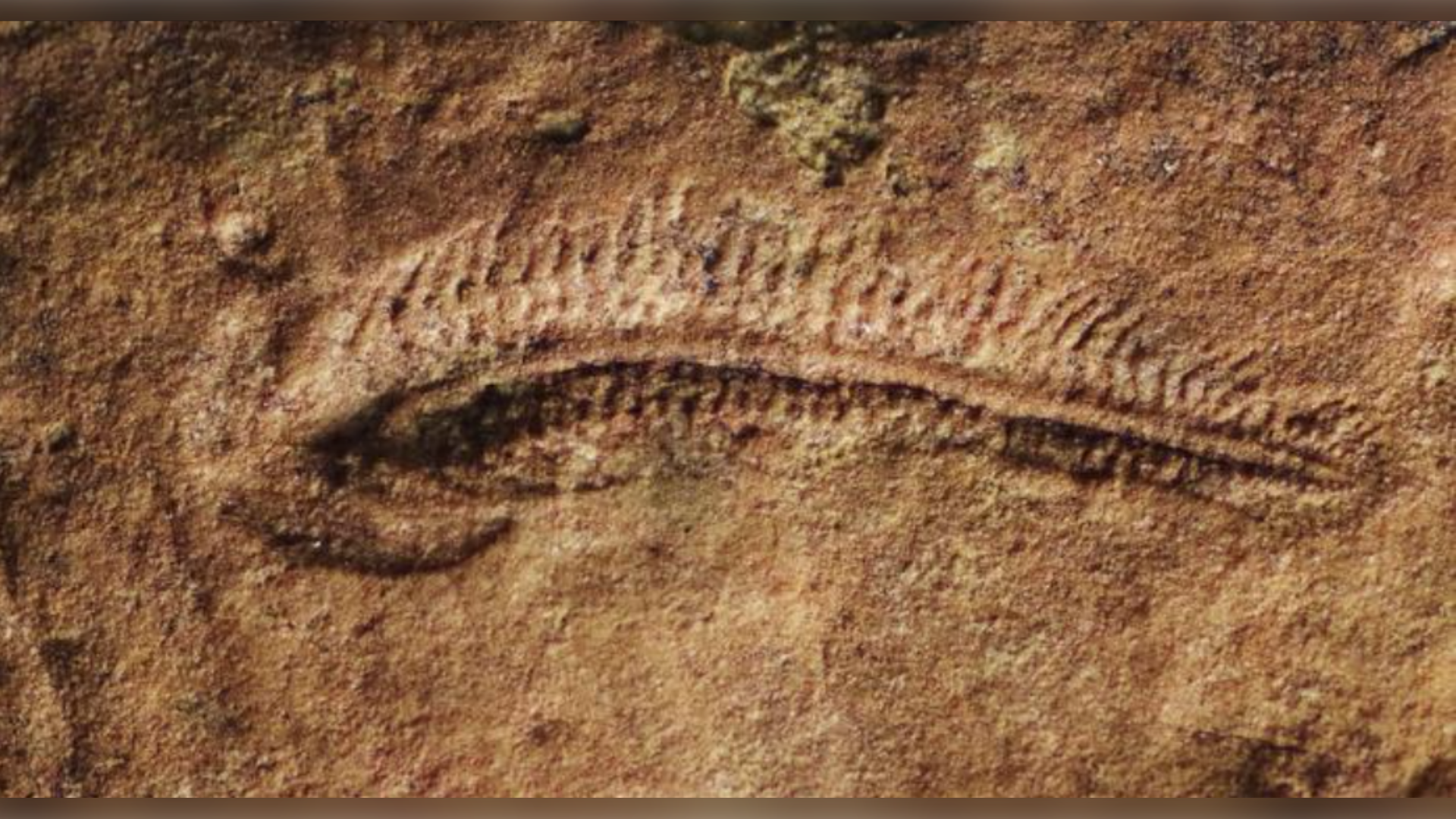
A worm-like ancient creature that lived hundreds of millions of years ago may be the first known animal on Earth to show a preference for turning towards the right, according to new research.
Scientists have unearthed fossil evidence of ‘Spriggina floundersi,’ tiny animals that seemed to display that preference as they navigated the sea and appeared to have a horseshoe-shaped “head” and a “tail,” according to experts.
Spriggina, the state fossil of South Australia, is named after geologist Reg Sprigg.
Sprigg discovered the Ediacara biota, including the Spriggina floundersi, in the Australian outback in 1946.
The recent finding suggests that creatures’ preference for being right-handed or left-handed may have emerged much earlier than previously believed, according to a news release by the American Museum of Natural History.
The study, published in the Scientific Reports journal on Thursday, was led by researchers from the American Museum of Natural History, Florida State University, Harvard University and the University of California, Riverside.
“When we talk about being right-or-left-handed, most people likely think about how they hold a pencil or a kick a soccer ball. But our research shows that an animal without hands or feet, living over 500 million years ago, may have had its own version of handedness,” lead author Scott Evans, assistant curator of invertebrate paleontology at the American Museum of Natural History, said in the news release.
Researchers found that twice as many specimens appeared to be leaning towards the left than the right.
“Because these fossils preserve mirror-image impressions of the original animals, a leftward bend in the rock represents an animal that bent to the right in life,” the press release explained.
Among earliest known to have body features similar to humans: experts
The Spriggina floundersi was one of the earliest known animals with bodies that have some similar features as humans and most animals today. The Spriggina has “distinct front and back, left and right sides, and top and bottom,” according to the release.
Spriggina floundersi lived about 550 million years ago during the “transformative” Ediacaran Period, according to the release.
The Ediacaran Period is known for “the evolution of the earliest multicellular animals” and the Ediacara fauna, according to Britannica. It lasted for nearly 100 million years – from around 635 to 538 million years ago.
The Spriggina floundersi fossil was discovered in areas in South Australia in 1946, in and around Flinders Ranges.
Experts also excavated other “exceptional records” of fossils at Nilpena Ediacara National Park. The fossils in that area captured “snapshots of the seafloor 550 million years ago,” according to the release.

