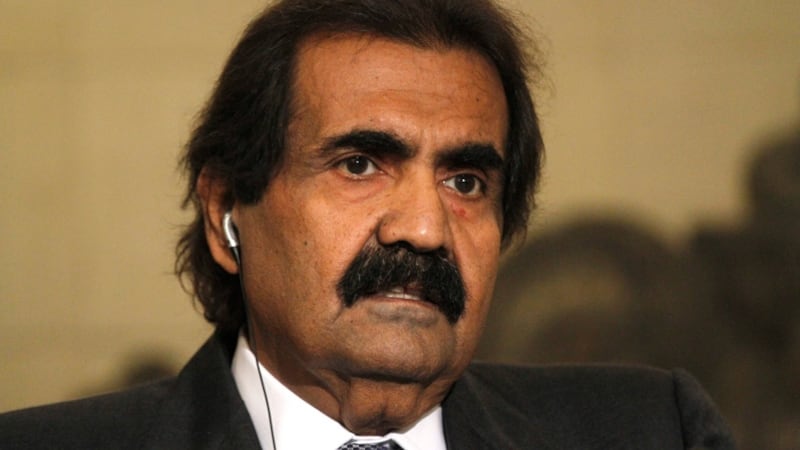
Qatar’s government on Sunday announced the death of former leader Sheikh Hamad bin Khalifa Al Thani, who led the country from 1995 to 2013. He was 74, according to a government website.
Sheikh Hamad was seen as one of the architects of modern Qatar and led the country during a period of rapid economic growth.
Thousands of mourners gathered at Doha’s Imam Muhammad bin Abdul Wahab Mosque for evening funeral prayers before the former leader’s burial at Lusail Cemetery, north of the Qatari capital.
In a statement, the emir’s office said it “mourns the great loss to the nation of the late -- may God have mercy on him -- His Highness the Father Emir Sheikh Hamad bin Khalifa Al Thani”.
Officials announced several days of public mourning across the country, with government offices and public institutions closed and flags flown at half-mast.
Sheikh Hamad took power in June 1995, overthrowing his father in a bloodless coup while the latter was abroad.
The former ruler inherited a small, largely marginal emirate with nearly empty coffers and transformed it into a major player on the regional and international stage.
Condolences poured in from across the world following the news of his death, including from the leaders of Gulf states, Egypt, Turkey and Italy, as well as Britain’s King Charles III.
Afghanistan’s Taliban government, Lebanese Hezbollah and Palestinian Hamas also issued statements mourning the former Qatari leader, as did Iranian President Masoud Pezeshkian, despite Qatar earlier on Sunday confirming fresh aerial attacks from the Islamic republic against its territory.
Within a few years, Sheikh Hamad laid the foundations for Qatar’s rapid development. Although the country is only about one-third the size of Belgium, it possesses one of the world’s largest natural gas reserves.
- Gas wealth -
Thanks to investments and international partnerships, the emirate became a leading producer and exporter of liquefied natural gas.
It also rose to become one of the wealthiest countries on the planet in terms of GDP per capita. Qatar’s population under Sheikh Hamad’s rule numbered barely two million, the majority of them foreign nationals.
His time in office saw the launch of Al Jazeera in 1996, following a decree issued by the emir, with the international broadcaster becoming one of the most influential media outlets in the Middle East.
The Qatar Investment Authority was also established with the aim of investing billions of dollars, particularly abroad, in companies including German automaker Volkswagen, London’s luxury department store Harrods, and French football club Paris Saint-Germain.
Sheikh Hamad was still emir when Qatar was awarded the right to host the 2022 FIFA World Cup in 2010, amid allegations of corruption and, later, criticism over the treatment of foreign workers.
Also under his reign, Qatar began paying hundreds of millions of dollars to the Gaza Strip, notably funding road projects along the coast. A hospital in Gaza City bears his name.
In June 2013, Sheikh Hamad surprised many by voluntarily abdicating in favour of his son, Sheikh Tamim bin Hamad Al Thani, a first in the recent history of the Arab world.
Qatar is one of the smallest Arab states with a population of around 3 million, most of whom are foreign workers.
The country was a British protectorate for 55 years until 1971.
It has been ruled by the Al Thani family since the mid-19th century.

