
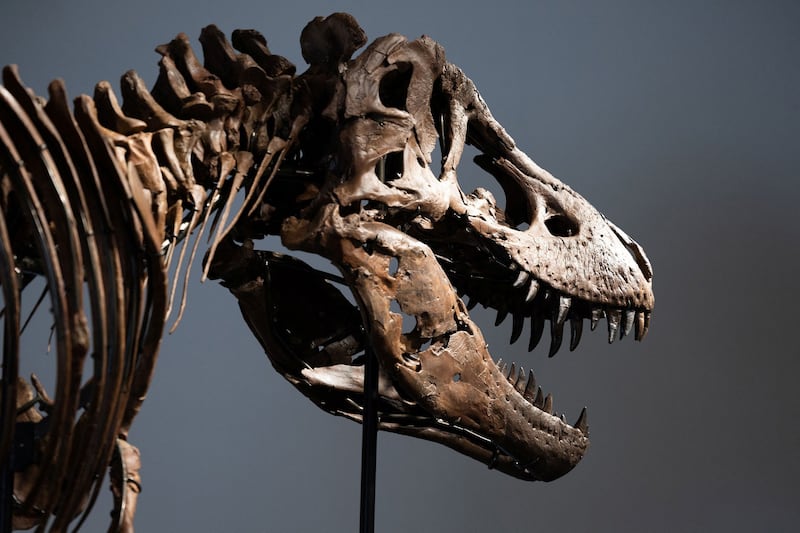
A Tyrannosaurus rex skeleton from South Dakota has become the world’s most expensive fossil sold at auction, after fetching a record US$50,130,000 at Sotheby’s in New York Tuesday.
The skeleton, which is about 67 million years old, is nicknamed Gus after the late Gary ‘Gus’ Licking, a cattle rancher from Harding County, South Dakota, who owned the land where the specimen was found. He died in 2022, one year into the excavation of the fossil.
Gus the T. rex is 38 feet long and 12.5 feet tall, with a skull measuring 54 inches, which makes it one of the largest T. rexes ever found, according to Sotheby’s. It includes 183 fossil bone elements, making it about 61 per cent complete by bone count, or 75 per cent to 80 per cent complete by mass.
Like many other T. rex skeletons, Gus comes from the Hell Creek Formation, a legendary geological boneyard that stretches across Montana, Wyoming and the Dakotas. One of the first skeletons of T. rex was found there in 1902, and the name T. rex was given to the species based on fossils unearthed in this area.
The previous record for a fossil auction belonged to Apex the Stegosaurus, bought in 2024 by billionaire Ken Griffin for $44.6 million. It is currently halfway through a 4-year loan at New York’s Museum of Natural History.
The presale estimate for Gus was between $20 and $30 million. The winning bid was placed over the phone.
Lost to science?
Paleontologists generally believe that once a fossil ends up in private hands, it is lost to science. Scientific journals will only publish research conducted on specimens held in publicly accessible collections; if a fossil is privately held, studies can’t be reliably reproduced, an important standard for verifying scientific findings.
Gus has many features that made it interesting both to scientists and prospective buyers. The skull has about 82 per cent of the original bones represented, and the skeleton includes rarely found components such as the wishbone, a complete pelvis and both feet. Sotheby’s said only one other specimen is known to have two well-represented feet. Gus reportedly also shows bite marks and evidence of fractures that the dinosaur survived.
The auction house said Gus is one of the most complete T. rex fossils ever found, but the specimen is less complete than Stan — a T. rex sold at auction in 2020 for $31.8 million, which is about 70 per cent complete by bone count — and Sue, the first dinosaur fossil ever sold at auction in 1997. The latter skeleton set the standard with its impressive 90 per cent completeness.
Gus, however, comes with “full rights,” meaning it does not contain any copyrighted bits of other dinosaurs. Usually, when a bone is missing from a skeleton, a cast from another, existing skeleton is purchased to fill in the gap.
The de facto standard for this process is Stan, which comes from the same South Dakota county as Gus. The buyer of Gus could, potentially, become a Stan competitor and license or produce casts for museums or private collectors.
All eyes are now on the buyer, whose identity is currently unknown, and what they will decide to do with the fossil.
By Jacopo Prisco, CNN

