Scientists have created the most detailed map yet of dark matter in the Northern Hemisphere, offering a new look at one of the universe’s biggest mysteries.
The map was created by an international team of researchers, including Canadian scientists, using observations of about 62 million galaxies collected over nearly a decade, through the Ultraviolet Near Infrared Optical Northern Survey, also known as UNIONS.
Much of the data came from the Canada-France-Hawaii Telescope atop Mauna Kea in Hawaii.
According to Mike Hudson, a physics and astronomy professor at the University of Waterloo and one of the researchers behind the project, dark matter does not emit, absorb or reflect light, making it invisible to telescopes. Scientists instead infer its presence by observing its gravitational effects.
“We can’t see it. It doesn’t shine, it doesn’t reflect light in any way, but it does bend light, so it actually distorts the distant universe,” Hudson said in an interview with CTV Your Morning Monday. “By measuring this warping, we can actually … map out where dark matter is in the universe.”
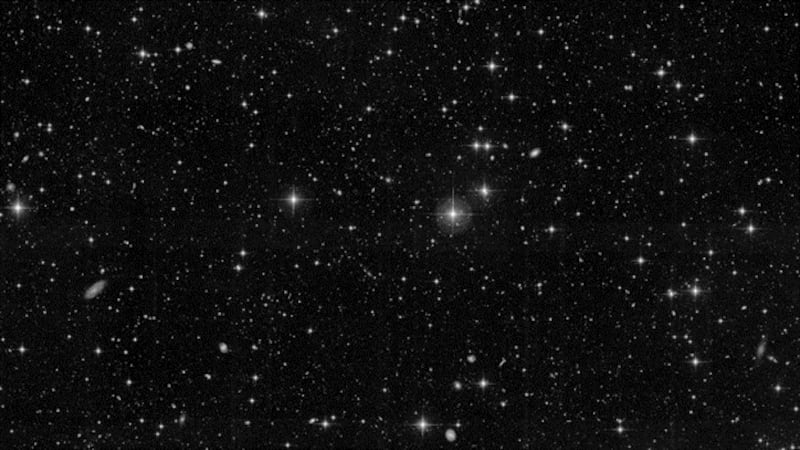
Hudson said the technique relies on detecting tiny distortions in the appearance of distant galaxies, allowing researchers to piece together where dark matter is concentrated across space.
“It’s very subtle,” he said. “It’s extremely hard to measure, which is why it’s taken us 10 years to get to this stage in the project.”
The findings offer new insight into how dark matter is distributed across the universe.
“It’s not smooth, it’s clumpy,” Hudson said. “That level of clumpiness tells us how structures in the universe, including our own Milky Way galaxy, formed from a very smooth beginning and slowly got clumpier and clumpier.”
Despite the new findings, Hudson said the biggest mystery remains unanswered.
“I still really want to know what the dark matter actually is. Is it some kind of particle?” he asked. “Some subatomic particle that hasn’t been detected yet? Or maybe it could be black holes formed in the very early universe.”
The current map is considered an early version, with researchers planning to release an even more complete picture as additional survey data become available.

