


Canada’s top trade officials were back at the negotiating table Thursday, a day after U.S. President Donald Trump extolled his tariff regime and lobbed insults at Canada.
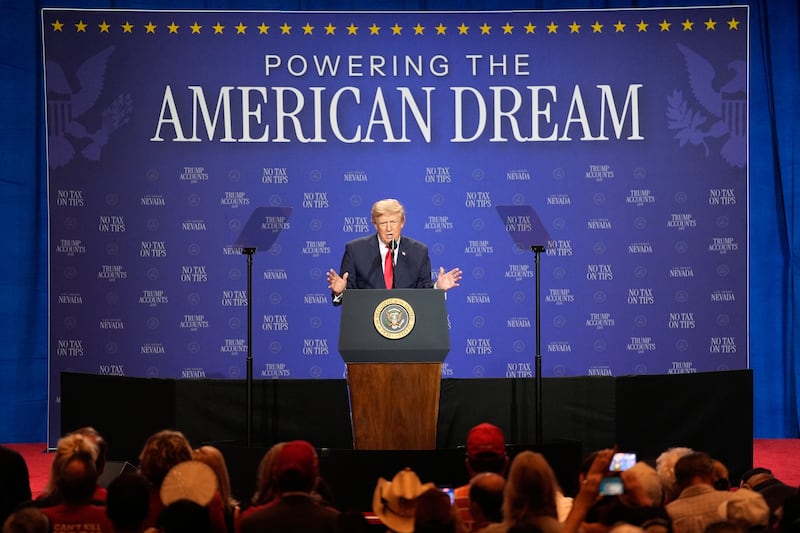
“I love tariffs, right? Because we’ve been screwed by tariffs used against us for years. By China, by Japan, by South Korea, by Germany, by everybody, by Canada,” he said to jeers from the crowd at the Red Rock Casino on Wednesday.
“Canada’s nasty. They are. They’re nasty,” he added. “I love the people but they’re nasty. Nasty leadership.”
Canada-U.S. Trade Minister Dominic LeBlanc and Chief Trade Negotiator Janice Charette met U.S. Trade Representative Jamieson Greer in Washington Thursday afternoon, less than 24 hours after Trump’s comments.
According to LeBlanc’s office, the meeting lasted more than one hour and 30 minutes, despite being scheduled for only 30 minutes.
Hours after the meeting, LeBlanc posted to X that he had a “constructive and detailed” discussion with Greer, focused on “striking a comprehensive deal that addresses sectoral tariffs and benefits Canadian workers, farmers and businesses.”
PM Carney responds to Trump
Speaking to reporters in Saguenay, Que., on Thursday, Prime Minister Mark Carney was asked to respond.
“Whatever adjective is used, yes, we’re standing up for Canadian workers, for Canadian businesses, as we always have from the start,” said the prime minister, who also mentioned he spoke with Trump last week.
Canada and the U.S. have been in a tit-for-tat trade war for over a year. Trump has imposed a series of levies against a wide range of Canadian goods, and Canada has retaliated with its own taxes on select American metals and autos.
The two countries are months into official free trade negotiations, though Ottawa has been tight-lipped on progress to adapt the Canada-U.S.-Mexico agreement, commonly known as CUSMA.
A large portion of Canadian goods are exempt from Trump’s tariffs because of the trilateral free trade deal, which the U.S. refused to renew on July 1.
CTV News U.S. Political Analyst Eric Ham says he did a “double take” after hearing Trump’s “nasty” remark.
“I thought maybe he was talking about the Iranians or Russians,” Ham told CTV News from Washington, D.C., adding that this kind of “vitriol” indicates a trade deal is still a ways off.
But Trump’s comments also indicate Canada’s retaliation efforts are effective, according to political analyst Lori Turnbull.
“Those things are getting under Donald Trump’s skin, big time,” she told CTV News Channel, referencing in part the widely adopted provincial moratorium on U.S. liquor sales, which she called a “leverage point.”
“He’s calling us nasty, and I think I’m OK with that,” Turnbull said. “We’re not just taking crappy deals like other countries have done.”
Trump says tariffs ‘made us rich’
On Wednesday, Trump said his tariffs have “made us rich.”
Between January 2025 and May 2026, the U.S. raked in around US$269 billion in gross customs revenue through the Trump administration’s tariffs, according to estimates from the University of Pennsylvania.
About US$166 billion of that was raised through Trump’s so-called “reciprocal” tariffs imposed on imports from countries around the world. However, those levies were struck down by the conservative-led U.S. Supreme Court in February, and court records indicate the administration has since paid US$100 billion in refunds.
Meanwhile, trade between Canada and the U.S. has slumped.
A spokesperson told The Canadian Press on Wednesday that total trade is down C$1.9 billion (0.6 per cent) in the first quarter of 2026 compared to the same period in 2024. Autos made up the bulk of the decline in two-way trade, which fell by 18.9 per cent, or $6.7 billion.
Iron and steel were down 43.5 per cent, and mineral fuels and oils were down 3.3 per cent, the spokesperson said.
Poilievre ribs Carney on ‘concessions’
Conservative Leader Pierre Poilievre was asked if he thought the prime minister has been too patient with the president.
As the trade war trudges on, Poilievre said Canada has fumbled a lot of its leverage.
“I don’t understand the strategy of making concession after concession after concession before even getting to the negotiating table,” he told reporters in St. John’s.
He noted the Carney government’s decision to drop the digital services tax after Trump said he was ending trade talks back in June 2025.
He also mentioned the “Netflix tax,” in what may be a reference to the Liberals’ call to “eliminate” the financial contribution requirement for streamers set by the Canadian Radio-television and Telecommunications Commission (CRTC).
“He agreed to Mr. Trumps demands on military spending,” Poilievre also said. In July, Carney conceded Trump “won the argument” pushing Canada and European allies to spend more on defence.
“Many of these things were going to have to happen. But why not bring them to the bargaining table and get something in return for them, rather than making every concession and then showing up empty-handed in a position of weakness?” asked the Opposition leader.
With files from AFP and CTV News’ Rachel Aiello

