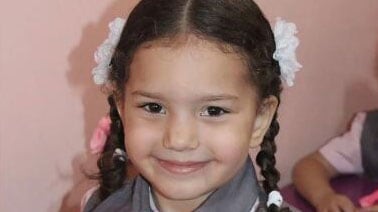
JERUSALEM -- Israel’s military on Wednesday announced its first criminal investigations into troop conduct in Gaza, focusing on the killings of 5-year-old Hind Rajab and her family and of 15 Palestinian paramedics.
The military said it would not probe three other attacks that killed aid workers from World Central Kitchen and Doctors Without Borders. It said it had completed reviews of 150 incidents of troop conduct in Gaza and made decisions on the five cases.
Chef Jose Andres, founder of U.S.-based World Central Kitchen, condemned the decision on X as “wrong and painful.”
The investigations involve killings that drew a heavy international outcry. Hind was trapped in a vehicle with her slain relatives, pleading for help by phone before she too was killed in February 2024. After the shooting of the 15 medics in March 2025, troops then bulldozed their bodies into a mass grave.
Israel’s campaign in Gaza has killed more than 73,000 people, including tens of thousands of women and children, according to the territory’s Health Ministry. Rights groups and UN commissions have said the campaign amounts to genocide and that Israeli forces have committed a litany of war crimes, including indiscriminate use of force and deliberate killings of civilians.
Israel denies accusations of genocide and war crimes and says it is targeting Hamas after its October 2023 attack on southern Israel. It blames civilian deaths on Hamas because the militant group operates in populated areas in the tiny, overcrowded strip.
Israeli officials contend its justice system can address any violations by its troops, but rights groups say soldiers are almost never held accountable.
Wednesday’s statement did not mention many other high-profile killings that Israel has pledged to investigate, such as its strikes on a hospital in southern Gaza that killed five journalists in August 2025, including Mariam Dagga, a visual journalist who freelanced for The Associated Press and other news organizations.
The 5-year-old was the last alive in a stranded car
Hind’s grandmother, also named Hind Rajab, told the AP by phone that the Israeli investigation into her killing is not enough.
“An international investigation is required to uncover the truth and hold all those responsible accountable,” she said. “We call for justice, not only for Hind, but for all Gaza children.”
The military in Wednesday’s statement admitted to firing at the car carrying the 5-year-old, four of her cousins and her aunt and uncle as they fled an Israeli invasion of Gaza City.
As gunfire sprayed around them, the girl’s cousin, 15-year-old Layan Hamada, called the Palestinian Red Crescent paramedic center, telling them her family had been killed. Seconds later, more gunshots were heard, and Layan’s screaming stopped, according to the Red Crescent recording of the call.
Palestinian paramedics dispatched an ambulance to rescue Hind and stayed on the line with her until contact was lost. Hind, her five relatives and two medics from the ambulance were found dead 12 days later.
The military admitted Wednesday that troops had fired toward that ambulance, killing the two medics.
Dyab Abou Jahjah, director of the Belgium-based Hind Rajab foundation, told Al-Jazeera he considered the military investigations a “charade meant to whitewash the culprits instead of convicting them.”
The Palestinian Red Crescent also insists on an international investigation, said Raed al-Nims, a spokesman for the organization in Gaza. “Israeli measures are not enough,” he told the AP.
A movie docudrama about Hind’s death, “The Voice of Hind Rajab,” won international awards and was nominated for an Oscar.
The 15 medics had been trying to reach casualties
In the paramedics’ killing, Israeli troops fired on an ambulance driving to retrieve casualties from an Israeli offensive in the southern city of Rafah, then fired on other emergency vehicles that came looking for the first one, according to phone footage and the sole survivor of the shootings. Fifteen medics and emergency responders from the Red Crescent and Gaza’s Civil Defense were killed.
Troops then bulldozed over the bodies and vehicles, burying them in a mass grave. UN and rescue workers were only able to reach the site a week later to dig out the bodies.
The Israeli military initially said it opened fire because the vehicles were “advancing suspiciously” on troops without headlights or emergency signals. But it backtracked after the footage emerged, showing the teams driving slowly with their emergency lights flashing and logos visible. A deputy commander was directed to step down over the killings.
“We are not obligated to prove the truth because it is already proven to the whole world,” Eid Azizi, a Palestinian Red Crescent spokesperson, told the AP in a phone call. “We shouldn’t have reached this point if they respected and followed the international humanitarian law.”
Israel will not criminally probe World Central Kitchen strike
The military said it had decided against a criminal investigation into April 2024 airstrikes that hit a convoy of World Central Kitchen vehicles, killing seven staffers.
The aid group, which distributes food in Gaza, said at the time it had coordinated with the military over the convoy’s movement. The vehicles, which had the group’s logo on their roofs visible from the air, were left incinerated and mangled.
Wednesday’s military statement said individuals in the vehicles were mistakenly identified as armed Hamas operatives. But it concluded that the commanders’ decisions “did not raise reasonable suspicion of criminal misconduct.” At the time, two officers were removed from their positions and three others reprimanded.
World Central Kitchen responded in a statement saying the military’s account of the strike was untrue, “conflates different timelines and events, muddies the story and shifts the blame.” It called for an independent investigation.
The military also decided not to take criminal action over the killings of four staffers from Doctors Without Borders in two separate instances in November 2023 and February 2024.
What happens next?
Military investigators will now take up the probes and present their findings to military prosecutors. The military advocate general can then decide to keep investigating, indict any soldiers involved or decline to charge them.
Any action will take a long time, if it comes at all, said Tal Steiner, head of the Israeli rights group HaMoked.
Indictments are very uncommon and convictions even more so, she said, recalling only one soldier who had spent time behind bars since Oct. 7, 2023, for alleged abuse of Palestinian prisoners. That soldier was imprisoned for seven months under a June 2025 plea bargain.
“It’s very rare that soldiers accused of harming Palestinians even go to court ... and even rarer that they get a severe punishment,” Steiner said.
Just 0.17% of all military investigations launched during three Gaza operations from 2014 to 2022 led to prosecution, according to an analysis by Israeli rights group Yesh Din.
The war’s toll keeps growing
The war began on Oct. 7, 2023, when Hamas-led militants killed 1,200 people, mostly civilians, in southern Israel and abducted 251 others.
Israeli strikes have continued in Gaza since a ceasefire deal came into effect in October, killing at least 1,270 people, according to the Health Ministry.
The ministry, part of the Hamas-led government, maintains detailed casualty records that are seen as generally reliable by UN agencies and independent experts. It does not give a breakdown of civilians and militants but says women and children constitute about half of the dead.
Magdy reported from Cairo. Associated Press writer Erin Cunningham in Jerusalem contributed to this report.
By Julia Frankel And Samy Magdy

