
Iceland’s freezing temperatures typically last about five months of the year, but the government has chosen a balmy summer day for its pivotal national referendum. On Saturday, residents of the Nordic island are voting on another un-thawing of sorts – whether to restart long-frozen talks to join the European Union.
Iceland initially applied to join the EU in 2009, following the financial crisis that devastated many families and businesses in the country of only 400,000 people. But a few years into the process, an incoming centre-right government abruptly put those EU ambitions on ice, arguing they could lead to a loss of control over Iceland’s territorial fishing waters and sovereignty.
More than a decade later, the current centre-left coalition government campaigned on the idea of holding a referendum about restarting EU talks “no later than 2027,” as well as pursuing a foreign policy of closer cooperation with the EU, other Nordic countries and NATO.
While the referendum debate has almost entirely centred on the economy – for example, the potential impact of joining the Eurozone and changing fishing policy – the vote is not happening in a vacuum.
Since last year, U.S. President Donald Trump’s aggressive moves toward Greenland have brought discussions of Arctic security to the forefront in Europe and beyond. Iceland, which has a robust coast guard but no army or defence ministry of its own, finds itself in an interesting position in a world of great power coercion.
But the country does have strong existing partnerships through its membership of NATO and the European Economic Area (EEA), which provides free movement of people, goods and capital across 30 countries. It’s also already in the Schengen zone of visa-free travel. And it just signed a pact with four other NATO countries to bolster maritime security in the Arctic and North Atlantic – considered a key area given Russian naval movements in that region.
Analysts say security is weighing on minds in Brussels.
“For the European Union, Iceland will be in the security environment a much more relevant partner compared to, say, 10 years ago,” said Almut Möller, the director for European and global affairs at the European Policy Centre, a think tank in Brussels. “This is a very different context.”
And at a time of global instability, there is also an appetite within the 27-nation bloc to “show the union is alive and ticking. That it’s welcoming new members, and it is a union that is also growing in geostrategy, geopolitics and security,” said Möller. That’s especially true following the United Kingdom’s “Brexit” vote of 2016, which fuelled speculation about other nations wanting to leave the European project.
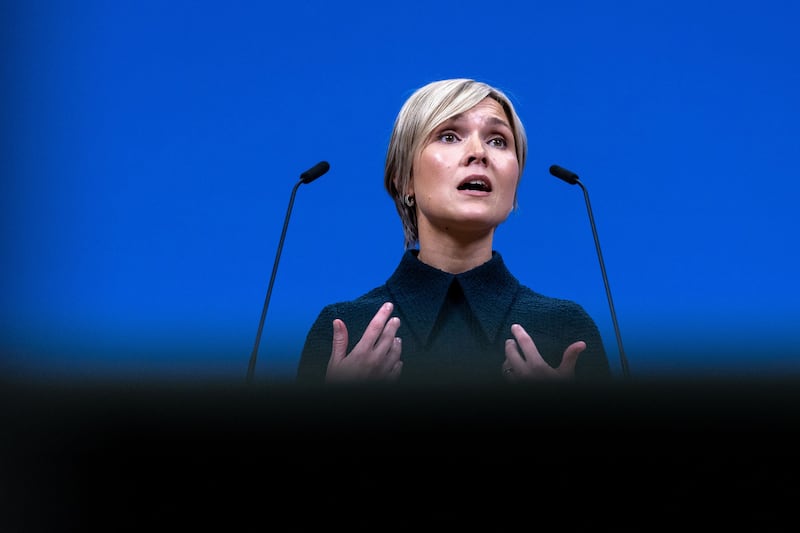
Iceland’s Prime Minister Kristrún Frostadóttir said in a recent podcast interview that the EU’s interest could work in their favour.
“I think this is a great time for Iceland to join, because of the geopolitical situation we’re in,” Frostadóttir told The Rest is Politics podcast. “It also gives us a stronger position, I think, in accession talks.”
The general population of Iceland isn’t used to thinking of itself as strategically relevant, but that’s changing rapidly right now, according to Ragnar Hjálmarsson, a senior adviser at the Icelandic think tank Varda. The country was neutral during the Second World War and hasn’t faced any strong threat since the days of the Soviet Union. The U.S. military, which once had a presence there, decided to leave in 2006 as the perceived threat level subsided. But U.S. Navy activity and NATO investment returned following Russia’s invasion of Ukraine.
Meanwhile, “the Trump administration’s actions toward Greenland caused some level of fear. The brazenness of it caused angst in Iceland,” Hjálmarsson said. It didn’t help that Trump repeatedly misnamed Greenland as Iceland when talking about demanding control of the neighboring Arctic territory.
“But it also made Icelanders aware of… the strategic importance of Iceland. It has, however, not changed what the voters are talking about.”
Polls are neck and neck
The Social Democratic Alliance-led government’s argument for voting “yes” boils down to: let’s at least see what we could get in a potential EU deal.
“It’s preserving optionality” to see what an agreement looks like, according to the prime minister. “You can be a ‘maybe’ person on the EU and still say ‘yes’ (to talks) because you want to see what this looks like.”
Frostadóttir’s key argument is that joining the eurozone will offer new investment opportunities and stability for Icelandic people and businesses, which currently operate using the volatile krona. She has also said that maintaining their own currency reserves is “costing us a ton,” and cited other possible EU benefits such as grants for Arctic agriculture, infrastructure loans and academic research integration.
But the prime minister also acknowledged that many people are understandably concerned about moving more power to Brussels.
Meanwhile, the “no” camp is firmly against joining the EU, citing issues of sovereignty, especially when it comes to the idea of foreign vessels potentially gaining access to Icelandic fishing waters. (The fishing industry accounts for about 6.5 per cent of Iceland’s GDP, according to Nordic Council data).
Polling data from Gallup shows the referendum could go either way – about 51.5 per cent of those who had a position on the matter said they want to resume EU talks, 48.5 per cent said no. A small percentage said they were still undecided.
If the referendum passes, it will prompt a second national vote – likely more than a year down the line – on whether to formally seek to join the EU. Iceland’s foreign minister told local media that the negotiations to reach an accession deal could take 18 months.
It’s the economy, stupid
Part of what makes this referendum feel different from other countries’ accession processes or from the U.K.’s Brexit quagmire is the fact that things are going pretty well for Iceland already.
The country ranks in the top 10 globally for GDP per capita (at US$98,300, it’s a notch above the United States) and has relatively low unemployment. Residents also have universal healthcare, universal preschool and equal paid family leave as part of the country’s Nordic welfare model.
But it’s not without problems. The scars of the 2008 financial crisis are still scorched into Icelandic memory, and the small national currency lends itself to volatility and inflation spirals. The cost of living is also incredibly high.
Some in the pro-EU camp argue that using the krona makes it more difficult to attract international investment and to prevent monopolistic behaviour.
“People are hoping that joining the EU would provide us with economic discipline and more stability, as well as more competition at home,” said Hjálmarsson, summarizing the argument in favour of restarting EU talks. “Oil import and distribution is controlled by three or four companies – same thing goes with all big sectors.”
The “no” side has its own economic concerns.
Hjálmarsson said the Euroskeptic view is that “our own control over our own resources – and not foreign domination – has secured Iceland’s prosperity. So, if we endanger our own control of our own resources, we endanger our future prosperity.” Since 2009, some labour unions and industrialists have changed their position to the anti-EU camp.
And the idea of a formal seat at the EU table hasn’t yet been compelling for Euroskeptics, led by the opposition Independence Party. “What’s a seat at the table worth if we don’t have the final word?” Independence Party leader Gudrún Hafsteinsdóttir said in a statement.
But analysts have also noted that because Iceland is an attractive prospect for the EU – it would be a net contributor to the EU budget given its wealth and require fewer reforms than the Balkan countries hoping to join – it might be able to secure some exceptions from the bloc’s fishing and agriculture policies.
“I believe there would be a willingness to accommodate Iceland’s special context – that includes also natural resources,” the European Policy Centre’s Möller said.
If Iceland votes yes, things could still fall apart in the months-long talks to reach a formal agreement. The big unknown is how much the EU will be willing to offer Iceland, whose population is very much on the fence, in order to secure its membership.

