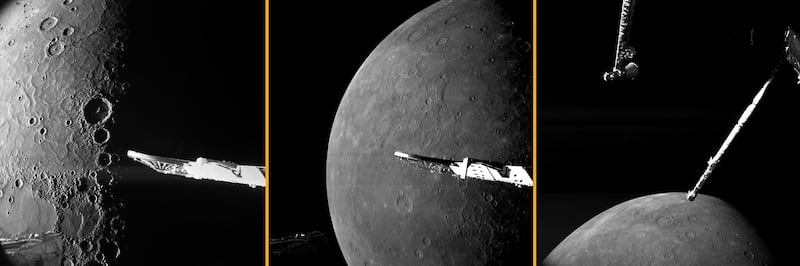
An ambitious mission to reveal the secrets of the least explored planet in the inner solar system is about to arrive at its cosmic destination after a lengthy journey.
The BepiColombo mission, a joint effort between the European Space Agency (ESA) and the Japan Aerospace Exploration Agency, intends to use two complementary orbiters to reveal insights into how Mercury formed and evolved so close to the sun.
The mission launched on an Ariane 5 rocket from Europe’s Spaceport near Kourou, French Guiana, in October 2018. Since then, it has traveled more than six billion miles (10 billion kilometres).
BepiColombo is named for Italian engineer and mathematician Giuseppe “Bepi” Colombo, who studied Mercury’s peculiar rotation and proposed trajectories that enabled NASA’s first flybys of the planet in 1974.
Earth is about 10 times closer to Mercury than it is to Jupiter, but BepiColombo has taken longer to reach the tiny planet than previous missions such as Galileo and Juno heading to the largest planet in our outer solar system.
“You can go faster to Mercury if you take a direct way to it,” said Frank Budnik, flight dynamics manager for the BepiColombo mission at the ESA. “But the problem is we want to insert into an orbit with respect to Mercury. You have to bring the spacecraft to the same velocity as Mercury has, and this is a very energy-demanding transfer.”
A combination of electric propulsion and gravitational boosts from a total of nine flybys of Earth, Venus and Mercury have aided BepiColombo in reaching the correct velocity on its long cruise.
The Mercury Transfer Module, which has powered the multiyear voyage, separated from BepiColombo’s stack of two science orbiters at 8 a.m. ET Thursday.
The ESA hosted a live broadcast to share milestones of the nail-biting separation. Confirmation of separation arrived at ESA’s mission control at 9:53 a.m. ET, when the agency acquired a signal from BepiColombo. The mission team also confirmed that “the spacecraft is healthy and operating as expected.”
The mission’s flight dynamics team shared that the Mercury Transfer Module will remain in orbit around the sun for the foreseeable future and will not impact Mercury.
Ignacio Tanco, head of Inner Solar System Mission Operations at the ESA, compared the separation to launching a new spacecraft around a different planet. All went according to plan — but that’s just the beginning of a complex process.
“Unlike in other missions, BepiColombo’s arrival doesn’t mean a single event,” Tanco said. “We have about half a year of intense operations ahead of us.”
The challenges of venturing toward the sun
Establishing an observational orbit around Mercury is even more difficult than the journey to get there.
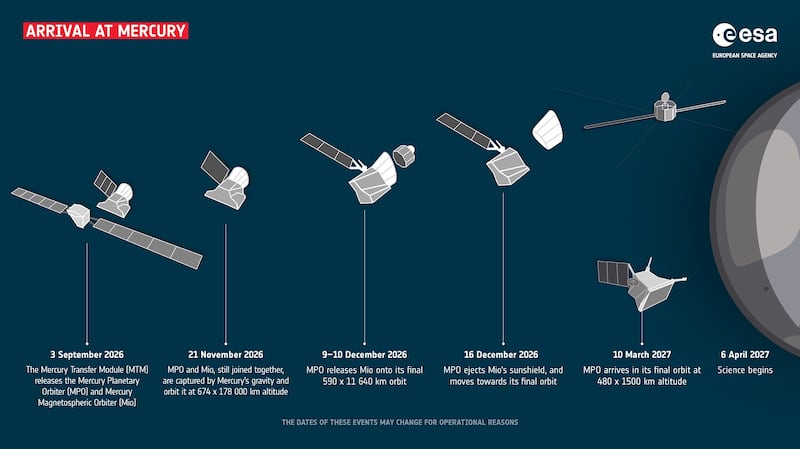
ESA’s Mercury Planetary Orbiter, or MPO, and JAXA’s Mercury Magnetospheric Orbiter, or MIO, will be captured by Mercury’s gravity and enter orbit around the planet on Nov. 21.
The two orbiters will separate from one another between Dec. 9 and 10, with the Mercury Planetary Orbiter moving into its orbital position on Dec. 16 and the Mercury Magnetospheric Orbiter following on March 10.
Science operations will officially begin for both orbiters in April.
“It will be the first time that a mission releases two fully independent, fully operational separate spacecrafts around a different planet,” Tanco said.
The MPO will observe the planet itself, while the MIO will focus on the space environment around Mercury, said Santa Martinez, BepiColombo mission manager at the ESA.
Mercury is about 36 million miles (58 million kilometres) from the sun on average, and completes one orbit around our star every 88 days, according to NASA. Such proximity means that the planet’s surface temperatures can reach about 800 degrees F (430 C) during the day.
Mercury’s close distance to the sun has made it a challenging planet to explore — and it’s the main driver of BepiColombo’s complexity. Only two previous missions, NASA’s Mariner 10 in 1974 and its MESSENGER mission in 2011, have been in the vicinity of the rocky world. Like BepiColombo, MESSENGER took nearly seven years to reach Mercury.
“The spacecraft in itself has been designed to operate within conditions which are extremely punishing,” Tanco said. “It’s essentially equivalent to operating with a very hot pizza oven running right on your back.”
Both orbiters are equipped with solar arrays to provide them with power, and they are at risk of overheating so close to the sun.
The MIO will spin 15 times a minute, while the MPO will position its array at an angle almost edge-on to the sun to receive just enough sunlight while also preventing solar radiation damage.
Solving Mercury’s mysteries
Putting two spacecraft in orbit around Mercury will provide unprecedented views of the planet and open a new chapter in scientists’ understanding of the solar system, Martinez said.
The orbiters will help map the planet in high resolution and answer questions that cropped up during MESSENGER’s detailed survey of Mercury.
Each orbiter is equipped with a range of instruments to explore Mercury’s structure and composition, including craters and evidence of ancient volcanic activity on its surface, as well as the planet’s magnetic field and its exosphere, a thin cloud of gas that surrounds the planet, said Geraint Jones, lead project scientist for BepiColombo at the ESA.
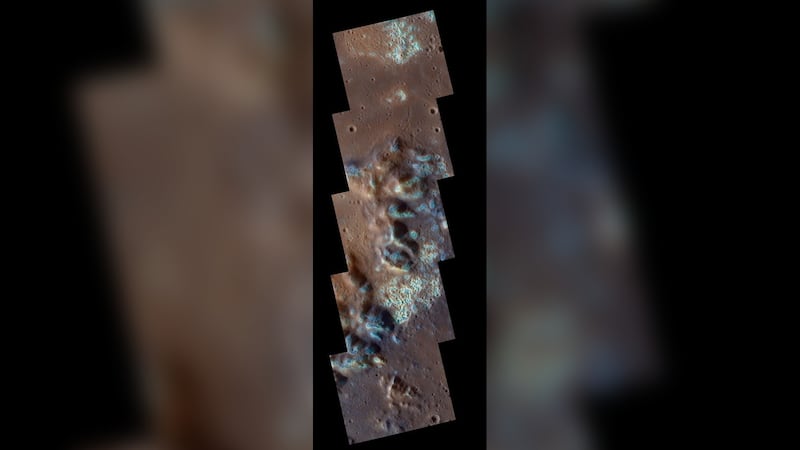
One of the mysteries that scientists are hoping to probe are the so-called hollows spotted on Mercury by Mariner 10 and MESSENGER.
“There are depressions in the surface that look like the surface is being eaten away,” Jones said. “It might be possible that we can see changes in these regions over time.”
Hollows haven’t been found elsewhere on planets in our solar system, and with no wind or water to form the thousands of puzzling depressions, scientists want to know what forces sculpted them.
The orbiters could also help uncover the truth behind why Mercury is so dense for its small size.
Some 4.5 billion years ago when the planets formed from the debris surrounding the sun, “it’s thought that Mercury started forming, created a modest-sized planet and then it was hit by another large planetesimal, which ripped off its outer crust,” Jones said. “So that means that the overall density of the material that was left behind was much higher, and that’s why it has the high density it has now.”
Learning more about Mercury’s surface and interior could uphold the theory or provide new answers, Jones said.
By Ashley Strickland, CNN