

A Russian drone hit a passenger train on Ukraine’s border with NATO member Poland on Sunday, shortly after former British Prime Minister Boris Johnson and other European diplomats had used the same line.
The train, on a route frequently used by foreign delegations returning from Kyiv, was attacked just two kilometres (1.2 miles) from the Polish border, Ukraine’s railway operator said.
No casualties were reported.
“This wasn’t our train, but the one just minutes after us by the border crossing. It was evacuated as the drone approached and no one was hurt,” Carl Bildt, former Sweden’s Prime Minister said on X.
He and other politicians were returning to Europe by train after attending a conference in Kyiv.
“It is entirely possible that the Russian drone’s intended target was the diplomatic train, which departed the station earlier than scheduled after train timetables were adjusted in real time because of the constant threat of Russian strikes,” Ukraine’s railway operator, Ukrzaliznytsia, said on Telegram.
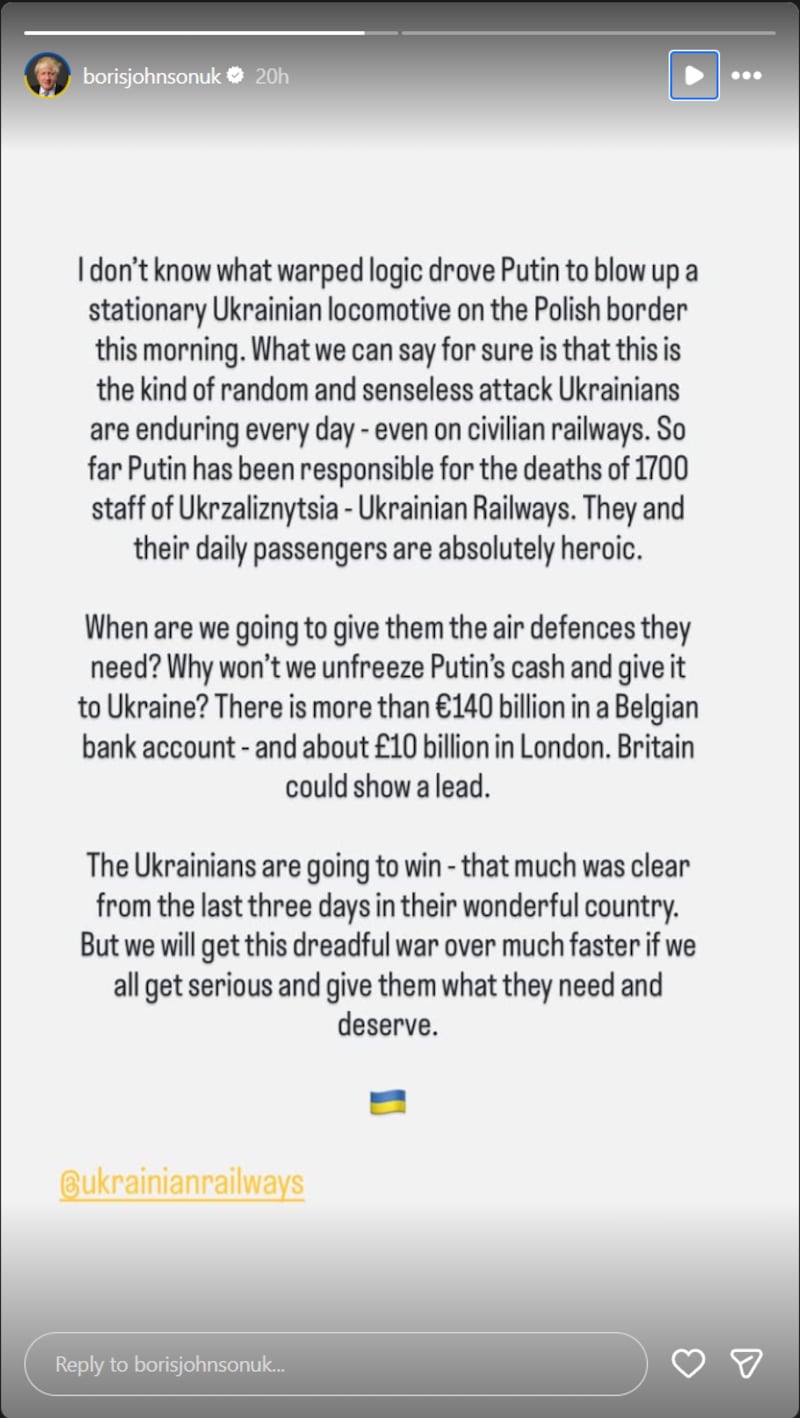
Boris Johnson, who was also on the train that left the station shortly before the strike, condemned the attack as “random and senseless” in a post on Instagram.
With the front line largely static, both Moscow and Kyiv have intensified long-distance strikes in recent weeks to try to shift momentum in the war.
Polish foreign minister Radoslaw Sikorski described Russia’s increasing attacks on NATO’s doorstep as “an escalation.”
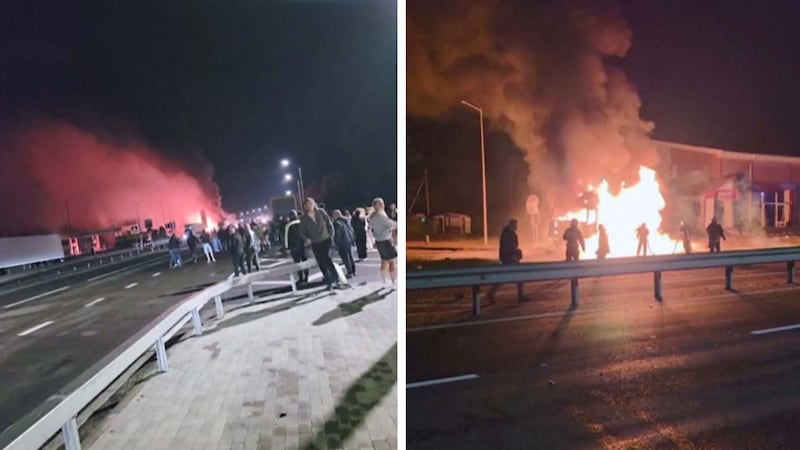
Earlier on Sunday a truck less than one kilometre from Ukraine’s border with Poland was also hit, prompting the Dorohusk-Yahodyn crossing point to briefly halt operations, according to border guards.
Russia’s Defence Ministry said it had targeted infrastructure facilitating military cargoes from Europe in Western Ukraine.
Russia has begun targeting Ukraine’s border crossings with its Western allies in recent weeks, part of a growing campaign by both sides to erode the other’s economic infrastructure more than four years into Russia’s invasion.
Russia reports strike near Zaporizhzhia nuclear power plant
Overnight, hostilities showed no signs of letting up.
In the Russian-held part of Ukraine’s southeastern Zaporizhzhia region, the head of Russia’s state nuclear energy company Rosatom accused Ukraine of striking fuel trucks close to the Zaporizhzhia nuclear power station, Europe’s largest.
The Zaporizhzhia nuclear plant has been controlled by Russia since March 2022, and remains close to the front line. A Ukrainian military spokesperson did not immediately respond to a request for comment.
In Russia itself, the mayor of the city of Nizhnekamsk, in the Volga River region of Tatarstan, said that “civilian and industrial” targets in the city had been struck by Ukrainian drones, causing at least two deaths and several more injuries.
Mayor Radmir Belyaev did not clarify which targets had been struck, but the city hosts a major oil refinery which has been attacked in the past.
Ukrainian authorities did not immediately comment on the strike on Nizhekamsk, but did say they had struck another refinery in the southern Krasnodar region.
Reporting by Felix Light, Pavel Polityuk, Andriy Perun and Anna Wlodarczak-Semczuk; editing by Philippa Fletcher and Christina Fincher

