
MADRID- Protesters said they would return to the streets across Spain and press on with their encampment in central Madrid after parliament on Friday rejected the government’s attempt to answer their complaints about a mounting housing crisis.
Crowds gathered outside the assembly chanted “your profits, our misery” as lawmakers voted down the minority government’s decree that had been drawn up to address mass anger over the eviction of an 87-year-old woman.
Protesters expressed exasperation as the debate in parliament over the measures highlighted bitter divisions about how to address the crisis. Earlier on Friday, Spanish media said Prime Minister Pedro Sanchez might call a snap election for November if the legislation failed to pass.
Sanchez’s office declined to comment on the reports.
The legislation had sought to ban evictions of vulnerable tenants until 2030, impose a two-year rent freeze extension for existing leases and introduce tighter rules for short-term rentals.
‘We’re aiming for a general strike’
The decrees failed after lawmakers from Catalan separatist party Junts — a sometime ally of the left-wing government — joined the opposition in voting it down, arguing that the proposals would exacerbate matters by reducing housing supply. A second decree proposing automatic and indefinite renewal of rental contracts also failed.
The Tenants’ Union, which had driven the protests, said it would press on with plans for more mass rallies for Saturday, piling pressure on the coalition.
The eviction of pensioner Maricarmen Abascal last week triggered protests across Spain. Young people pitched tents in Madrid’s central square and other cities for almost a week, reviving memories of anti-austerity sit-ins sparked by the global financial crisis in 2008-12.
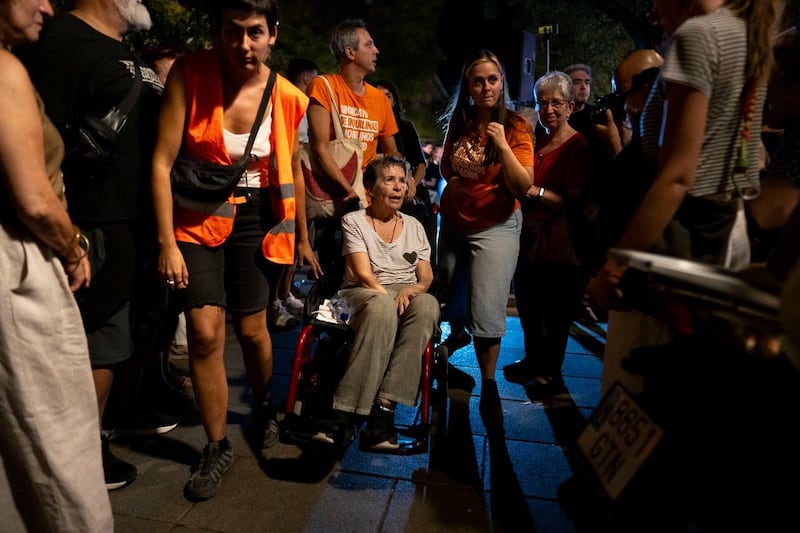
“The encampment will continue and will continue expanding to other neighborhoods. We’re aiming for a general strike,” Tenants’ Union spokesperson Alicia del Rio said after the decrees were struck down.
Abascal’s eviction unleashed anger over the cost of housing, with many young people living with parents past 30 years of age.
Rents have doubled over the last decade with average prices reaching €1,176 (US$1,323) a month, equivalent to 98.7 per cent of the average salary for a young person, according to the Youth Council of Spain.
Opposite effect of intended aims
Sanchez’s coalition government has 147 seats in the 350-seat chamber and relies on smaller parties, including Junts, to pass legislation.
Junts parliamentary spokesperson Miriam Nogueras said the decrees would have the opposite effect of their intended aims. “Finding housing will become more difficult every day. Our responsibility is to provide certainty, not uncertainty.”
She urged the government to work on a new decree.
The opposition People’s Party also voted against the measures.
“Housing doesn’t become more affordable through decrees; it becomes more affordable by building more homes. We’re not going to lie to you — it’s not going to be easy, and it’s not going to happen quickly,” said PP lawmaker Juan Bravo.
Sanchez, who in recent months has faced pressure over the government’s handling of a migrant crisis in Ceuta and accusations of corruption in his party, could decide that calling an election would be a good way to change the narrative, said Alejandro Quiroga, a political scientist at the Complutense University of Madrid.
“This could be Sanchez’s last big chance to become prime minister again,” Quiroga said. “By swapping Ceuta for Maricarmen, you’re setting up a new framework for the conversation.”
PP leader Alberto Nuñez Feijoo said he would welcome a snap election.
“If the prime minister needed a story to call an election and thus try to cover up corruption we still don’t know about, then so be it. He has the alibi – just set a date,” Feijoo said in a press conference after the vote.
Reporting by David Latona, Victoria Waldersee, Mireia Merino, Emma Pinedo and Jesus Aguado; Writing by Charlie Devereux, editing by Aislinn Laing, Xevi Fontdegloria and Andrew Heavens

