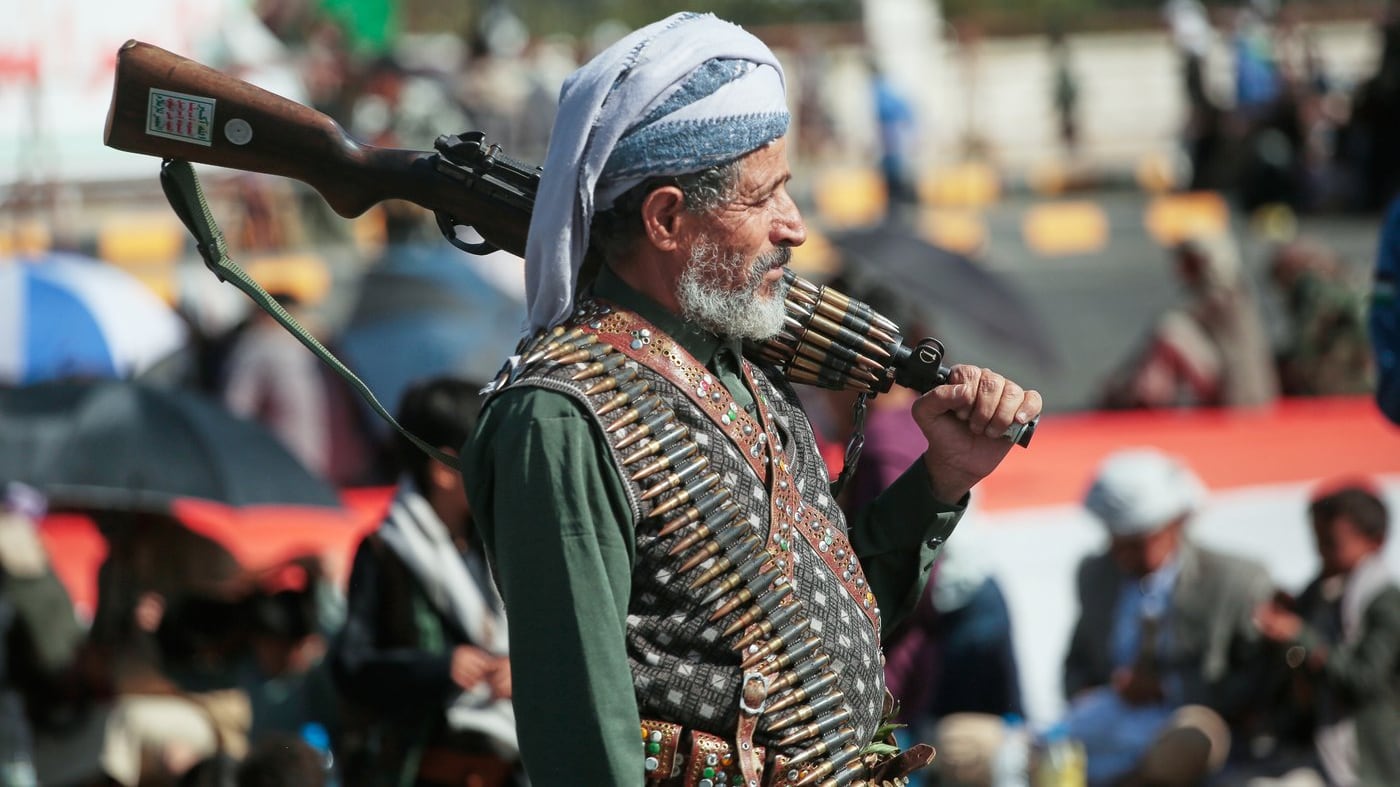
CAIRO -- Iran-backed Houthi rebels struck a residential area in Yemen’s third-largest city on Tuesday, killing two teenage girls and renewing attention on the dangers faced by civilians in Taiz, which has been under attack and siege during the country’s escalating conflict.
The Houthis have largely encircled Taiz, cutting it off from most supply routes and putting civilians at “grave risk,” UN human rights chief Volker Turk said Tuesday. The UN says the siege of the strategically important city in southwestern Yemen has left many residents without food and other necessities as prices soar.
The attack on Taiz came a day after a Houthi strike on a government military camp killed 73 recruits, the deadliest strike since the resurgence of the conflict over the summer, according to a senior Yemeni government official.
The conflict has intensified since forces from the internationally recognized government and Saudi-led coalition launched airstrikes on Houthi-held Sanaa International Airport in July, shattering a 2022 ceasefire deal that largely stopped fighting in the country’s civil war.
Yemen has become a widening front in the Iran war that began in February -- and the Houthis have increasingly launched attacks on Saudi Arabia because it supports Yemen’s internationally recognized government.
Britain said on Tuesday that it would expand its military support for Saudi Arabia to include “defensive” air patrols by Royal Air Force jets.
UN says Houthi siege of Taiz risks humanitarian crisis
Heavy fighting between the Houthis and Yemeni government forces caused extensive damage in a densely populated residential area of Taiz. Six people were wounded in the Houthis’ deadly attack there.
Resident Zainab Ali said she was away when the strike occurred but returned to find her home had been destroyed.
“We are a family of orphans, and we do not know what to do,” she said.
Late on Tuesday, Yemen’s government forces claimed -- without providing evidence -- that they had thwarted Houthi attacks in several areas across Taiz and had killed dozens of Houthi fighters. The claim could not be independently verified, and the Houthis did not immediately comment. The rebel group rarely releases its own casualty figures.
A strategic gateway to southern Yemen, Taiz has been a focal point of fighting since the civil war began more than a decade ago; it is also one of Yemen’s most important historic and cultural centres.
Houthi fighters began advancing again on Taiz last month, after capturing the port city of Mokha, an area vital to controlling shipping through the Red Sea.
The Houthis have besieged Taiz as part of their monthslong offensive, repeatedly targeting Yemeni government forces with missiles and artillery.
“Humanitarian aid must be immediately allowed to enter the city and its passage must be facilitated. Civilians wishing to leave must be allowed to do so freely and safely,” Turk, the UN human rights chief, said.
He urged the Houthis and Saudi-backed government forces to avoid using explosive weapons in areas where they could hit civilians and civilian infrastructure.
Britain pledges additional support to defend Saudi Arabia
While Saudi Arabia said Tuesday that it intercepted a ballistic missile fired by the Houthis, the country has struggled to defend against the rebel group’s missile and drone attacks despite far superior U.S.-supplied arms.
“Saudi Arabia is in a very difficult position,” but the United States is not prepared to send troops to help, Tom Barrack, the U.S. envoy to Syria and Iraq, told the Global Security Forum in Doha, Qatar.
Barrack said U.S. President Donald Trump “has been clear that he supports Saudi Arabia, and the backing that they need logistically we’ll supply, but America getting involved in a ground kinetic battle somewhere else seems fruitless.”
U.K. Defence Secretary Wes Streeting said the British government would expand its support to Saudi Arabia to include defensive patrols to protect Saudi cities from attacks. It means British planes would attack missiles or drones in the air, but would not strike Houthi targets on the ground. Britain had already offered to help with in-air refuelling of Saudi planes.
The Egyptian government also will deploy air defence systems and aircraft to help repel missiles and drones fired toward Saudi Arabia but won’t deploy ground troops to Yemen, according to a regional official who was briefed on the matter. The official spoke on condition of anonymity because he wasn’t authorized to speak to reporters.
The matter still requires parliamentary approval.
Houthis attacked a Yemeni military camp as recruits were being trained
The Monday strike on the al-Alam military camp hit while recruits were lining up in formation for a training session. More than 200 recruits were wounded in the attack.
Videos from the area circulated online and analyzed by AP showed many motionless bodies lying on the sandy ground of the camp.
The recruits were all aged between 18 and 20, Shabwa governor Awad Ibn al-Wazir told AP. They were being trained to provide security in the province and not for combat operations, he said.
Yemen plunged into civil war in 2014, when the Houthis seized Sanaa and much of northern Yemen and forced the government into exile.
A Saudi-led coalition intervened the following year in an attempt to restore the government to power. The conflict killed more than 150,000 people and created one of the world’s worst humanitarian disasters.
___
By Samy Magdy and Sarah El Deeb
El-Deeb reported from Beirut. Associated Press writers David Rising in Bangkok and Jill Lawless in London contributed to this story.

