A simple selfie could hold surprising clues to your overall health and longevity, especially among people with cancer.
Researchers at Mass General Brigham in Boston have developed artificial intelligence models that they say can predict a cancer patient’s biological age and chances of survival using nothing more than a single photograph of their face.
The research, published Monday in the journal The Lancet Digital Health, suggests that facial analysis could become an additional tool for doctors to consider when evaluating a patient’s chances of survival and when deciding which treatment approaches may work best for their cancer patients.
“I was pretty surprised to find out that we could pick up signs of mortality risk from just a facial photograph,” said study author Dr. Raymond Mak, a radiation oncologist at Mass General Brigham Cancer Institute and a faculty member in the Artificial Intelligence in Medicine program at Mass General Brigham.
The AI models – trained on more than 40 million facial images – specifically assess different aspects of the face to gauge a cancer patient’s overall health and biological age. Unlike chronological age, which measures the number of years a person has lived, biological age reflects how well the body has aged at the cellular and physical level.
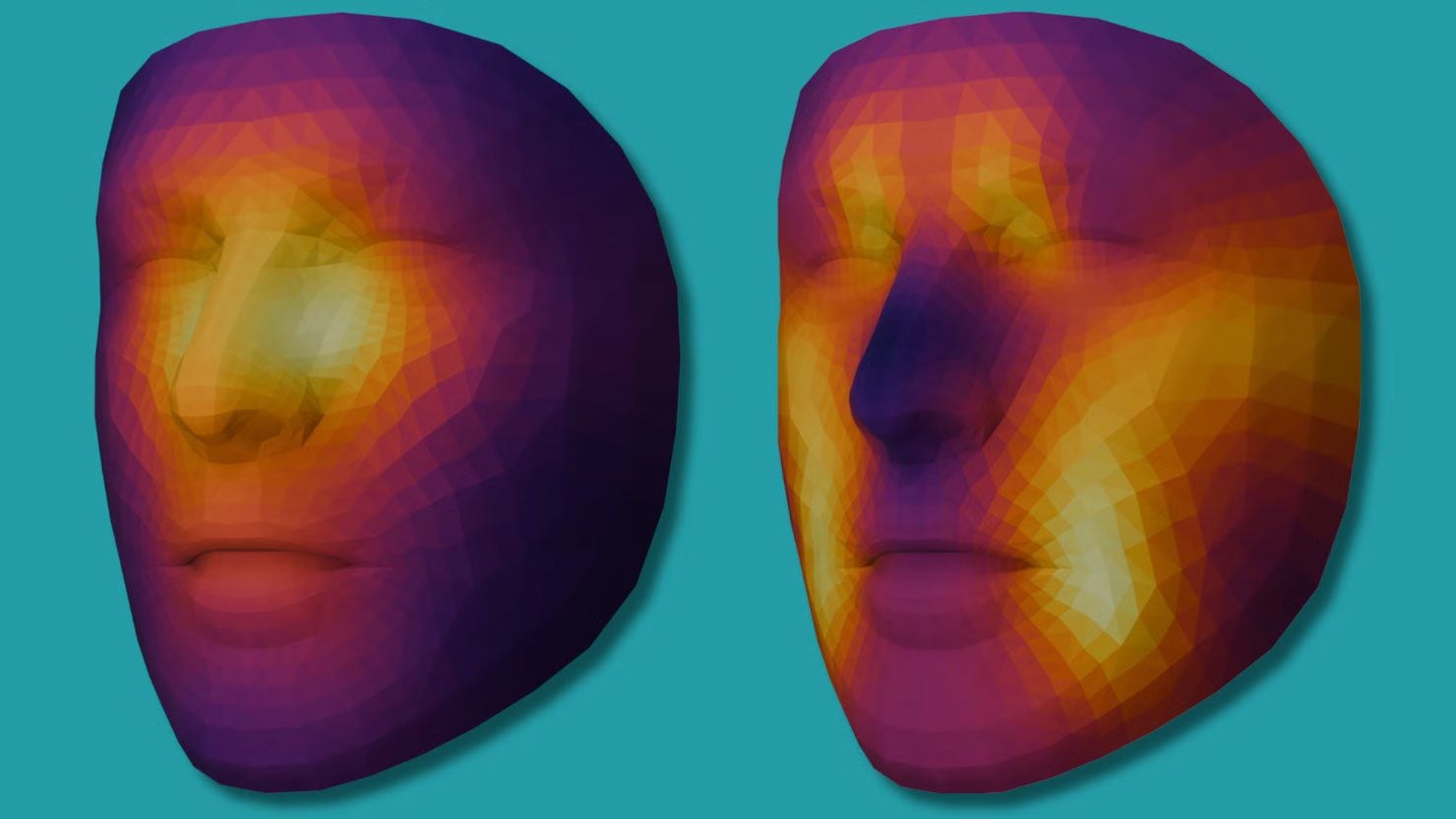
“The age estimation algorithm is looking at the area around the temples, the area on the forehead, above the eyes and then what we call the nasolabial fold, the line that connects the nose down to the corner of your mouth,” Mak said of what parts of the face the AI models consider when assessing biological age.
“In contrast, the mortality risk prediction algorithm is looking at a totally different part of the face,” Mak said. “It’s looking at the bridge of the nose and the area under the eyes.”
Eerily, the same regions of the face that the AI model assesses to predict biological age and survival are the same parts that Greek physician and philosopher Hippocrates referenced in the Book of Prognostics, written around 400 B.C., when he described “the nose sharp, the eyes sunken, the temples fallen in” as signs of muscle wasting and mortality risk.
“To think that our algorithms might be replicating that wisdom of Hippocrates from millennia ago was mind-blowing to us,” Mak said.
The AI algorithms had no awareness of Hippocrates’ ancient texts, because “our algorithms are trained purely on face photographs and then whether somebody died or not, or their age,” Mak said.
“It does not factor in the text, knowledge or wisdom that’s aggregated on the internet,” he added. “So hearing Hippocrates echo over millennia in our algorithms was very eerie.”
Mak and his colleagues originally built a robust AI model called the Foundation Artificial Intelligence for Health Recognition-Face (FAHR-Face) that was trained on more than 40 million facial images spanning diverse ages and ethnic backgrounds.
The model was then fine-tuned and used as a foundation to build two other models that could perform specific tasks: The FAHR-FaceAge model estimates the biological age of someone based on a single photo, and the FAHR-FaceSurvival model predicts a cancer patient’s chances of survival by combining facial features with other clinical information.
With the FAHR-FaceSurvival model, the researchers found that among 122 cancer patients who were indicated by the model to have a high risk of death, more than half – 52.5 per cent – died within 90 days of the assessment, as predicted. In comparison, only about two per cent of the 975 patients in the lowest-risk FAHR-FaceSurvival group died within 90 days.
When evaluating the FAHR-FaceAge model, the researchers found that 21 per cent of the 1,060 patients whose biological age was more than 20 years above their chronological age died within 90 days. In comparison, about six per cent of the 4,195 patients with biological ages at least 10 years younger than their chronological age died within 90 days.
The researchers found that cosmetic changes to the face – such as surgery, injectables like Botox or makeup – did not affect the AI models’ performance.
‘A promising proof of concept’
The study authors emphasize that their AI models are not intended to replace physicians or existing clinical evaluations. Instead, they describe the technology as an emerging tool that could someday help inform a doctor’s assessment of a patient’s health or their decision-making around treatment options.
“If we can pick up accelerated aging or higher mortality scores early, we might be able to screen for those or identify patients who may benefit from further testing for serious conditions earlier,” Mak said.
And while the new study was conducted only among cancer patients, Mak said more research could reveal whether similar findings may emerge among otherwise healthy people who may be interested in their longevity.
The study’s use of AI technology is fascinating but still needs to be evaluated clinically, said Dr. Wilbur Lam, research chair and professor of pediatrics and biomedical engineering at Emory University.
“This is an extremely compelling study that stems from a large data set and its associations between facial images and biological age as well as cancer survival risk appear to be robust. Its true clinical utility, however, will need to be demonstrated prospectively,” Lam, who was not involved in the study, said in an email.
“Moreover, as the authors themselves allude to, whether this tool can be accurately used for specific subpopulations remains a question,” he said. “For example, how strong the effects are for people with specific facial features, skin color, age groups will also need to be prospectively tested in order for the technology to be clinically implemented.”
The study provides “convincing evidence” of a statistical link between facial appearance and survival in cancer patients receiving radiotherapy, Miroslaw Bober, professor of video processing and machine intelligence at the University of Surrey, said in a statement distributed by the U.K.-based Science Media Centre.
But “predicting an outcome is not the same as explaining it. Despite the references to ‘biological age’, the AI estimates age from facial appearance rather than directly measuring any underlying biological ageing process,” said Bober, who was not involved in the study.
“The authors link the facial regions the AI relies on to the ‘look of dying’ described by doctors. However, the study did not test whether the AI recognises anything a doctor would not,” Bober said.
“It has not shown that these predictions add clinically useful information beyond doctors’ assessments of a patient’s general health and fitness, which were not measured in the study,” he said. “This is a promising proof of concept, but it is not ready for clinical use. The tool still needs testing against doctors’ own judgement and across different hospitals and patient groups.”
Jacqueline Howard, CNN

