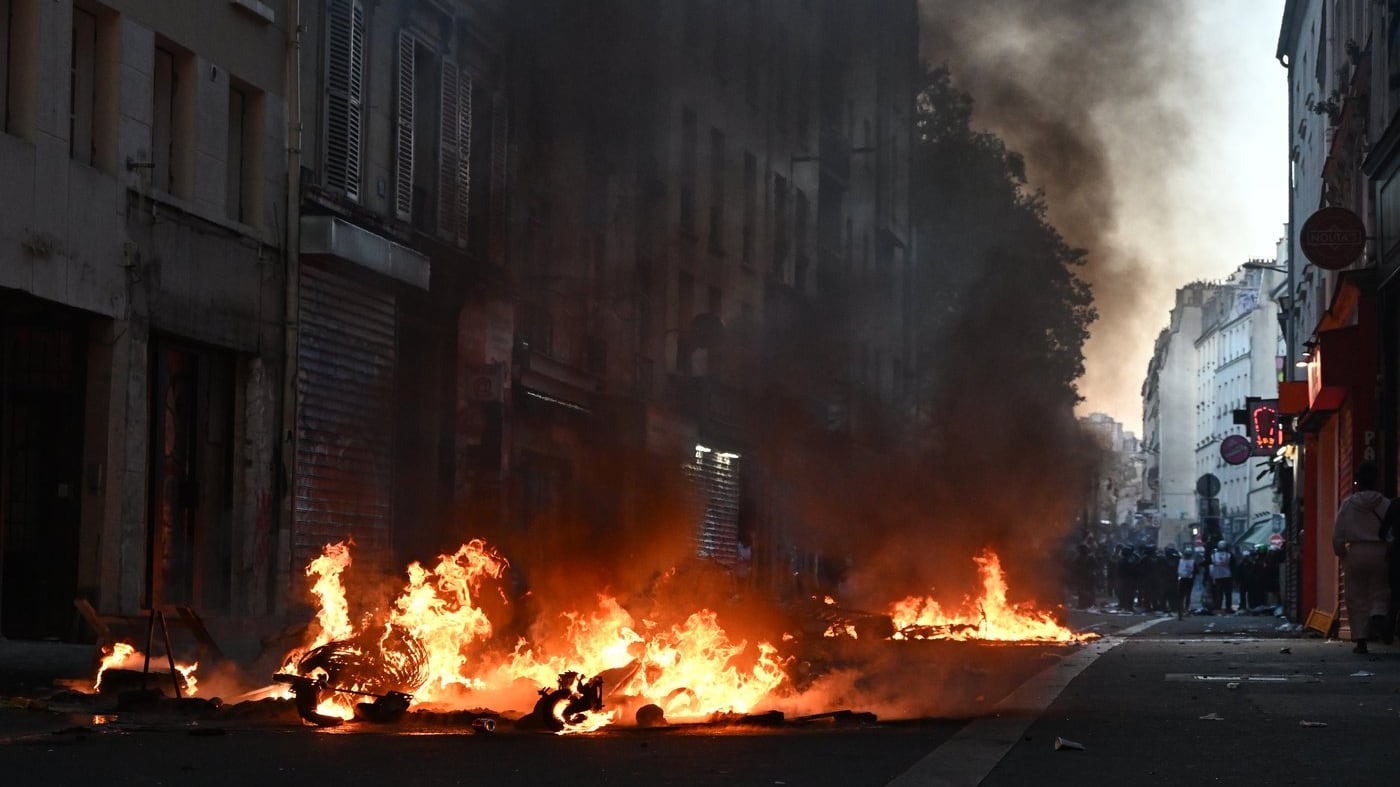
Lawyers said Friday they would sue the interior minister over alleged police brutality during France’s ongoing protests, which they say has led to severe injuries, including several demonstrators hit in the eye.
France has been rocked by high-school student blockades and cost-of-living protests in recent weeks, less than six months before elections to replace centrist President Emmanuel Macron after his maximum two terms, with the far right leading in the polls.
Rights activists have accused law enforcement of using disproportionate force, following several incidents including a 15-year-old losing a hand to a crowd-control grenade.
“We now believe it is imperative to target the person responsible for these mutilations and massive damage, namely Interior Minister Laurent Nunez,” attorney Arie Alimi said at a press conference of lawyers representing at least 18 victims.
He said the lawyers would lodge a complaint with the Court of Justice of the Republic (CJR), the only court able to deal with cases against sitting members of government “for the orders he gave to use weapons which he knows to be mutilating”.
Around 10 of their clients have given their consent to sign this collective complaint before the CJR, the lawyers said.
Alimi said the chances were slim it would lead to the opening of an investigation.
But “we have to do something to prevent more people from being mutilated, especially children,” he said.
‘Greatest proportionality’
Nunez has said that police have acted with “the greatest proportionality” since the beginning of the high-school protest movement.
On Friday evening, he said he sincerely regretted the injuries but every time police officers used force, it was “within a legal and reglementary framework”.
He said “intermediate” crowd-control means, such as grenades and tear gas, were essential for police to carry out their job.
Police’s rubber-coated projectile balls or grenades have caused at least 20 people -- including teenagers -- to be seriously injured during protests since mid-September, according to an AFP count.
As of October 30, police had opened 105 internal investigations into allegations of police brutality, according to a source close to the case.
Of those, 52 were linked to the high school student movement, 48 to violence during mass protests on October 17 and 18, and five to incidents on October 24.
Earlier cases of alleged police brutality included a 14-year-old who in September lost most of his teeth when a police officer appeared to fire a grenade at him at very close range.
A 15-year-old in October lost his hand at a protest when a grenade exploded. A police union source said he picked it up, but a witness said the grenade landed on him.
Three hit in the eye
Alimi said more cases were still being discovered, with a particularly “horrifying” toll for October 17, a day when arson and looting broke out in several cities on the sidelines of peaceful protests.
“It feels like being in a wartime infirmary,” he said.
Among those wounded on October 17 was his client Ahmed Benmezroua, a 27-year-old independent photographer who had been attending his first protest in Paris. He almost died after a grenade ruptured an artery in his leg, he said.
A young engineer was “on the verge of losing his foot” after a grenade exploded underneath it, the lawyer said.
A 19-year-old nursing student was hit in the eye with a sting-ball grenade, resulting in a fractured nose and possible loss of the use of an eye, Alimi added.
In the eastern city of Strasbourg, a 27-year-old lost an eye after police fired a sting-ball grenade on October 17, the lawyer said.
At a protest the same day in the eastern city of Mulhouse, a student called Maissa lost the use of an eye just before her 18th birthday, her attorney Pierre Brunisso said.
Several demonstrators were wounded in the eye during the Yellow Vest protest movement that shook Macron’s first term.

