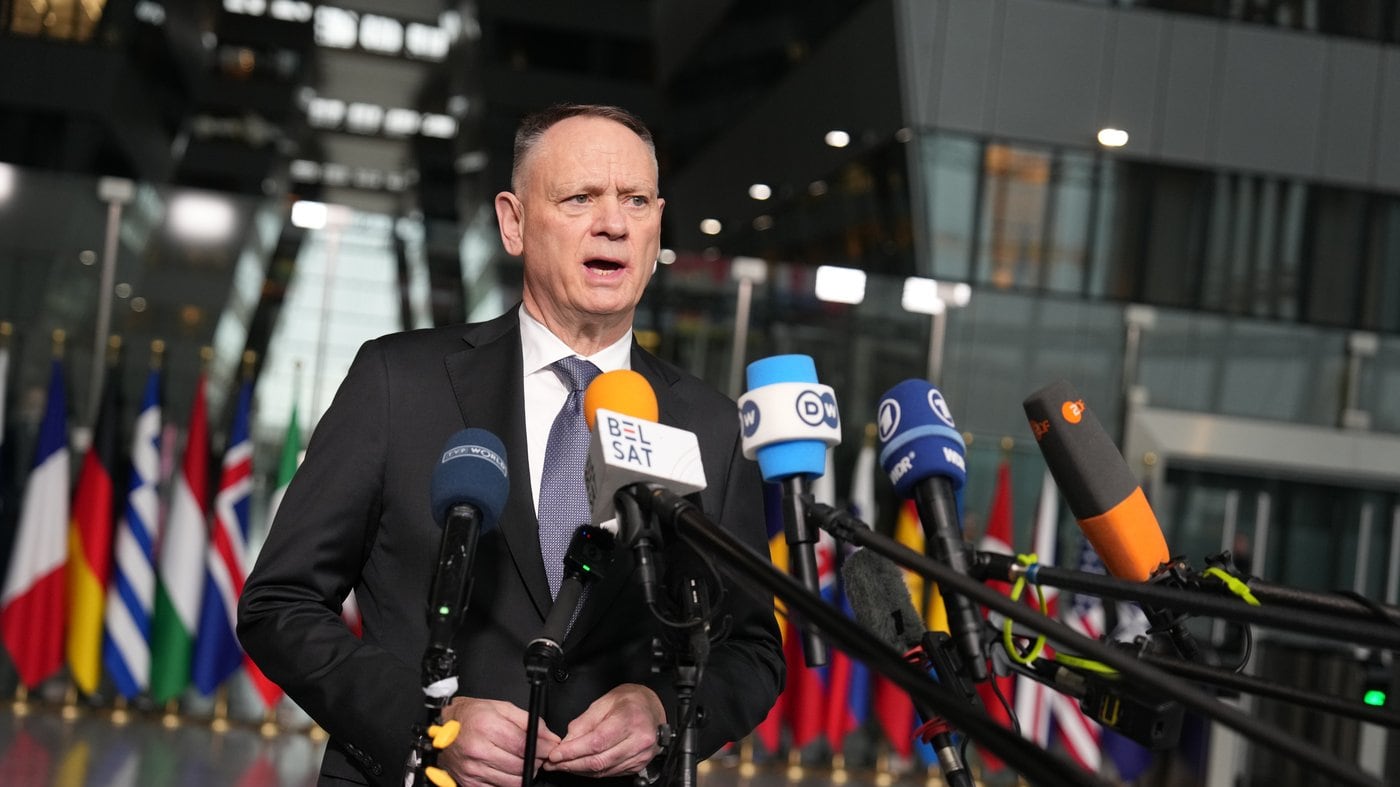
OTTAWA — Ukraine’s struggles with the Starshield military satellite network show why Canada is pursuing its own sovereign low-Earth orbit satellite network, Defence Minister David McGuinty said Tuesday.
On his way into NATO headquarters in Brussels, where the Ukraine Defence Contact Group was meeting Tuesday, McGuinty said the federal government is following the issue “very closely.”
Ukrainian President Volodymyr Zelenskyy has said in recent days that repeated restrictions on his country’s use of the Starshield military satellite communications system, run by Elon Musk’s SpaceX company, have undermined its ability to intercept Russian attacks.
Restrictions on Ukraine’s use of the satellite service have throttled the speeds at which its drones can operate to intercept incoming attacks.
The Liberal government has pledged billions of dollars to support a host of sovereign space capabilities -- including money to build up Telesat’s low-Earth orbit Lightspeed network for future military communications.
When asked by reporters if Canada will bring up Ukraine’s access to Starshield with U.S. President Donald Trump’s administration, McGuinty said he expects Prime Minister Mark Carney will follow through.
“It’s an issue that we’re following very closely. You can imagine, of course, on a continental basis with Norad, with integrated air-and-missile defence systems between Canada and the United States, this is something that we are following,” McGuinty said.
“It’s also one of the reasons why Canada is building its own domestic sovereign capabilities in this area. It’s something that I’m sure the prime minister will touch upon with the president in due course.”
A spokesperson for McGuinty clarified later on Tuesday that the minister was referring to President Zelenskyy, not Trump.
Zelenskyy has questioned whether the problems with Starshield are actually technical in nature and has said SpaceX appears to have imposed the restrictions. Moscow has repeatedly targeted Ukraine’s power grids.
NATO Secretary-General Mark Rutte told reporters Tuesday that the “relevant parties are working very hard to make sure that as soon as possible things are back to normal” with Ukraine’s access to the satellite system.
Rutte said Tuesday’s discussions are about ensuring Ukraine has what it needs to get through the winter and stand strong in peace negotiations with Russia.
McGuinty told reporters in Brussels that, based on the reports he’s read, Russia’s negotiating position is “predictable” and unserious.
“I don’t think that that’s good-faith negotiation, but I’m not at the negotiating table,” McGuinty said.
Media reports have suggested Russia is demanding control of the Donbas region and a ban on Ukraine joining the NATO alliance in exchange for ending the war.
Russia’s terms reportedly would also have the defensive alliance withdraw to its 1997 borders by removing NATO troops from its easternmost European member countries.
Canada is currently leading a multinational brigade in Latvia, where it has some 2,000 troops stationed.
The Pentagon has urged Western supporters of Ukraine to focus their military aid on equipment for front-line combat, rather than support for Ukraine’s deep strikes into Russia.
U.S. Undersecretary of Defense Elbridge Colby said deep strikes have “not been effective in driving an end to the war.”
The defence ministers of the United Kingdom and Germany pushed back against the suggestion that Ukraine should not strike deep into Russian territory -- indicating a wide gulf between American and European views on how to end the war.
German Defence Minister Boris Pistorius said criticizing strikes against strategic military targets in Russia is “quite a stupid thing.” He said the focus should be instead on Russia’s “terroristic strikes every night and every day on civil energy, water and heating infrastructure in Ukraine.”
Tuesday’s meeting of the Ukraine Defence Contact Group, an alliance of more than 50 countries, was called by the U.K. and Germany.
A meeting of some three dozen countries that support Ukraine, known as the coalition of the willing, is set for Berlin on Thursday.
With files from The Associated Press
Kyle Duggan, The Canadian Press

