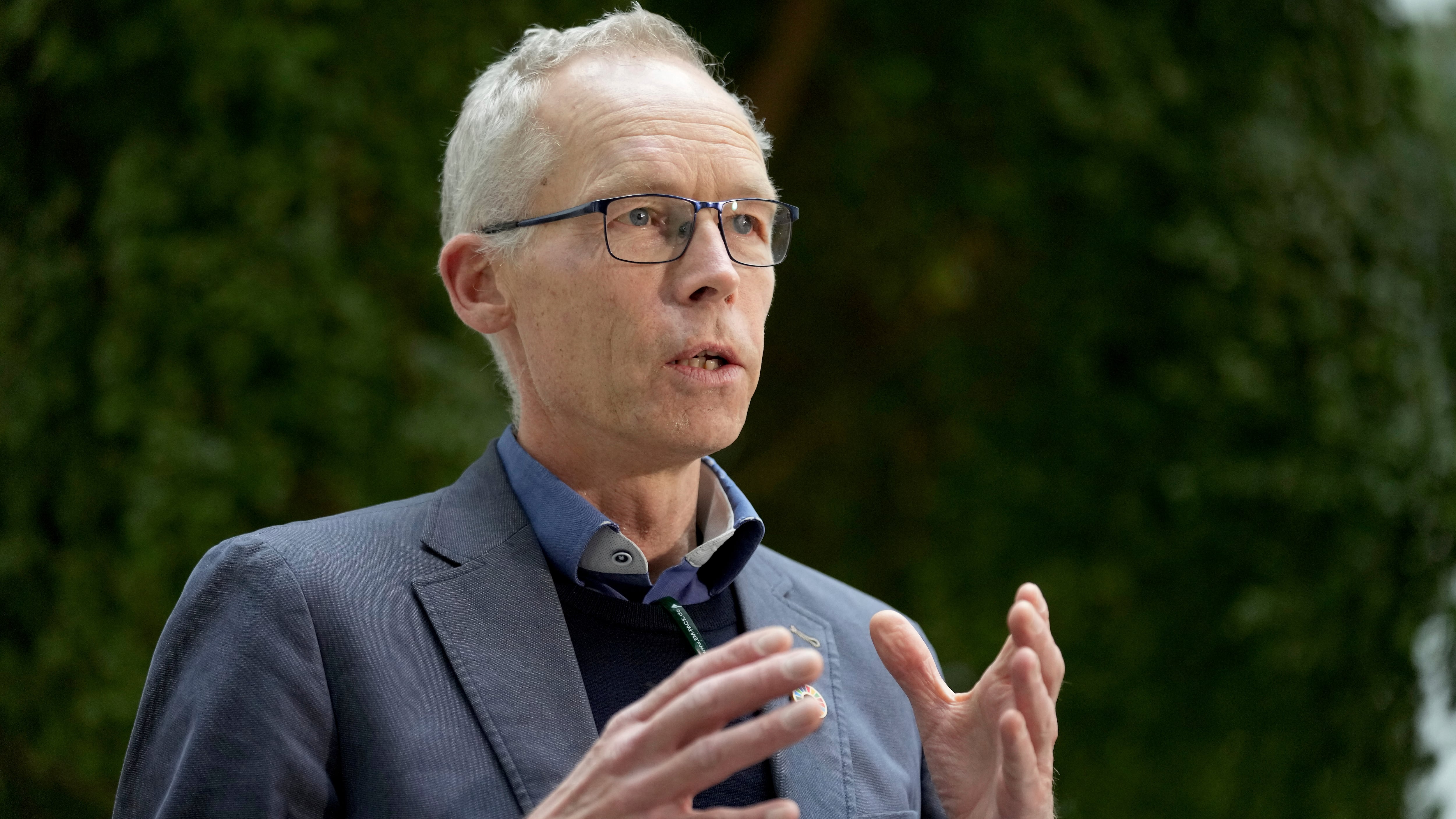
He’s briefed world leaders and business tycoons, appeared in a documentary with Leonardo DiCaprio, and amassed a cult following with his animated, no-nonsense warnings about the perils of climate change.
For a scientist, Johan Rockstrom is about as close to a rock star as it gets and at the United Nations climate conferences, the straight-talking Swede is in his element.
But this year, Rockstrom is on the offensive as science emerges as a key battleground at COP31 in Turkey.
Debates have dragged over the science of crossing the 1.5C temperature limit while a long-running standoff over the work of the Intergovernmental Panel on Climate Change (IPCC) has spilled into the talks.
Rockstrom, who is director of the Potsdam Institute for Climate Impact Research in Germany, paused to speak with AFP after shaking hands with admirers in Antalya. This interview has been edited for length and clarity.
Q: You’ve been warning for years that the 1.5C goal would be crossed without urgent cuts to planet-heating emissions. The UN says overshooting 1.5C is now imminent and unavoidable. Have we failed this goal?
A: “I think science clearly shows that we need to have a more nuanced way of describing this. The first is that we have to admit failure. We signed the Paris agreement 11 years ago and so far we’ve just added emissions. And now we will inevitably be crashing through the 1.5C limit. That is failure so far and that has to be admitted, because that’s the key why we need to accelerate. For every year that we fail in bending the curve, the pathway to safety becomes steeper and steeper.”
Q: Where are we heading?
A: “We’re not following a pathway that brings us back to 1.5C. We’re following a pathway that takes us to 2.8C, 2.9C, perhaps even 3C of warming within just 75 years... there’s no evidence we can support the world as we know it at that level. It’s a path to disaster.”
Q: Does science have a solution?
A: “The best the science can offer is to limit warming, and peak warming, somewhere around 1.8C and then potentially bring it back to 1.5C. And that is what policy-wise is described as ‘keeping 1.5C alive’. But that is an enormously heavy lift... and the first step is the most urgent one, which is to put a brake on warming.”
Q: So by drastically and immediately reducing emissions, and then pulling carbon from the atmosphere, it might theoretically be possible in future to return to 1.5C?
A: “I think it is correct to say that 1.5C is theoretically still possible. We definitely need to hold on to it as the landing zone. That would be a big mistake to now compromise with 1.5C.
“Exceeding 1.5C brings us into danger in two ways. One is that it increases the frequency and severity of extreme events... but it’s also pushing us closer to tipping points which if crossed, would bring us to irreversible changes that would push us forever into less and less liveable conditions on Earth.”
Q: Some nations at COP31 have questioned recent studies into overshooting 1.5C -- is the science sound?
A: “This is obstruction, it’s complete nonsense, and everybody knows that... these are robust, scientifically verified scenarios.”
Q: There’s also a separate spat involving the IPCC, with some nations pushing to delay the publication of its next major reports. Is science under attack here?
A: “We are seeing efforts of doing that -- to undermine the role of science as the basis for the whole policy regime around climate. This is highly frustrating... We have to stand up and defend science very, very clearly.”
Q: Are you optimistic humanity will change course?
A: “That’s the big question, isn’t it? If you look at the world today, the answer would be -- I’m skeptical.
“We are in a world that is so fragmented and focusing entirely on geopolitics... In that sense I’m really, really nervous.”
Q: Is there any light in the tunnel?
A: “We are on a journey. We’re showing that solar, wind, biomass, hydro, efficiency of energy systems, are starting to scale in a way that almost exceeds our expectations.
“We are at this collision point. That is one reason why countries that feel threatened are digging in their heels even deeper. Because they see this is no longer a sideshow -- this is a main show. This is really the path toward not only solving the climate crisis, but it’s also a pathway to competitiveness.”

