WASHINGTON -- Democrats overwhelmingly nominated Hakeem Jeffries on Wednesday to be speaker of the U.S. House, as he brushed past most skeptics and was on track to make history as the nation’s first Black lawmaker with the gavel.
Jeffries secured the nod during closed-door voting, 251-11, ahead of a full U.S. House vote when the new Congress convenes in January. Among those opposing him on the secret ballot were a group of progressive newcomers, who said in a statement there is “still work to be done” to ensure their priorities.
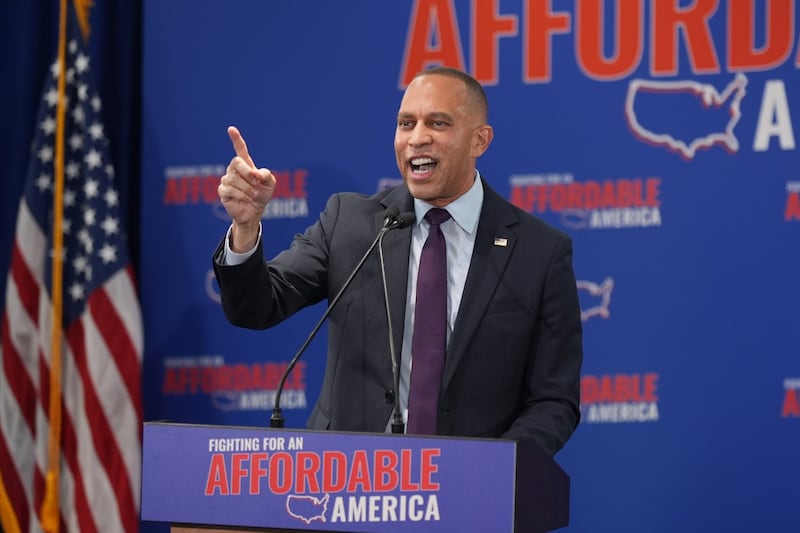
Afterward, Jeffries vowed to work hard, through every corner of the Democratic caucus, and said each generation has the opportunity to “show up, speak up, stand up, and help the country march toward a more perfect union.”
“Our job is to fight MAGA extremism, not each other,” he said, “and to get big things done for the American people.”
Jeffries, of New York, ran unopposed but faces a restive party eager for a change in Congress after voters ousted Republicans in a rebuke of U.S. President Donald Trump and the party in power. Phone calls and social media campaigns have been flooding the offices of Democrats in both the U.S. House and the Senate, demanding a fresh start. Protesters heckled Jeffries last week during a Democratic conference in Denver.
Ahead of Wednesday’s vote, Jeffries said he was taking nothing for granted. Yet having led the Democrats to one of the biggest incoming U.S. House majorities in decades, he has room to maneuver.
Those opposing Jeffries, including some backed by the Democratic Socialists of America, signaled that conversations are ongoing as they push to deliver Medicare for All, stop harsh actions from U.S. Immigration and Customs Enforcement, get money out of politics and end Israel’s war in Gaza.
“We have worked to secure commitments from Leader Jeffries in good-faith conversations,” they said in a joint statement.
Signing on as opposed were members-elect Darializa Avila Chevalier of New York, Adam Hamawy of New Jersey, Melat Kiros of Colorado, Donavan McKinney of Michigan, Chris Rabb of Pennsylvania and Claire Valdez of New York and Frederick Haynes of Texas, though he was one of two Democrats who did not vote. Reps-elect Angela Gonzales-Torres of California and Don Leonard of Ohio also said they voted against.
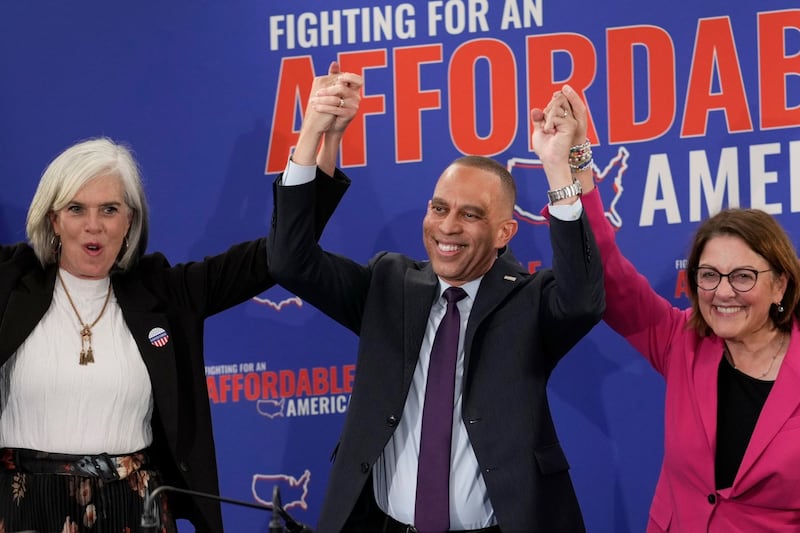
Jeffries is part of a leadership trio with Rep. Katherine Clark of Massachusetts and Rep. Pete Aguilar of California, who would all be historic firsts -- Clark as the first female majority leader and Aguilar as the first Latino to serve as the majority whip. They also ran unopposed and were elected, as was Rep. Ted Lieu of California, as chairman of the U.S. House Democratic caucus.
He will need a simple majority of 218 votes from the whole U.S. House to be elected speaker when the new Congress convenes on Jan. 3, 2027. It would be a milestone in the nation’s struggles to create a representative democracy, since the first Black lawmaker was elected to the U.S. House more than 150 years ago.
Skeptics question whether leaders are up to the job
Wednesday’s vote was the first of their careers for dozens of members-elect, before they’re even sworn into office in January.
Jeffries was nominated for U.S. House speaker by five Democrats essentially representing all aspects of the caucus, including Rep. James Clyburn, the legendary lawmaker from South Carolina.
“This is a historic moment for our nation,” Clyburn told the room, according to his private remarks that invoked voters’ outpouring for a change in the country.
Rep. Rosa DeLauro, D-Conn., discounted the naysayers and said: “It is a day in the history of this nation that cannot be diminished in any way. I could never be more proud to be a Democrat than I am today.”
Rep. Kweisi Mfume of Maryland, who first came to Congress in 1987 with the late Civil Rights leader Rep. John Lewis of Georgia, said: “It just means so much in terms of moving the ball forward. Somebody’s got to break the glass, and in this instance that’s exactly what has happened.”
The tally, with 262 votes cast, included those elected to the new Congress and the U.S. House delegates.
Returning Rep. Emily Randall of Washington said earlier that she fielded questions about U.S. House leadership during town halls in her district and on her Instagram feed. So she decided to start dialing people back.
“People have messaged me asking if Bernie Sanders could be the speaker of the U.S. House,” she said, referring to the Vermont independent senator who caucuses with Democrats. “Technically yes, and it would be probably difficult.”
(It’s true that the U.S. House can elect anyone speaker, but it’s unlikely to be Sanders because he already has his day job in the Senate.)
She said she was voting for Jeffries. Lawmakers pointed to the livestream from Rep. Alexandria Ocasio-Cortez of New York trying to explain the role of the speaker and her support.
“There is one candidate in this race: Hakeem Jeffries,” Ocasio-Cortez said earlier at the Capitol.

First leaders of a post-Pelosi era
Jeffries, Clark and Aguilar have risen together, as a team, as the first new generation of leaders after the Nancy Pelosi era and will soon serve as leaders in the majority for the first time.
When Pelosi, of California, stepped aside from leadership in 2022 after the party’s electoral defeat that handed Republicans the majority, it set the stage for this era.
A similar upheaval with Democrats angling for change is happening in the Senate, where Senate leader Chuck Schumer of New York faces a challenge from Sen. Chris Van Hollen of Maryland in elections next month.
Schumer insisted Wednesday he had the votes: “I will be reelected as majority leader.”
Returning Rep. Yassamin Ansari of Arizona said the situations in the Senate and the U.S. House “are quite different.”
She said Jeffries has been a collaborative leader who is listening to ideas from progressive caucus members like her and others. “His job is to reflect all of us, not just a faction,” Ansari said.
Rep. Shomari Figures of Alabama, who pulled off a stunning victory in a redrawn district favouring the Republican candidate, said before the vote that he’d be supporting Jeffries.
“It’s not even like a complex question,” he said about Jeffries, who he said “led us through what is likely the most tumultuous two-year tenure of any presidency in the history of this nation.”
“I’m not going to not stand by him right here on the precipice of history,” he said.
By Lisa Mascaro
Associated Press writers Kevin Freking and Mary Clare Jalonick contributed to this report.

