
Canada is expected to look considerably different on the religious map by 2070, with Christians projected to make up just one-third of the population and people identifying with no religion becoming the country’s largest group.
The forecast comes as Islam is projected to overtake Christianity as the world’s largest religious group within the next decade, according to new research from the Pew Research Center.
While the global shift is being driven largely by higher birth rates among Muslims, Canada’s changing religious composition reflects a different demographic picture, including a decline in Christian identification and growth in the number of people who say they have no religious affiliation.
Canada’s changing religious landscape
Pew’s projections show Christians accounted for 53.3 per cent of Canada’s population in 2020, making Christianity the country’s majority religion.
By 2070, that share is expected to fall to 33.3 per cent.
Meanwhile, the proportion of Canadians identifying as religiously unaffiliated is projected to increase from 34.6 per cent in 2020 to 40.5 per cent in 2070.

Muslims are also expected to represent a considerably larger share of the population, rising from 4.9 per cent to 15.6 per cent over the same period.
The projections suggest that, while Christianity will remain an important part of Canada’s religious landscape, it will no longer be the country’s largest religious group. The religiously unaffiliated are expected to take that position.
Muslims projected to become world’s largest religious group
Christians currently make up the world’s largest religious group, followed by Muslims. But that ranking is expected to change by 2035, according to new projections from the Pew Research Center.
The centre estimates there were almost 2.3 billion Christians and around 2 billion Muslims worldwide in 2020. By 2035, the Muslim population is projected to reach 2.57 billion, narrowly surpassing the 2.52 billion Christians.
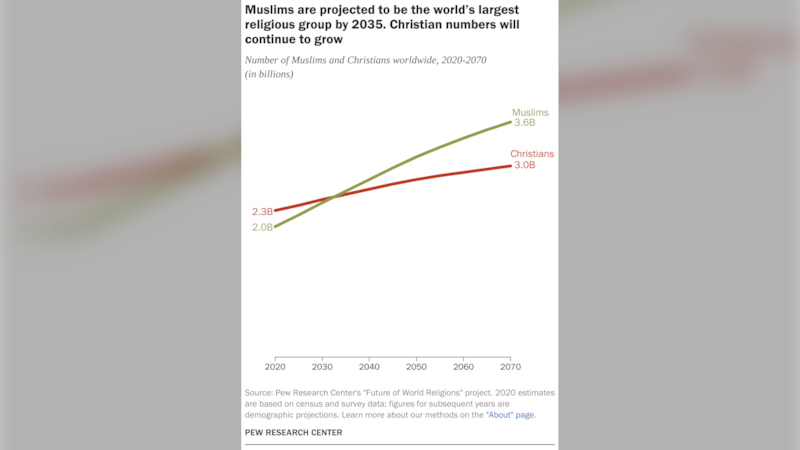
The gap is expected to widen over the following decades. By 2070, Muslims are projected to number above 3.6 billion, compared with roughly 3 billion Christians.
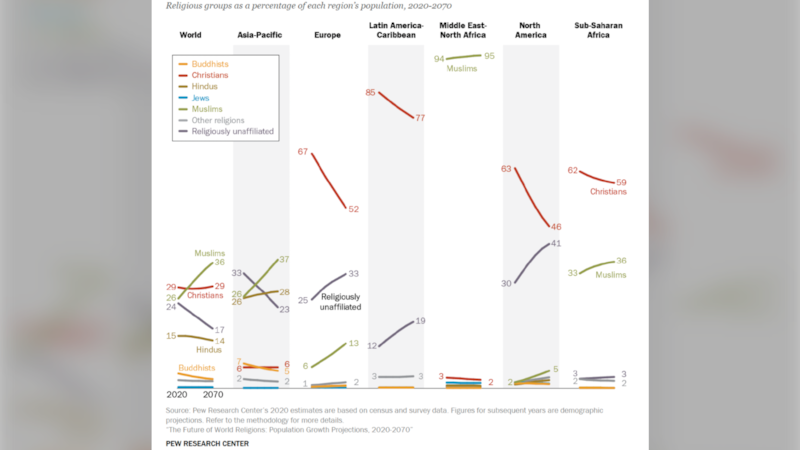
As a share of the world’s population, Muslims are expected to increase from 25.6 per cent in 2020 to 35.8 per cent in 2070. Christianity’s share is projected to remain relatively stable, rising slightly from 28.8 per cent to 29.1 per cent.
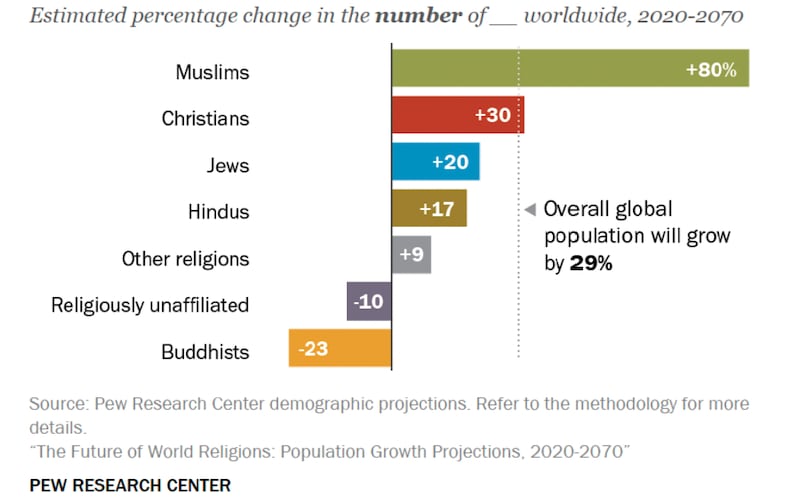
The projections do not mean Christianity will shrink in population. Both religions are expected to grow, but the Muslim population is forecast to expand considerably faster.
Birth rates are a major factor
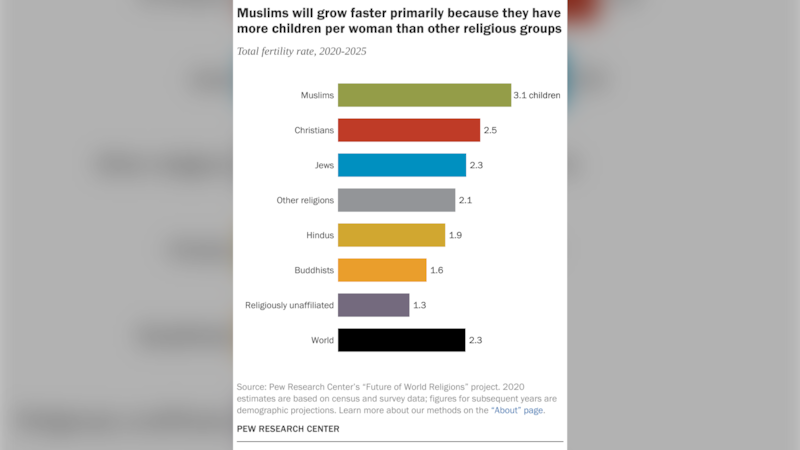
The difference in fertility rates is one of the main reasons behind the projected shift.
Between 2020 and 2025, Muslim women had an average of 3.1 children, compared with 2.5 among Christian women. The average for women belonging to other religious groups combined was 1.6 children.
Pew says both Muslims and Christians are expected to gain more people through births than they lose through deaths over the next five decades.
Between 2020 and 2070, the Muslim population is projected to gain 1.6 billion people through natural population change, compared with 792 million for Christians.
Religious switching plays a role
Pew projects a net loss of eight million people from Islam through switching, compared with a net loss of 105 million from Christianity.
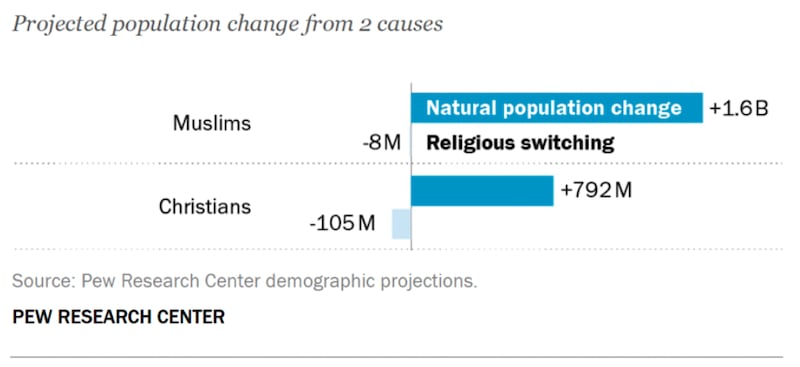
The research also indicates that the projected growth of Islam is not primarily the result of Christians converting to Islam. The number of Muslims expected to become Christian and Christians expected to become Muslim is projected to be relatively balanced.
What the projections mean for Canada
Canada’s projected changes are part of a broader transformation across North America.
Pew estimates that Christians represented almost 63 per cent of North America’s population in 2020. That proportion is expected to fall to around 46 per cent by 2070.
Over the same period, the religiously unaffiliated population is projected to increase from 30.2 per cent to 41.2 per cent.
The Muslim share of the region’s population is also expected to grow, from 1.6 per cent in 2020 to 4.9 per cent in 2070.
However, Pew cautions that its projections are based on demographic trends and assumptions continuing over the coming decades. They account for factors including age, fertility, mortality, migration and religious switching, rather than attempting to predict every possible social, political or economic development.

