TACHOTT, Mauritania — Alexandre Deitos studied the shaky video taken by a fisherman as it panned across the small boat stuck on a sandbank.
He sighed. Inside the craft were eight decomposing bodies and a ninth was floating nearby. Deitos knew his grim job would not be easy: identifying the dead.
In a long career with the Brazilian police, the criminal forensic investigator had put names to corpses mangled in plane crashes, crushed beneath collapsed buildings and buried in mudslides. But he had never worked on a case like this.
His first mystery would be fairly easy to solve. In analyzing the contents of the boat, which included 28 mobile phones and two IDs, Deitos and his colleagues surmised the boat had originated in West Africa carrying migrants to Europe. Something had gone wrong, and the open 13-meter (42-foot) fishing boat had then drifted hopelessly for weeks across the Atlantic.
The next part would be harder: putting names to the bodies. He ran into roadblocks with officials in Africa. Some emails went unanswered and the little information shared led nowhere. Deitos and his boss realized they needed to take a different approach, and they turned to an unexpected place for a hand: “Would you help us?” Deitos asked me.
As an Associated Press reporter, I had written about such “ghost boats.” I had already been in touch with them for a story about this particular tragedy and shared with them my previous coverage.
Their request launched an unusual partnership between a police officer and a journalist to identify the boat’s passengers. Two years later, our work took us to the nation of Mauritania, in the Sahara Desert, to collect DNA from the grieving parents, wives and children of those who had perished on that fateful voyage.
The men on this boat were no different from the thousands of others who have disappeared in the Atlantic trying to reach Spain’s Canary Islands, on what some experts say is the world’s most dangerous migration route.
While the majority of the missing vanish without a trace in what are known as “invisible shipwrecks,” at least a dozen such boats have washed ashore in Latin America and the Caribbean in recent years. The United Nations’ International Organization for Migration estimates that more than 6,500 have died on the route since at least 2020. A Spanish migrant rights group, Walking Borders, says it has documented nearly 26,000 such deaths during the same period.
Tens of thousands of migrants have gone missing globally on land or sea journeys, whether crossing the Mediterranean Sea or the U.S.-Mexico border. While it is states’ responsibility to investigate and identify these victims, regardless of their nationality, they have largely failed, experts say. The U.N. migration agency has called the global crisis “one of the great political failures of modern times.”
An unusual partnership
When I saw news reports about the boat on a Saturday in April 2024, I called Brazilian authorities for comment and wrote a news story. A few days later, I got in touch with Deitos and his boss. They explained the Brazilian police had made no headway with authorities in West Africa.
Deitos said he considered the migrant crisis to be an international disaster that deserved more attention. In researching the problem, he said he had learned that many dead migrants are never properly identified, meaning their families never learn what happened to them. While he had gone overseas to identify Brazilian migrants who had died in Mexico and assisted in investigating international plane crashes, Deitos had never handled a case like this.
Brazil had investigated only one such “ghost boat,” in 2021, and police had failed to make any progress in identifying its victims.
He said he hoped his work on this case might become “a model for other countries” to follow.
“Each person has the right to be identified,” Deitos said. “And each family has the right to receive the body of their loved one.”
However, Deitos and his boss said they were not sure how to proceed. He did not think he would get anywhere by sticking to official channels. He needed to identify the nine victims on the boat. To do that, he would have to locate their families.
Deitos thought I might know what to do because I had investigated a similar migrant tragedy in the Caribbean. That reporting had presented some of the same challenges facing Deitos and had required AP to locate relatives and friends of the victims to figure out who had embarked on that deadly journey.
I explained that I was in contact with many activists and community leaders who have documented hundreds of people missing after boarding such boats. Such grassroots networks, I explained, have sought to fill a void they say has been left by government inaction. With their help, I had already located family members of those who got on the boat.
Journalistic conventions dictate that we maintain distance from officials we cover. Deitos and his boss promised that any information I shared would be used solely for identification purposes. After receiving permission from my editors, I agreed.
The investigator
Deitos, a fit and trim 52-year-old father of one with brown hair and brown eyes, was a dentist before pivoting to forensic anthropology.
He joined the federal police in 2009 and, since 2013, has specialized in identifying victims of disasters. Until June, he had chaired Interpol’s working group on disaster victim identification.
Deitos and I quickly developed an easy working relationship, which was helped by the fact I am Brazilian and speak Portuguese.
Our first task was to figure out who was on the boat. We had some good clues: two IDs from Mali and Mauritania. We also had more than two dozen cell phones. Most were badly damaged by the salt water, but Deitos provided me with the data salvaged from a few of them, as well as several handwritten notes with names and phone numbers. I began making phone calls and started piecing together a list of potential passengers.
I spoke to mothers, wives, brothers and sisters of those who had boarded the boat. They directed me to relatives of other potential passengers.
I cross-checked the dates and locations of their disappearances and obtained photos of those who vanished. I shared photos of clothing, jewelry and personal objects that were found on the boat.
After months of work, we had a list of 30 potential victims who boarded the boat on Jan. 23, 2024, in Nouadhibou, Mauritania. Police only recovered the bodies of nine men, meaning survivors must have been tossing overboard the bodies of those who perished along the way.
Only DNA testing of relatives could confirm what we had been carefully piecing together.
That meant our next stop was in Africa.
Mauritania
We arrived in Mauritania in June. Over the previous two years, Deitos had not given up trying to win assistance from West African governments and international organizations. The International Committee of the Red Cross agreed to help him collect the DNA. Officials in Mauritania eventually cooperated, granting him permission to work in the country and accompanying him throughout the mission.
Escorted by the country’s police, we drove 1,500 kilometers (930 miles) across the Sahara Desert to meet with families. The heat was suffocating. Sand drifted across the road as we sped through an empty landscape except for scattered mosques and homes, mostly financed by migrants abroad.
One village was so remote that outside houses tall poles stood with baskets and ropes to hoist mobile phones high enough into the sky to get a signal.
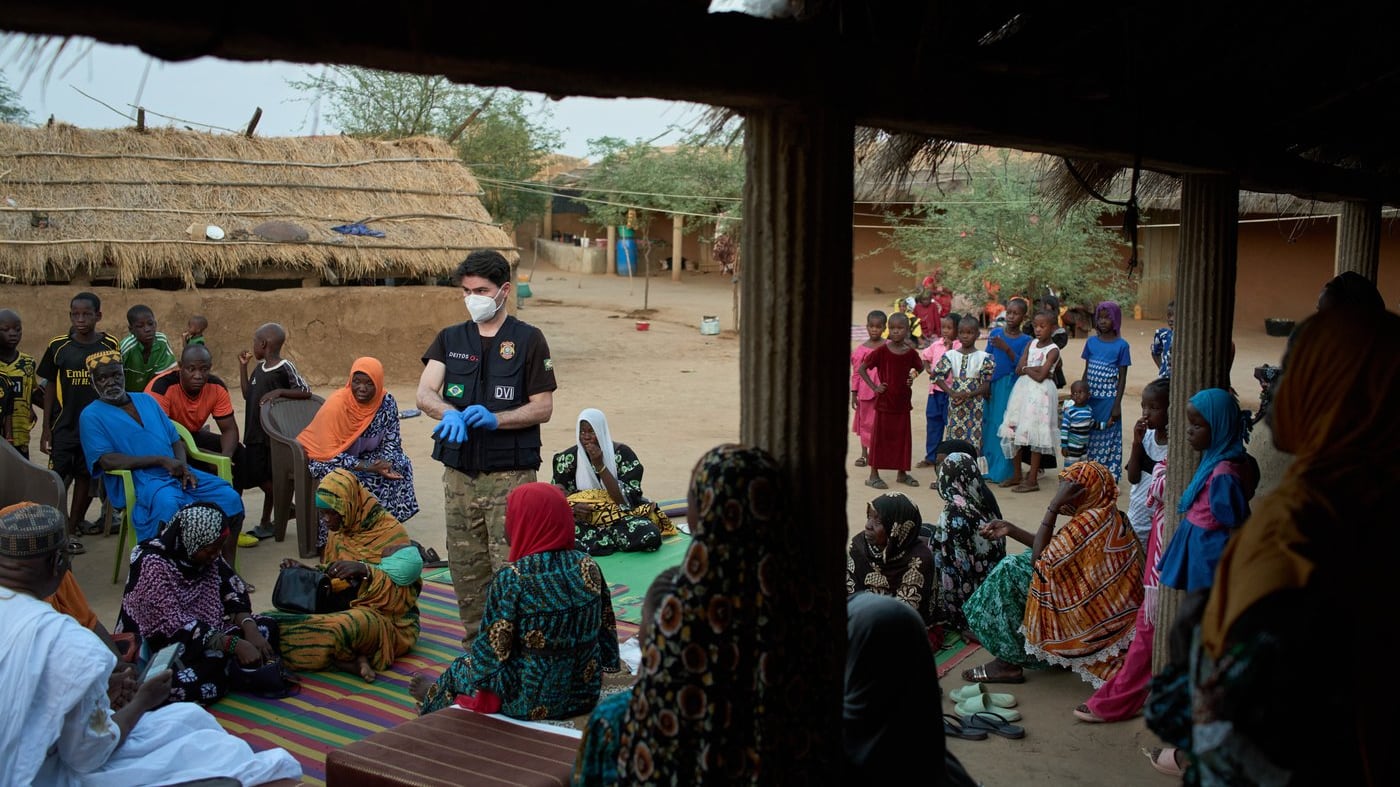
When we pulled up to Hassi Bagara, dozens of people hustled to greet us. We sat on a carpet under the shade of a large tree and answered their questions about Deitos’ mission.
We also learned about the men who had left and their families who stayed behind. The men had no jobs at home, and had hoped to find better opportunities in Europe.
It’s the same story in other West African communities, some of which face more threats, including from rising extremist violence and climate change.
Among the suspected passengers from the region was Issa Diakhité. His father, Sabara Diakhité, said he had accepted his son’s death, but other relatives were living in denial, preventing them from properly grieving.
“How to make his mother understand it?” Diakhité said. ”How to make his brothers understand it? How can anyone understand it?”
Deitos listened and explained how DNA worked. The investigator donned a mask and put on latex gloves before gently swabbing the inside of the man’s cheeks for the cells necessary to make a DNA comparison.
The father thanked him for coming all the way from Brazil. It was rare for local officials to visit, he said, let alone foreign ones.
‘The road of death’
Few people were as prepared as Kadiatou Gassama for confirmation of the worst.
We met her in Mauritania’s capital, Nouakchott. Kadiatou said she knew her husband, Souleimane Gassama, had been on the boat. She had spoken with him hours before he boarded the vessel. His was one of the IDs police had recovered among the remains.
Without a funeral or death certificate, Kadiatou said she and her six children have struggled to register them for school exams, obtain her residency permit or apply for benefits. Thousands of relatives of missing migrants, especially wives, find themselves in a legal limbo that complicates their ability to remarry, inherit their husband’s property or even access bank accounts.
Kadiatou, an immigrant from Congo, said she lives in fear of being deported, and separated from her six children. A deal between Mauritania and the European Union to curb migration has led to a crackdown on immigrants like her. Without her husband, she said, she feels exposed.
For years, she said she tried to convince him to abandon his dream of migrating to Europe. She even threatened to divorce him if he took the perilous voyage. He agreed the trip would be dangerous, calling it “the road of death.” Nevertheless, he told his wife it was worth the risk: Several friends had reached Europe and were sending remittances to their families.
He told her the journey should take no more than three days.
The morning he left, with nothing more than a backpack, he asked for his wife’s forgiveness. After a few days without word from her husband, Kadiatou began to grow nervous. Her concern spiked with each passing day. She called the smuggler — her husband had left his number with her – but each time he gave a different excuse.
She joined a WhatsApp group created by relatives of migrants who had vanished on such trips.
She found others wondering what happened to her husband’s craft:
“Has your brother arrived?”
“No.”
“Has your father arrived?”
“No.”
Three months later, someone shared an article about a Mauritanian boat that washed up in Brazil. There were no survivors. Kadiatou felt a sudden urge to vomit.
Within days, an activist connected her with me. I told her that Brazilian authorities had found her husband’s ID and phone.
I shared with her some photos taken of the victims’ clothing, and she recognized a pair of boxer shorts. She was eager to provide DNA samples to confirm her worst fears.
As Deitos swabbed the children’s cheeks, the boys and girls giggled. Their mother said they were having trouble acknowledging their father’s fate. Her youngest son told people his father was in France. A daughter believed he was a cast-away on an island.
“Until we find his body,” she said, “until we see Souleimane in a coffin, they cannot accept that he is dead.”
A surprise identification
Word got out, and the number of families who offered DNA samples grew. So did the list of potential passengers on the boat. By our last days in Mauritania, we had a list of 42 men who may have boarded the craft.
When we reached Sélibaby in southern Mauritania, dozens of relatives showed up unannounced at our hotel, eager to help and for information.
The throng included Kouna Cissé. Determined to reach us, Cissé snuck through the closed border from Mali with help from his community who chipped in to pay for his travels. He was desperate for news of his son, Sidy, who had supported his parents, his siblings, his wife and three children.
Before meeting with Cissé and other relatives in a hotel conference room, Deitos had spread photographs across a table that the investigator thought might help identify the victims. Among the images of dirty T-shirts and ripped trousers was an X-ray that Brazilian authorities had taken of a man’s surgically repaired ankle. The X-ray revealed the joint was held together by three screws.
As Cissé’s eyes skimmed across the photos, they stopped dead at the X-ray.
“It’s my son’s foot,” he said.
As a youth, the father said, his son had broken it in a motorbike accident.
Relatives sent him a photograph of an X-ray taken at the hospital, and Deitos compared the two images side-by-side on his computer. The screws and their positions looked almost identical. Deitos said his team in Brazil would need to confirm the match, but Cissé had seen enough.
“It’s painful,” Cissé said. “But for nearly three years now, I didn’t have the certainty of my son’s death. I haven’t slept well. I haven’t eaten well. I’m not at ease in my skin. I worry all the time.”
“When I go to bed tonight,” he said, “I will sleep better.”
A video at sea
In the village of Tachott in southern Mauritania, so many relatives lined up to share their DNA that Deitos needed a second day to collect all the samples.
Among those providing DNA was the father of Hademou Sokhona, who was 20 when he vanished. There was little doubt that Sokhona had been on the boat. Brazilian police had recovered a phone that they quickly linked to him. On the device was also a short video he had taken about two weeks after they had set off from Mauritania.
In the video, Sokhona looks emaciated and exhausted, forced to shield his head from the unrelenting sun with a T-shirt. He says nothing as his phone pans the rest of the craft, providing glimpses of at least six other men, also barely alive.
Before he took the father’s DNA, Deitos handed over a screenshot from the video that showed Sokhona looking directly into the camera.
For several seconds, the father, Boubou Sokhona, said nothing as he stared at the image.
It was his son.
“Peace be upon their souls,” the father said.
‘He went until the end’
After 10 days in Mauritania, Deitos flew back to Brazil with the DNA samples of 85 people from 29 families. The results came back in mid-October.
Of the nine migrants whose bodies were found with the boat, six were identified, a much higher number than Deitos had expected.
Now Deitos had to tell family members the hard truth. After the intimate, face-to-face work of taking DNA samples, the confirmation of deaths would come at a distance, via video conference.
The calls all started with Deitos thanking them for their cooperation and ended with telling them that a plaque with their relative’s name would be placed at a cemetery in Belém, Brazil, where the remains had been buried.
In call after call, Deitos stuck to the facts and watched silently as loved ones processed the news.
Each call was unique and required planning. The lack of signal in many households meant some had to travel to the nearest town to connect. In one case, relatives joined from two different continents, a mother from Mauritania and a brother from Spain. A few broke down in tears; others just sighed. All were relieved that their two-year nightmare of doubt was over.
It was moments like this, he said, that had kept him going.
When Deitos told Kadiatou Gassama that her husband’s remains were among those found on the boat, the wife leaned back and covered her face with her hands.
“Alhamdullilah,” she said, sobbing. “Alhamdullilah.” Thank God.
She caught her breath, saying she was pleased to learn she would get a death certificate. It would help her children accept their father’s death and possibly with immigration issues. She also thanked Deitos for giving her a sense of peace she had not anticipated.
The results meant that her husband, Souleimane, had been among the final survivors, that he had fought to return to his family.
“Thank you for clarifying that my warrior did everything,” she said. “He went until the end.”
___
This story was reported in partnership with TV Globo’s Fantástico program in Brazil.
The Associated Press receives financial support for global health and development coverage in Africa from the Gates Foundation. The AP is solely responsible for all content. Find AP’s standards for working with philanthropies, a list of supporters and funded coverage areas at AP.org.
Renata Brito, The Associated Press

