


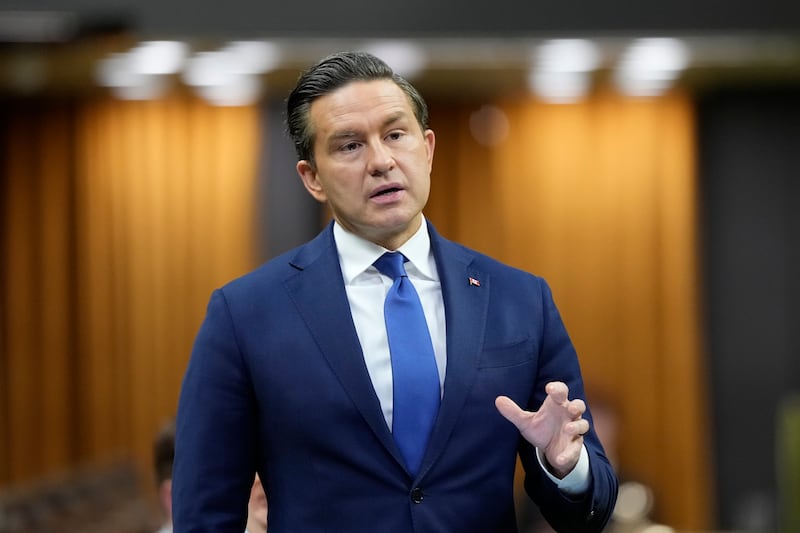
OTTAWA — Despite being dealt double-digit defeats in the three federal byelections that handed Prime Minister Mark Carney his majority, Conservative Leader Pierre Poilievre says he has no plans to resign.
“Canadians might be discouraged right now because of the current political situation, but let us say this, Canadians should not give up,” he said in the House of Commons on Tuesday, vowing to continue fighting for Canadians.
“And I will continue to lead that fight in this House, across this country, and in the next election.”
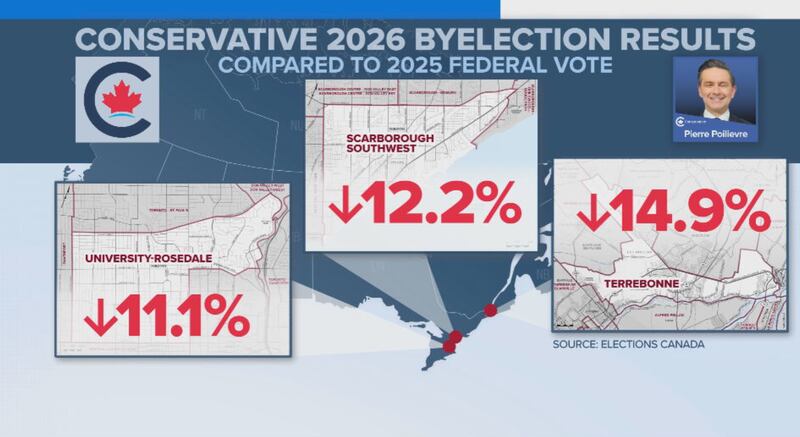
The Conservatives’ vote share shrunk by more than 10 per cent in all three ridings compared to the 2025 federal vote, seeing Poilievre’s candidate in the downtown Toronto race drop to third place.
In closely watched Terrebonne, the Conservatives slid from 18.2 per cent of the vote in 2025, to 3.3 per cent in the byelection.
That decline boosted both the Bloc Quebecois and Liberal vote shares.
“The Bloc Quebecois did much better than we did last year,” leader Yves-Francois Blanchet said. He attributed that to the collapse in Conservative and NDP support.
“We lost because even if we added a lot more votes in terms of percentage than last year, the Conservatives crashed to [3.3 per cent] and the NDP crashed to [ 0.5 per cent] and almost all those votes went to the Liberals.”
In Scarborough Southwest, the Conservatives pulled 12.2 per cent less support than in 2025, and 11.1 per cent less in University-Rosedale.
“I think for the Conservatives, the message that they should be receiving last night is whatever their strategy was doesn’t work,” CTV News’ pollster Nik Nanos said.
“It doesn’t work in delivering their own base, or what was their base in 2025, and it speaks to the importance of them kind of recalibrating and rethinking what their approach is going to be.”
Conservatives in ‘weakened position’
While Conservatives say these ridings were not Poilievre’s to win, there is some acknowledgment that the downward trend isn’t a good sign for the party.
“It leaves them in in a less well, let’s say a weakened position relative to where they have been,” said David McLaughlin, former chief of staff to prime minister Brian Mulroney. “It’s just more proof that the narrative of losing is setting in.”
McLaughlin went on to say, “the decision on Mr. Poilievre’s future has shifted from the party to the caucus.”
Former prime minster Stephen Harper’s then-communications director Dimitri Soudas said that when the party loses by as much as Poilievre did on Monday night, “it’s not business as usual.”
“Because what that indicates is that if there was an election today, many Ontario Conservative MPs would actually lose their ridings,” he said.
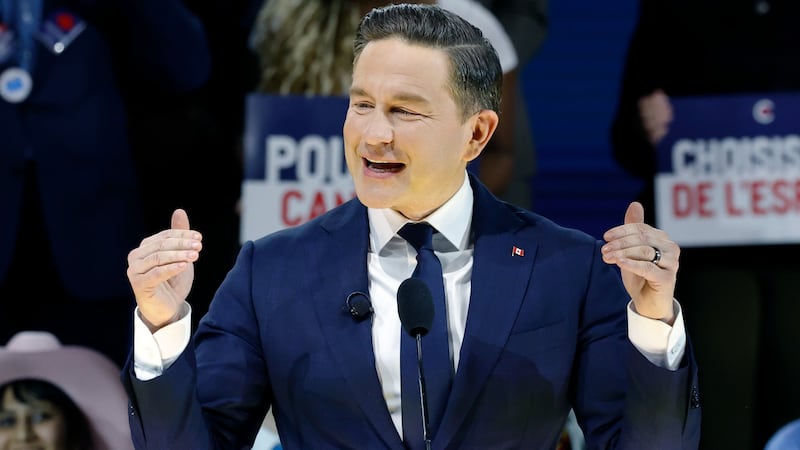
Soudas cited Poilievre’s recent critique of Carney – accusing the prime minister of being “very badly educated on economics” – as something that “just turns caucus off.”
“I think that the Conservative caucus has spent enough time asking what needs to change,” Soudas said. “The harder question, the one that actually leads to power, is who needs to change?”
Though, when asked on Parliament Hill about the byelection results, Conservative MPs who stopped to take reporters’ questions were defiant.
“I 100 per cent support Pierre,” said Conservative MP Ben Lobb. “He’s trying to do the right things.”
“He’s awesome. He’s fantastic. He’s well informed, he has the experience, he’s on top of the issues, he cares about Canadians, and he’s saying all the right things that Canadians need to hear,” said Conservative MP Costas Menegakis. “When he becomes prime minister, you’ll see a different government here that will deliver real results.”
“One hundred forty members in our caucus who continue to support and believe in Pierre Poilievre’s leadership,” said Conservative MP Michael Barrett.
Byelections ‘a report card’: Nanos
Nanos said that while caution is needed in projecting byelection results onto the broader country – in part because turnout is rarely comparable – it’s fair to consider them a report card on parties’ internal abilities to motivate and mobilize voters.
The fact of the matter is that all the parties have to be accountable for how they performed internally,” Nanos said.
Asked Tuesday if he was Poilievre, if he’d quit today, Carney was caught off guard.
“That’s an unfair question,” he said, laughing. “I can’t look into the heart of Mr. Poilievre. I respect him as a parliamentarian, as I do the other leaders of the other of the parties.”
Caney said he will “continue to work with him and all parliamentarians, as will my colleagues, to advance the interests of Canadians.”
Opportunity for the NDP
It was a slightly better night for the NDP. While support for Avi Lewis’ party slipped 2.1 per cent in Quebec, the New Democrats’ vote share was up in both Ontario ridings. In University-Rosedale, the NDP candidate placed second.
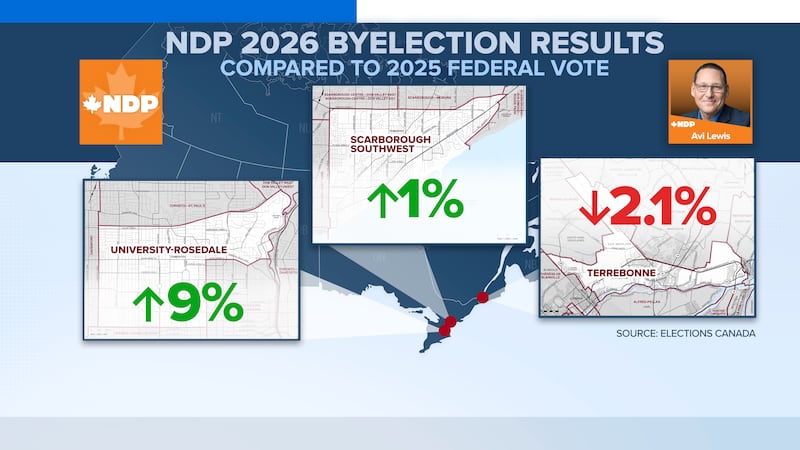
“I thought that was good news for them, especially considering they just have a new leader. The new leader is not in the House of Commons, so a bit of a glimmer of hope for the New Democrats in terms of the results from the byelections,” Nanos said.
Erin Morrison, who was former NDP leader Jagmeet Singh’s chief of staff said the takeaway for the party – based on the two Ontario ridings – was that more progressive Canadians “are feeling some discomfort with where Mark Carney is at and looking to support a more progressive option in the NDP.”
She said based on the byelection results, Lewis should start strategizing the NDP’s path back to 40 to 50 seats, to start.
“That means looking at seats like University-Rosedale and being dissatisfied with that 18 to 20 per cent range. He’s going to have to push that up,” she said.
Morrison said with the left end of the political spectrum “wide open” for the NDP, Lewis should double-down on his focus on cost of living and working-class issues.
Echoing this, Singh’s former communications director Melanie Richer said the challenge now will be to continue to do so “in a way that Pierre Poilievre has been successful in doing, but taking some of that wind away from him.”
“I think that it’s a massive opportunity for the NDP under Avi to say, ‘if you want the government to worry about regular folks, we’re the party to do that’ in a time where Mark Carney is focused on industry and focused on our economy,” Richer said.
“And at a time where Pierre Poilievre doesn’t really seem to know what he’s focused on.”
Correction
A graphic in this article has been updated to correct the NDP voting results in University—Rosedale.

