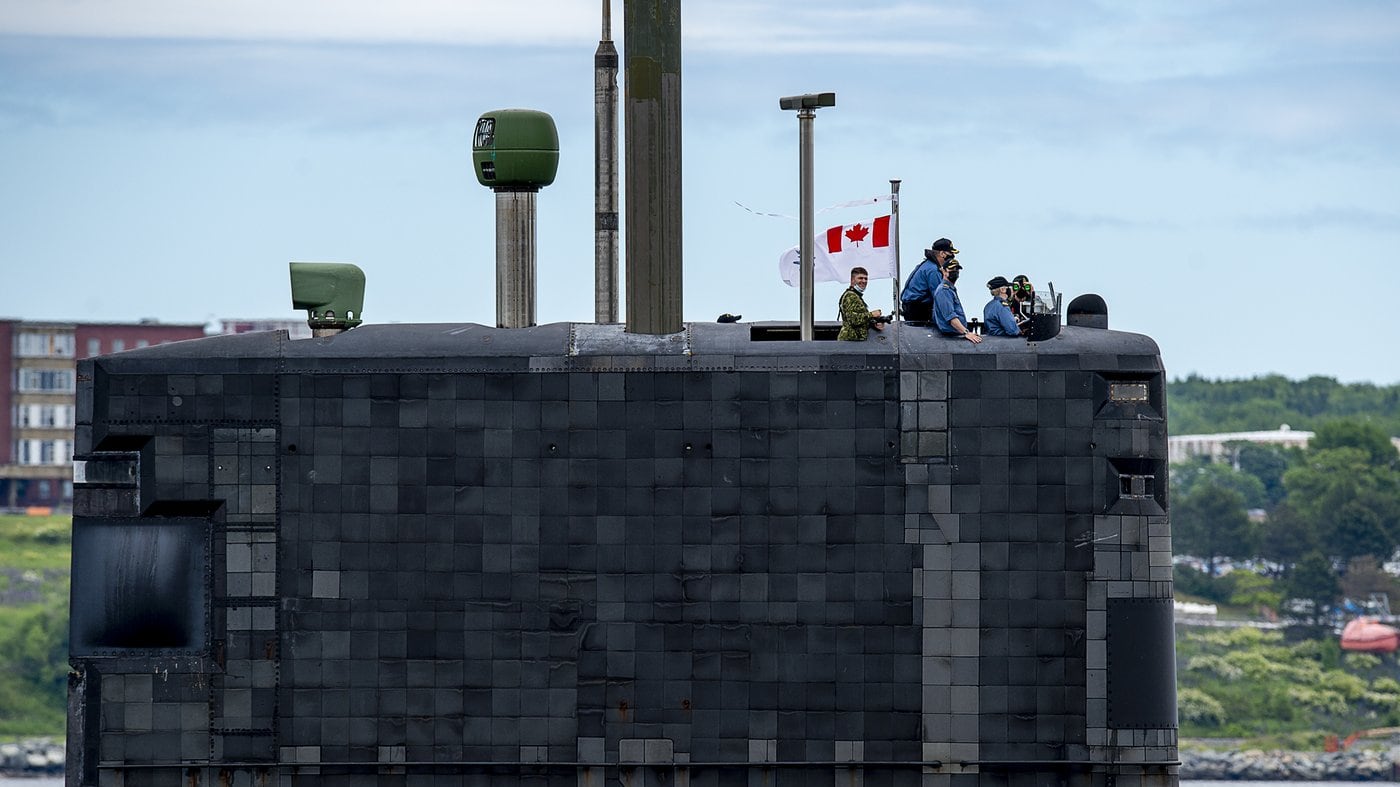
OTTAWA — The federal government has awarded Babcock Canada a six-year extension of its servicing contract for the Royal Canadian Navy’s Victoria-class submarines.
The contract is valued at $1.1 billion and includes options to extend in-service support through to the end of the current fleet’s life as the navy transitions to new submarines.
Canada’s fleet of four Victoria submarines is expected to be retired in the mid-2030s and replaced by a new fleet of up to 12 conventional submarines.
The servicing contract, which represents a significant portion of the firm’s revenue, indicates that Canada will continue to maintain the Victoria class subs, which are approaching 40 years in age, until their modern replacements arrive.
Babcock Canada CEO Tony March said Monday the transition period between the old subs and the new Type 212CD submarines Canada plans to buy is a critical one.
“I’ve been around the business long enough to remember the transition from the Oberon to the Victoria class in the late 1990s to early 2000s, and it was really challenging. There was a gap, there was a loss of capability, there was a standup of an industrial capability,” he said.
“Having that consistency and that transition of the existing workforce and maintaining that skill set across that bridge over about the next decade is really important. This contract award, this extension, helps maintain that expertise.”
Prime Minister Mark Carney announced earlier this month that Canada’s preferred bidder for its next fleet of subs is a German-Norwegian partnership.
Carney has said German shipbuilder TKMS could supply Canada with as many as four of its 212CD submarines by 2034. Ottawa will enter into contract negotiations with the shipbuilder and is looking to get a deal signed by the end of 2027.
Babcock has ties to the South Korean shipbuilder Hanwha, TKMS’s rival for the Canadian sub contract. It had an agreement with Hanwha to service its boats if it won the competition, while Babcock International makes the weapons handling systems for Hanwha’s KSS-III submarine.
The federal government wants to develop a domestic sustainment program for its future fleet of subs and March said his firm is eager to supply that service.
Submarines are among the most complex assets governments own and maintaining the Victorias is no easy task, March said.
The Victorias are sometimes referred to as an “orphan class” — a type of vessel other governments no longer use and suppliers no longer support with replacement parts.
March said his firm’s specialist workforce of hundreds conducts structural support work to ensure the Victoria-class boats remain safe and seaworthy.
“We’re replacing tons and tons and tons of structural steel and it’s not straightforward work,” he said.
March said there’s no manual explaining how to carry out some of the more complex repairs, such as re-skinning the hull.
“It takes more and more effort the older and older it gets,” he said. ”It’s like having an old car. It takes a lot more work to keep it safe and on the road.”
One of the Victorias, the HMCS Corner Brook, recently deployed for joint naval exercises in the Pacific with allies.
It’s taking part in the world’s largest international maritime warfare exercise, a biennial event known as the Rim of the Pacific or RIMPAC. That exercise runs in the waters off Hawaii until the end of the month.
This report by The Canadian Press was first published July 19, 2026.

