


Ontario Economic Development, Job Creation and Trade Minister Vic Fedeli says Prime Minister Mark Carney’s trade deal with China is a “mess.”
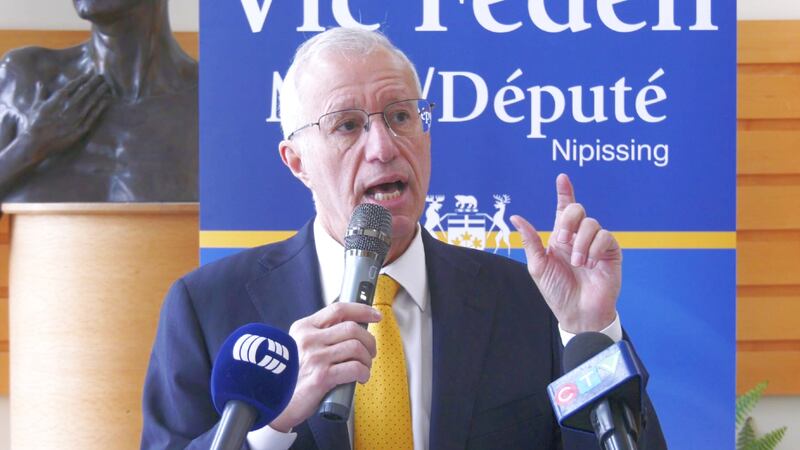
Speaking to reporters in North Bay, Ont., Friday morning, Fedeli said allowing electric vehicles made in China into Canada is “a horrific mistake.”
“Instead of bringing in cars that are made with no environmental concerns, cars that are made with no employment standards, they’re bringing those cars in here when they should be focusing on helping the Ontario car makers,” he said.
Carney said Friday he had secured a “preliminary, but landmark” trade agreement with Chinese President Xi Jinping, aimed at ending a tariff war.
Ontario will feel the pain
Under the agreement, Canada will allow up to 49,000 Chinese EVs in the country yearly at a tariff rate of 6.1 per cent, down from the current 100 per cent.
Fedeli said that workers at Ontario’s auto plants, already under attack by U.S. tariffs, will feel the pain in the long haul.
“They should be working with us to make more and build more here in Ontario, not bringing in cheap Chinese electric vehicles,” he said.
Ontario Premier Doug Ford also warned of the risk to Canadian auto workers. But Saskatchewan Premier Scott Moe, whose province was hurt by Chinese tariffs, praised the deal as a win for exporters.
The agreement restores access to one of Canada’s most important export markets. China is the second-largest buyer of Canadian canola after the U.S., and the world’s largest market for peas.
Diversifying trade
Fedeli said he has also been working to diversify trade away from the U.S., which launched a trade war with Canada and other countries since U.S. President Donald Trump took office.
“I travelled to 20 countries last year, bringing in new trade,” Fedeli said.
“We had 409 international companies land here, bring $40 billion worth of new work and hiring 24,711 people. So we are being successful in diverting the trade, except for the fact that we do $500 billion with the U.S. in two-way trade, which is more than $1 billion a day.”
Rather than allowing Chinese cars into the Canadian market, he said Carney should be working to bring “investment and jobs to assembly plant factory floors here at home.”
The prime minister framed the deal as the beginning of a broader strategic partnership that also includes expanding tourism, cultural ties and a commitment from China to allow visa-free travel for Canadians.
Good for farmers
The changes are especially significant for Canada’s farm sector. China is expected to cut tariffs on Canadian canola seed to 15 per cent from as high as 84 per cent by March 1.
Chinese “anti-discrimination” tariffs on Canadian canola meal, lobster, crabs, and peas will be lifted from March through at least the end of the year, though canola oil will remain subject to a 100 per cent tariff.
In exchange, Ottawa is opening limited space for Chinese EVs in the Canadian market.
Carney said half the imported vehicles will be priced under $35,000 by 2030 to improve affordability and stressed the 49,000-vehicle cap nearly matches pre-tariff levels, which represents less than three per cent of the domestic auto market.
Trump weighed in Friday, saying Carney is doing “what he should be doing.
“Well, it’s OK,” Trump told reporters at the White House.
“If you can get a deal with China, you should do that.”

