The Ontario government will cut the number of trustees at the Toronto District School Board (TDSB) nearly in half and create new non-elected executive roles as part of a bill aimed at overhauling school governance in the province.
The legislation, which was tabled at Queen’s Park on Monday afternoon, addresses alleged financial mismanagement at school boards across the province, according to ministry officials.
Eight school boards, including the TDSB, were previously placed under provincial supervision and their elected trustees were suspended due to their governance issues. Those boards remain under the government’s control and the legislation does not say when, or if, those trustees will regain their powers.
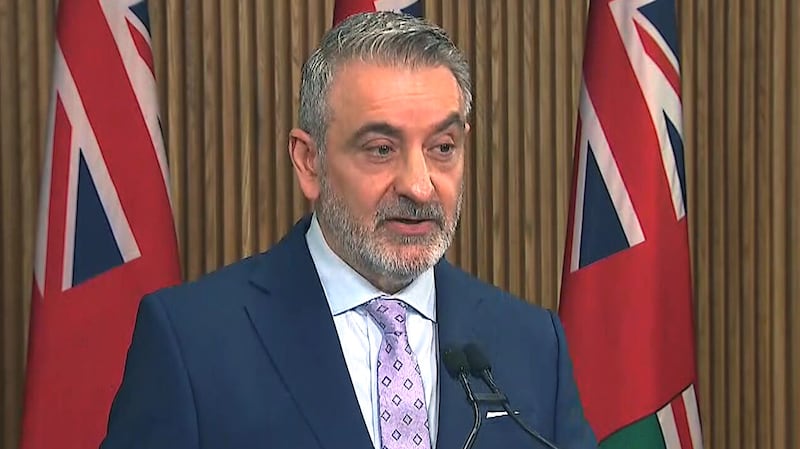
“I wanted to make sure we removed the distractions that come from trustees from the system so the new roles of a trustee will be significantly reduced from what it was before,” Education Minister Paul Calandra said at a news conference following the tabling of the bill.
“Vastly reducing their ability to disrupt the system, vastly reducing their ability to cause division in the system and refocusing them on what I am hearing, which is advocating on behalf of parents in the system.”
Dubbed the Putting Student Achievement First Act, Calandra teased last week that the proposed changes revealed today would be “significant.”
Here’s what’s included in the proposed legislation:
Number of trustees to be limited
If passed, the bill would reduce the number of elected trustees at boards in Ontario to 12, while also limiting their discretionary expenses and capping honorariums at $10,000.
The ministry notes that the Toronto District School Board currently has 22 trustees, making it the only board to be affected by the change. Those trustees remain suspended while under provincial supervision, however a fall election will still take place, the province confirmed.
Calandra added that boards with fewer than 12 trustees will be capped at that number.
“So if you have five trustees, you will have five trustees. This isn’t a move to increase the amount of trustees, it is a move to reduce Toronto’s amount of trustees and freezing the amount in every other board,” he said.
Calandra went on to say that while the legislation changes the role of a trustee “dramatically,” he could “refocus” the position further, if necessary.
“To be clear I will not hesitate to continue to look at the role of trustees should more refinement be needed.”
New executive roles announced
To strengthen school board finances and governance, the province has created two new roles.
The director of education would be known as the chief executive officer (CEO) of a school board and would be required to have a background in business.
The CEO would lead budget development and refer spending measures that can’t be agreed upon by trustees to the education minister for a final decision.
“The trustees will have an opportunity to weigh in on the financial side, but the CEO will be responsible for developing a budget and delivering a budget to the board,” Calandra explained. “Trustees will have the ability to weigh in on the CEO’s proposed budget, they will have the ability to make suggestions and they will have the ability to say ‘yes’ or ‘no’ but not make changes to that budget.”
“If they choose not to support the budget they can refer to the Minister of Education who will make the final determination on the budget.”
Trustees would keep the authority to hire a CEO, but would require approval from the minister to terminate them.
The province would also introduce a Chief Education Officer (CEdO), a person with a background in education and member of the Ontario College of Teachers or equivalent, to focus on advancing student achievement.
The CEO can also serve as the CEdO if qualified in both areas.
The CEO would be a non-voting member at Ontario school boards and would be required to provide confirmation on certain trustee resolutions, specifically those with financial implications, for them to take effect.
The changes would not impact French-language boards.
Curriculum changes
The province is also proposing changes that students will see in the classroom, including grading attendance.
If passed, the legislation would make participation and attendance worth 15 per cent for grades 9 and 10 and 10 per cent for grades 11 and 12. Students who miss class for an excused absence, illness or religious observance will not be negatively impacted.
Speaking on attendance, Calandra said he has seen absenteeism “creeping up” before the COVID-19 pandemic, and has yet to return to normal levels.
“I hear from teachers that this causes a lot of challenges in the classroom when a student is coming in and out of the classroom. There is no consistency in that. The old system, 100 per cent of that mark in some instances was based on course work. A student did not need to participate. This is an important change. It absolutely reflects what teachers and high school teachers have told me would help them get better management of their classroom and would help prepare their students for the real world,” he said.
Monday’s bill would also introduce mandatory written exams on official exam days, while providing greater clarity on how students’ final marks are calculated.
The province says it will mandate the use of approved resources in classrooms in Ontario to cut down on inconsistencies. Those materials include lesson plans, student materials, and assessment tools.
Limiting school board communications
Because the province says that some school boards and trustees are using their platform to discuss divisive political issues which are outside the scope of school operations, the bill would allow the minister to issue policies and guidelines to govern school communications.
The government said that the rules would only apply to those communicating as representatives of the school board and would not extend to trustees or other elected officials issuing public comments as a private individual.
Changes to capital project delivery
Due to budget overruns, delays and complications in delivering capital projects, the province says it will strengthen the minister of education’s ability to oversee, redirect or even cancel projects when necessary.
Beyond that, the minister will have the power to intervene by selecting a third party to take control of the project without putting the entire board under supervision.
Streamlining the bargaining process
Also included in the bill is a proposal to simplify the way collective agreements are negotiated.
As it stands, the four trustees’ associations negotiate on behalf of school boards in provincewide labour talks, making them the final decision makers in the process.
The legislation suggests naming the Council of Ontario Directors of Education (CODE) as the central bargaining agency to streamline the process for provincewide negotiations.
In the context of local bargaining, CEOs would ratify local agreements.
Union says bill amounts to ‘troubling corporatization’ of education system
In a statement released following the tabling of the bill, the Ontario Secondary School Teachers’ Federation (OSSTF) said that changes to education governance will not address what it called the “real issues” in schools, including rising violence, growing class sizes and chronic underfunding.
“Let’s be clear—replacing directors with CEOs with no experience in education or shifting governance structures doesn’t change who actually makes the decisions,” OSSTF president Martha Hradowy said.
The union, which represents 60,000 members across Ontario, said that move specifically “signals a troubling corporatization of public education at a time when they would be expected to lead central bargaining.”
In its own statement, the Elementary Teachers Federation of Ontario (ETFO) said it “rejects” the legislation entirely, calling it an “unprecedented rollback of local democracy.”
“While the Ford government ultimately rejected Minister Calandra’s initial plan to eliminate all democratically elected trustees — a reversal achieved through months of sustained advocacy by ETFO and its education partners — this legislation removes the essential powers trustees need to genuinely represent families and students,” ETFO president David Mastin said.
Opposition parties also slammed the government’s proposed legislation Monday.
“This bill does nothing to reduce class sizes, nothing to fund special education, and nothing to support student mental health,” Interim Liberal Leader John Fraser said in a statement. “
This is supervision by another name. For the last nine months, we have watched this minister override communities, talk down to teachers, and go on one long power trip. This legislation doubles down on that approach.”
NDP Education Critic Chandra Pasma called the legislation “a power grab” that would shut parents and communities out of schools.
“By further controlling appointments, budgets, and restricting what trustees can even discuss, this government is centralizing decision-making in Queen’s Park and sidelining local voices,” Pasma said in a statement.

