A group representing parents of children with autism says something has to be done to improve dismal waitlist numbers—and they’re targeting what they’re calling a “make-work project” for the private company administering the system.
Alina Cameron of the Ontario Autism Coalition (OAC) said lengthy annual interviews to determine the care needs for every child in the system aren’t necessary when many children’s care needs don’t change—and that’s a huge amount of resources.
“We’ve been asking for them to pull back and not have this as an annual process, thereby opening up more determination of need slots for children to come off the waitlist,” Cameron said.
Ontario’s Ministry of Children, Community and Social Services said in a statement that it’s trying to tackle the length and the scheduling times for annual interviews, known as “Determination of Need” interviews.
“We continue to explore a range of initiatives aimed at streamlining processes for families enrolled in OAP core clinical services, reducing burden and improving the overall family experience,” said Julia Lombardo, the issues and communications advisor for the ministry.
New figures obtained by the OAC and by public sector union OPSEU show the proportion of waitlisted kids getting core clinical services has dropped this March to 22.98 per cent, or fewer than one in four.
In the March data, 89,799 kids were registered on the waitlist, while 24,360 were enrolled to get core clinical services, and 20,633 had signed a funding agreement.
That puts the waitlist at 69,166 kids, the organization says, projecting that wait times are upwards of five years long.
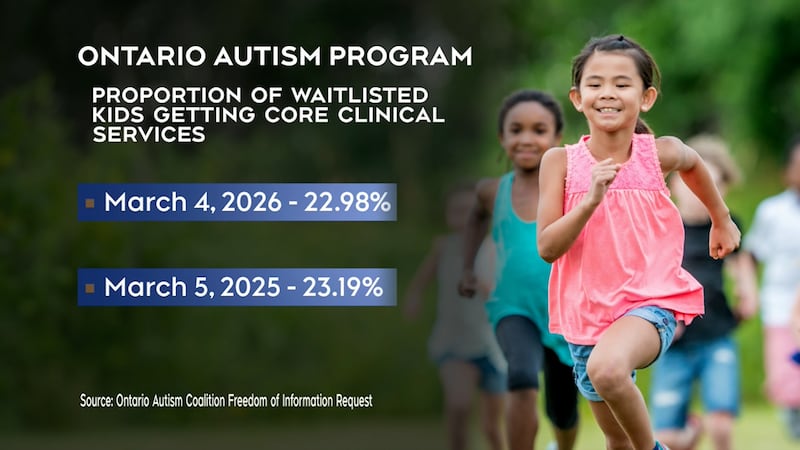
The numbers are worse than the March 2025 figures, which were 23.19 per cent, Cameron said, despite a funding injection by the provincial government of about $180 million this year.
“It always stays around 23 per cent,” Cameron said. “So we’re assuming most of that money goes to administration.”
Meanwhile, each child in the program and their family must do what’s called a “Determination of Needs” interview, which an internal ministry briefing note from 2023 said took on average two to three hours, but as long as four to five hours each.
Parent Danielle Weil was happy to find her eight-year-old child Emme was able to get off the waitlist recently. Emme has cystic fibrosis and autism.
She said it was great news, because it would provide the Weils relief from the $20,000 a year they’re spending privately.
But Emme’s other two sisters who also have autism are still on the waitlist, Weil said.
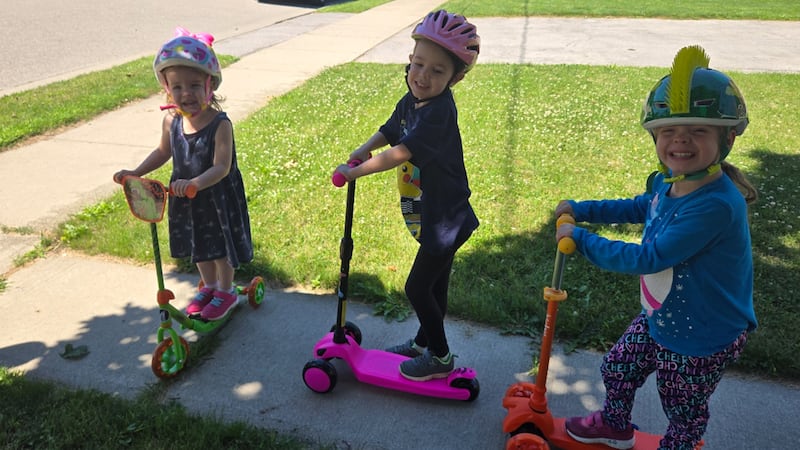
“It’s exhausting, frustrating, and just seems like one barrier after another is put up,” Weil said, likening the annual interviews of children in care already to a “make-work project.”
The reports say Accerta, the company that administers the program, fell short of its target enrolment by about 5,000 children and youth in 2024.
The company’s headquarters was recently the site of protests by striking members of OPSEU.
The union’s report says the company’s payments from Ontario tripled to more than $670 million in 2024, among three private-sector managers of public services whose payments surged past $1 billion.
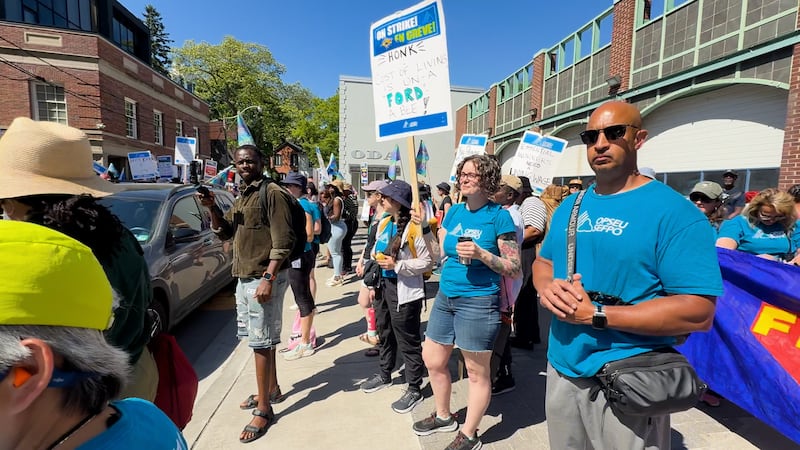
“The question we have for this government is, are you renewing that contract, or are you actually going to take that money and reinvest it in the front lines directly where it belongs?” OPSEU President JP Hornick said in an interview.
Accerta stands by its program, telling CTV News in a statement that it’s a Canadian-owned and operated social enterprise that has a long history of helping governments run public programs efficiently.
“We provide specialized expertise and modern technology that helps distribute public funds for critical social services to those who need them most as quickly and efficiently as possible. The funding associated with the programs we administer flows directly to eligible beneficiaries based on contractual terms,” said VP Operations and External Affairs Rose Sottile in a statement.
The provincial government said its funding of the Ontario Autism Program has topped $1 billion this year and pointed out that all registered families, even those on the waitlists, have access to foundational family services, urgent response services, caregiver-mediated early years programs, and entry to school programs.
“Under this government, the number of children in core clinical services has tripled, and we expanded Core Clinical Services to include applied behaviour analysis (ABA), occupational therapy, mental health supports, and speech-language pathology,” Lombardo said.

