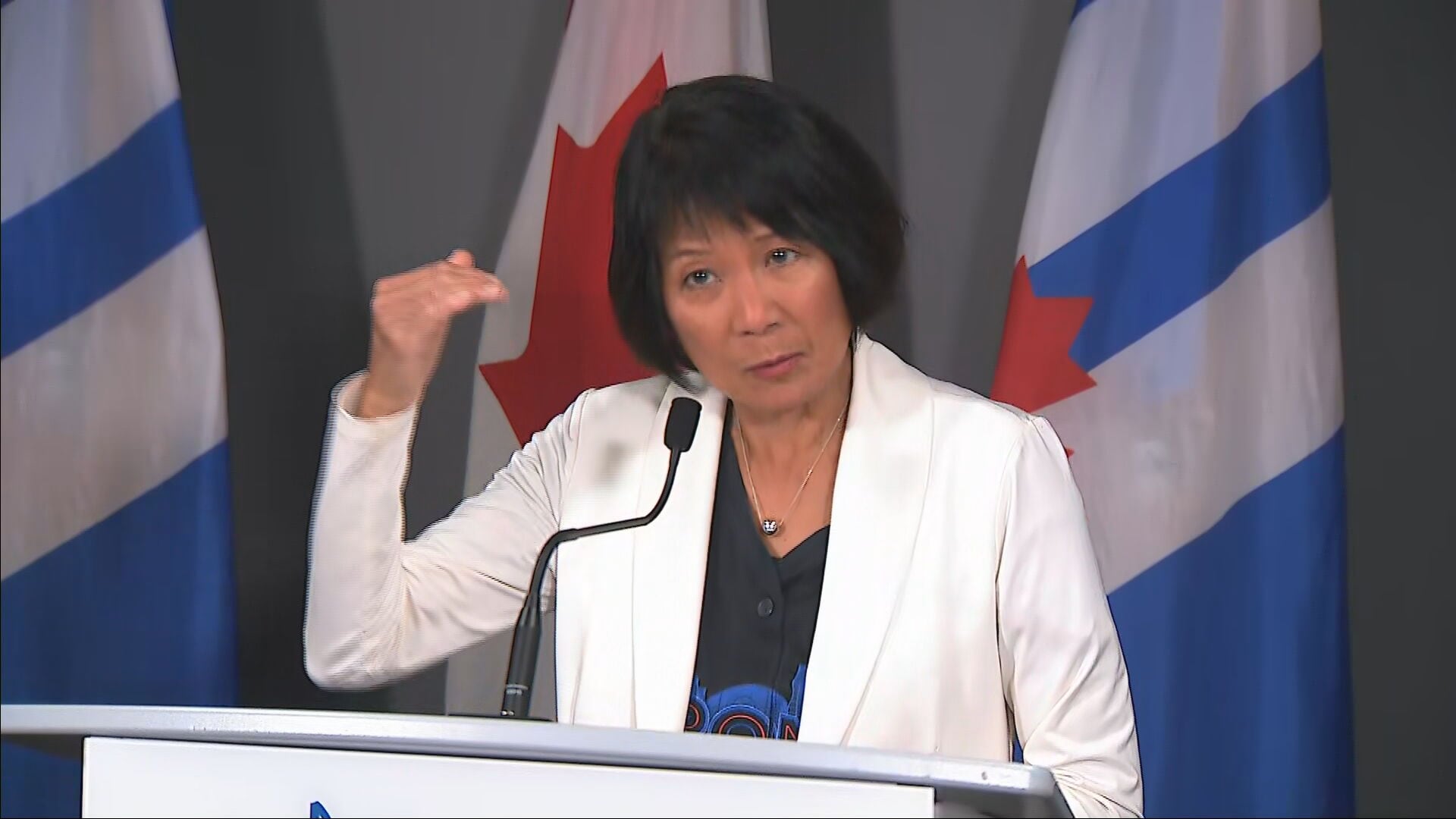
Toronto Mayor Olivia Chow is warning that Toronto residents could see a bump in their taxes to account for shelter costs, or see more people living on the streets, if the federal government doesn’t provide more cash for asylum seekers coming to the city.
In a news conference ahead of a meeting of her executive committee Monday, Chow said the city’s reserve funds are depleted.
“Because they (the federal government) haven’t been paying their bills, we’ve been taking money from the reserve funds in order to continue the services to shelter these refugee claimants,” Chow said.
She added that the city doesn’t want to see unhoused people in parks and ravines, but will face a choice between cutting services and asking taxpayers for more if the money doesn’t come from elsewhere.
“We can either stop sheltering refugees claimants, leave them on the street, which will make homelessness worse, reversing the progress we made on reducing the number of encampments, or Torontonians will have to pay for it through their property taxes,” Chow said. “Neither is fair. So the government, the federal government, must fulfill its responsibility, which is taking care of refugees and refugees claimants.”
Asked how much the city would need to raise property taxes, Chow said it would take an “at least two per cent” property tax hike to raise the extra money, an idea the city would explore through its upcoming budget process.
In further comments in a post on X Monday evening, Chow seemed to reject the idea of raising taxes to make up the shortfall.
“As Mayor, I refuse to ask Toronto’s taxpayers to cover the cost of the federal government’s cuts to shelters,” she wrote. “The federal government is leaving Toronto on the hook for $107 million in costs for city shelters accommodating asylum seekers. Cutting funding means more people will be living on the street and in parks. This is clearly federal jurisdiction, don’t download these costs to Toronto.”
A report before the executive committee today says city staff are projecting an unfavourable year-end operating variance of $105.4 million, mainly due to lower-than-expected funding from the federal Interim Housing Assistance Program (IHAP), a federal program that provides funding to municipalities to manage the downstream impact of asylum claimants.
City to get less through two programs
In a letter, Chow is asking council to make a request for the federal government to provide $107 million for 2025-2026 to support housing costs for refugee claimants and asylum seekers already in the city’s emergency shelter system.
She said the city is also facing another funding hurdle for next year, with the province saying Toronto will get just $7.95 million in 2026 through the Canada-Ontario Housing Benefit (COHB). The rent-supplement program is jointly funded by the provincial and federal governments and helps get people into housing. The less-than-$8 million figure for next year compares to $19.75 million in 2025 and $38 million in 2024.
Chow said the city will have spent its existing funding by October, meaning it will be unable to continue moving people from shelters to housing just as the weather gets cold.
“I know that both levels of government, including ours, all three levels of government, want to do the right thing, because Toronto and Canada has a history of settling newcomers, and we’ve done well because of it,” Chow said.
In a statement, a spokesperson for Ontario Minister of Municipal Affairs and Housing Rob Flack said the decrease in Toronto’s COHB share is due to a federal decision.
“Funding from the province, through the Canada-Ontario Housing Benefit (COHB), including for Toronto, is calculated each year through a standard formula - that formula is unchanged, and our investment remains whole,” the statement read.
“This year, the federal government made the decision to not provide Toronto with a top-up in funding which they have received for the last two years.”
Flak’s office pointed out that no household currently receiving COHB support will lose funding if they remain eligible.
The statement added that COHB has provided $78.1 million “to help 8,000 people find a safe, affordable place to call home” so far, while Toronto has received $19.9 million through another program, the Ontario Priorities Housing Initiative (OPHI).
Last month, Chow said she learned Toronto would only receive 26 per cent of its expected costs to shelter refugees and asylum seekers through IHAP. At the time, she said the lower funding amounted to “a cut.”
In a statement to CP24 last month, Immigration Refugees and Citizenship Canada (IRCC) said it has provided municipalities with $1.5 billion to offset the costs of shelter refugees and asylum claimants since 2017, including nearly $670 million to the City of Toronto.
Responding to Chow’s comments Monday, IRCC said there was “significant interest” in the IHAP program “with funding requests exceeding the funds allocated to the program.
“Grant amounts were largely based on the information applicants provided about their demonstrated need, cost-effectiveness, and the expected results of their projects.”
The ministry said it made it clear last year that program criteria would be adjusted “to reflect a renewed focus on helping partners develop more sustainable and cost-effective long-term housing solutions.”
“While IHAP initially focused on short-term emergency measures, the renewed IHAP model prioritizes cost-effective, sustainable solutions and long-term capacity building across Canada,” IRCC said. “These include building reception centres and providing sustainable temporary housing solutions.
The ministry said the move would reduce costs and improve outcomes for claimants.
‘Recipe for disaster’: advocates
The mayor previously had success wrangling more money from the feds to deal with asylum seekers sleeping on the streets of Toronto when the issue came to a head in 2023, when Toronto stopped admitting asylum seekers to its shelter system.
The crisis at the time led to the opening of a new welcome centre for refugees and asylum seekers near Pearson International Airport in Peel Region.
But the issue has continued to plague the GTA, with municipalities saying their shelter systems have been stretched to the limits.
Local civic group Progress Toronto held a protest at city hall Monday morning, echoing Chow’s call for the federal government to bolster both the IHAP and COHB programs, calling the funding reductions “a recipe for disaster” similar to that seen outside the Peter Street intake centre two years ago.
“We call on all levels of government to work together to ensure no one is left outdoors. The Canadian government must acknowledge its responsibility to cities and take immediate action to address the growing crisis of homelessness—a national human rights issue,” the group said in a statement.
They said they support Chow’s letter and further demanded that the federal government cover 95 per cent of the costs of sheltering refugees, claimants, and asylum seekers; remove the 90-day maximum shelter stay limit; and establish a coordinated refugee resettlement response so cities are not left to deal with the problem.
With files from Joanna Lavoie
Editor’s Note: This story has been updated to include further statements later provided by Chow, as well the federal and provincial governments.

