


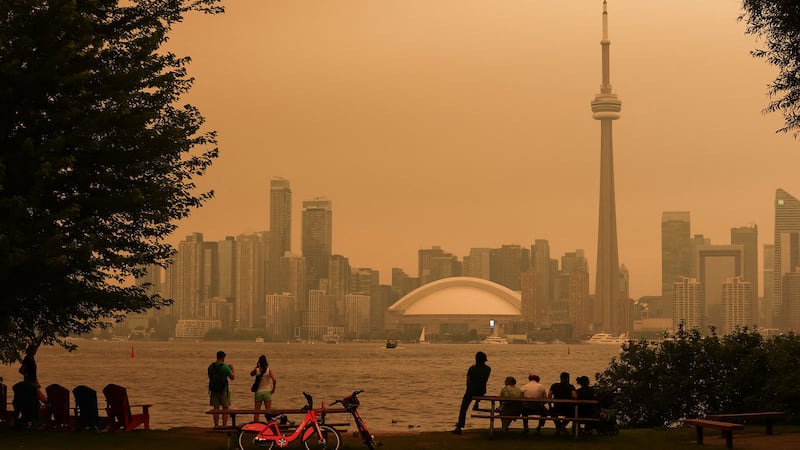
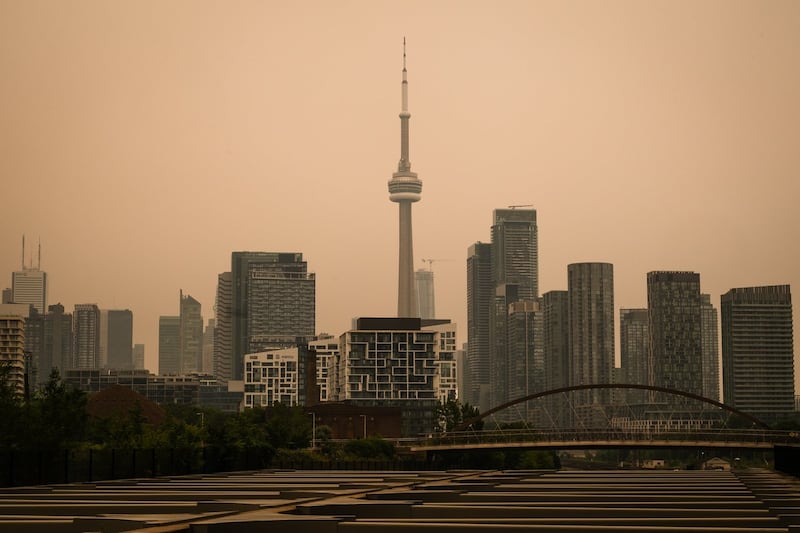
An orange haze washed over Toronto’s skyline on Wednesday as wildfire smoke drifted into the region, leaving Toronto with some of the worst air quality in the world on Wednesday.
An air quality warning, an orange alert, is in effect for the city as smoke from forest fires in northwestern Ontario moves south.
Key details:
- Toronto has been ranked among the worst in the world for air quality by IQAir
- The city is under an air quality warning, orange alert
- Some outdoor programming has been cancelled due to the smoke. Here’s a full list.
- The hazy conditions are expected to last until Friday
Here are the key developments on Wednesday:
8:06 p.m. - City of Toronto provides update on camps
The city says all of its outdoor pools and wading pools will be closed tomorrow, July 16.
Meanwhile, CampTO programs will be running with outdoor activities moved indoors. Field trips are cancelled.
The city adds other outdoor registered programming tomorrow will either be cancelled, postponed, or moved indoors where possible.
City-run child care centres will remain open and operate indoors.
7:45 p.m. - Outdoor concert proceeds
A concert at RBC Amphitheatre, an outdoor venue along the waterfront, is going ahead despite the air quality warning.
CP24 spoke to some fans of the band Muse, which is holding the concert.
“I was a little disappointed that it wasn’t (cancelled) but also really glad that it wasn’t because when do you get a chance to listen to this great band?” one fan said.
Another fan said he is confident concert attendees will be fine amid the conditions.
Some fans shared that they brought a mask in case the conditions deteriorate. CP24 caught fans arriving at the venue wearing N95 masks.
“We’ll maybe use those if it gets too tough for us,” one fan said.
7:14 p.m. - Thursday forecast
According to Environment Canada, it will be a mix of sun and cloud tomorrow with “widespread smoke becoming local smoke” in the morning. The daytime high will be 29 with a humidex of 33.
5:45 p.m. - Ford posts video on Ontario’s wildfires
In a video posted on social media, Ontario Premier Doug Ford addressed the ongoing wildfires in the province, pointing out that his government has 156 fire crews and nearly 150 water bombers and helicopters working to extinguish them.
“Our government will not spare a penny to keep people safe,” Ford said, proceeding to tout his government’s investment in forest firefighting, such as adding new personnel and adding new water bombers and helicopters.
He also acknowledged the help the province is getting from Alberta and Yukon. The premier also recognized those who are helping displaced residents.
“I’m encouraged by the compassion and the care we’ve seen from people across the province who are opening their communities to their fellow Ontarians who have been forced to evacuate as a result of these fires,” the premier said.
“I promise that our government will continue to do everything we can to protect people and communities across Ontario.”
The Ontario Liberal Party criticized the Ford government on Wednesday for underspending on emergency forest firefighting. The party said Ontario budgeted only $150 million this year, after spending $271 million last year. The province had initially planned to spend $135 million on fighting forest fires in 2025-2026.
“A realistic base budget would allow the ministry to recruit and retain crews, maintain aircraft, secure equipment, and prepare evacuations before communities are threatened, rather than scrambling once fires are burning and families are being forced from their homes,” Ted Hsu, the Ontario Liberal critic for Rural Affairs, Natural Resources, Mining & Forestry, said in a statement.
“The North will come together, as it always does, but its resilience cannot excuse a government that failed to prepare. Protecting Ontario means protecting all of Ontario, with enough crews, equipment and funding in place before the next emergency.”
4:43 p.m. - U.S. ambassador to Canada releases statement on wildfires
Pete Hoekstra, the U.S. ambassador to Canada, says responding to wildfires demands a “shared response” from both countries.
He noted that smoke has reached the U.S., including over his home state of Michigan.
“I commend the outstanding cooperation between the United States and Canada as we confront these fires together. Our two governments are monitoring and sharing information in real time – coordination that reflects our partnership at its best," Hoekstra said in a statement.
“This challenge knows no borders. The United States will continue to coordinate closely with Canada, just as we have for more than four decades of shared wildfire emergencies.”
In New York, Gov. Kathy Hochul urged residents to take precautions as an air quality health advisory is in effect.
New York City Mayor Zohran Mamdani also posted about the deteriorating air quality due to the wildfire smoke.
“Poor air quality affects everyone, but some people are more sensitive to it than others, including people with heart or lung conditions, older adults, pregnant New Yorkers, and infants and children,” the mayor posted on social media.
4:25 p.m. - Environment Canada meteorologist gives update
Brian Proctor, a meteorologist with Environment Canada, says much of the province is now covered in smoke, and he expects more areas could be impacted.
“In general, it’s expanding at this point and extending further and further and spreading across more of southern Ontario as we move through the evening into the overnight tonight,” he tells CP24.
Proctor says the smoke has limited the “incoming solar radiation” and helped the temperature, which is why the heat warning has ended.
3:45p.m. – York University prof discusses ways to mitigate poor air quality
The polluted air that blanketed the GTHA on Wednesday has greatly impacted the way people go about their lives, but there are ways to mitigate it, says a York University professor.
Eric Kennedy, a professor of disaster and emergency preparedness, said instead of riding his bike to work on Wednesday, he opted to take the TTC and wear a mask. He also shortened his dog walks this morning.
“The smoke brings health consequences for everyone. You know, folks who are vulnerable face increased consequences, but there’s no such thing as good smoke, even if you are quote-unquote healthy, try to minimize the exposure,” he urged.
Kennedy said individuals can protect themselves from the smoke particulate by installing a good-quality air filter on their central air system and making sure the fan is running well.
“Augment that as well by adding air purifiers around your house. That’s another way to keep the particulate matter down and help improve the quality of what you’re breathing in,” he said.
Those who go outside in these kinds of conditions should wear a “well-fit, high-quality mask” to reduce their exposure to particulates in the air, he said.

Kennedy said there are myriad things that can also be done on a societal level.
“We need to make sure, for example, that there are clean air shelters available for folks who might not have air conditioning at home and need a cool and safe place to be or might be unhoused. We can look at things like that distribution of air conditioning across our society, because those folks who are faced with the challenge of keeping cool or keeping air clean right now,” he said
“That’s a really tricky situation. And so, making sure that people have the ability to deal with this combined heat smoke event is critical.”
Governments, added Kennedy, can do their part by improving air quality in public places, notably schools and businesses in public buildings.
“We need to make sure that there is good indoor air quality, and that helps year-round with things. It helps in the summer with the smoke events we’re experiencing. It also helps in the winter with virus transmission, and so it’s a real sort of win-win and benefit for everyone,” he said.
On a larger scale, Kennedy said managing smoke comes from better fire management in the first place.
“This involves investing more money and resources into mitigation. How do we prepare the landscapes so that they’re able to more resiliently handle fire? And how do we make sure that our communities are well protected and resilient in the face of these fire events?” he said.
“It’s very easy to think about this in terms of response once it’s happening, but that mitigation and preparedness work—whether it’s for preventing fires in the first place or reducing their impacts, or whether it’s getting ready for smoke—mitigation and preparedness are critical.”
Joanna Lavoie, journalist, CP24.com
3:27 p.m. - Heat warning lifted
A heat warning for Toronto that’s been in place since Sunday has ended, Environment Canada says.
The air quality warning remains in effect. Environment Canada says air quality conditions may improve Friday morning.
3:23 p.m. - Temporary fire ban in Ajax
The Ajax Fire and Emergency Services (AFES) says a temporary fire ban is now in effect, which means all outdoor open-air burning is prohibited. They include recreational fires, fire pits, chimineas, and other outdoor wood-burning appliances.
AFES notes that all existing burn permits are suspended until the ban is lifted.
“The current weather conditions significantly increase the risk of fires starting and spreading rapidly,” Kaitlyn Moss, Ajax’s public educator, said in a statement.
“We’re asking everyone to do their part by respecting the fire ban and using extra caution with any activity that could create sparks or open flames. A single preventable fire can have serious consequences for our community.”
3:14 p.m. - Family doctor sees more patients with breathing difficulties
Air quality and heat warnings can have significant health impacts, especially for vulnerable populations like the unhoused, the elderly, and children.
Dr. Ashley Sebastian, a family physician from Brampton, speaks to CTV News Toronto about the challenges posed by extreme heat coupled with poor air quality.
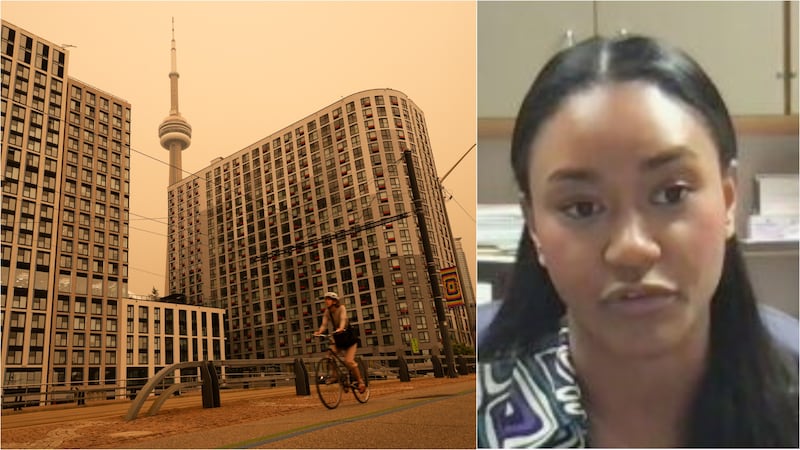
“It’s a bit of a challenge with the air quality and the heat. It poses a serious challenge for some of our patients. Most of our vulnerable population, those who are unhoused, the elderly, the children can see some adverse effects, including exacerbations in asthma, for example,” she said.
“So, we need to pay very close attention to this, and if you do need help, seek help at your local emergency department, if you can, or visit your family doctor.”
Sebastian says she’s seen a lot more patients coming in with breathing difficulties on Wednesday.
“Particularly, some cases in my office with the smoke advisories. Protecting yourself is important,” she said.
Joanna Lavoie, journalist, CP24.com
2:53 p.m. - Nearly 200 wildfires burning in northern Ontario
Nearly 200 wildfires are burning in northern Ontario, forcing residents to flee their homes, destroying buildings and sending smoke across much of the province.
A total of 185 active wildland fires—148 in the northwest region and 37 in the northeast region—are burning, according to the province’s latest updates posted Tuesday evening.
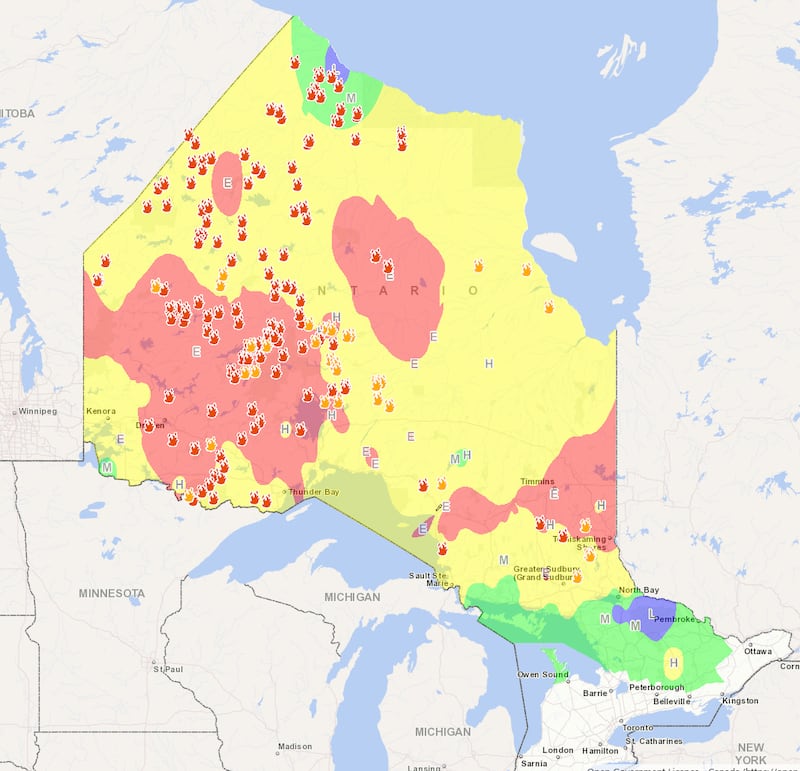
In the northwest, where the majority of the fires are reported, 69 are not under control, while seven blazes are being held and five are under control. Sixty-seven fires are being observed, and four were called out Tuesday.
Meanwhile, in the northeast, of the active fires, five are not under control, three are being held, one is under control, and 28 are being observed.
Ethan Morneau, CTVNews.ca national digital producer
2:45 p.m. - Toronto air quality second-worst globally
According to IQAir’s global air quality ranking, the pollution in Toronto is no longer the worst in the world.
The rankings now place Kinshasa, Democratic Republic of the Congo, in the top spot. Toronto is listed at number two.
2:36 p.m. - Wildfire smoke also drifting to New York
Smoke from the wildfire is also affecting residents south of the border. According to the National Weather Service New York, smoke will thicken over the state into tonight, possibly lingering into the end of the week. An air quality alert is in effect across New York state.
1:15 p.m.- Niagara Falls cancels fireworks
Niagara Falls will pause its fireworks program on Wednesday due to air quality advisories in the region, the city says.
12:50 p.m.- Vaughan cancels FIFA event
The City of Vaughan said Wednesday that it will be cancelling today’s Canada Celebrates the FIFA World Cup 2026 semi-final celebration at Assembly Park.
12:20 p.m.- FIFA Fan Festival cancelled, wading pools closed
The City of Toronto says that the air quality warning has prompted officials to cancel today’s FIFA Fan Festival.
“The decision was made to prioritize the health and safety of attendees, as well as police, fire, paramedics, event staff, volunteers and other personnel supporting the event as they would be exposed to air quality conditions for an extended period of time,” the city said in a written statement.
“The cancellation of FIFA Fan Festival Toronto allows emergency services, including Toronto Paramedic Services, Toronto Fire Services and Toronto Police Service, to remain fully available to support public safety needs during the Air Quality Warning.”
The match broadcast at Nathan Phillips Square today has also been scrapped.
The city confirmed that wading pools will be closed for the remainder of the day.
11 a.m.- City modifies outdoor programming
The City of Toronto has confirmed that all outdoor CampTO field trips and registered outdoor programs have been “cancelled, postponed, or moved indoors where possible” today.
9 a.m.- ‘It is intensifying’
Dr. Jeffrey Siegel, a professor with the University of Toronto’s department of Civil and Mineral Engineering, said the health impact to residents in the city, including otherwise healthy individuals, is “very significant.”
“It is intensifying and we are going to have certainly for the rest of today and probably into tomorrow some very unhealthy conditions,” he told CP24’s Courtney Heels.
“Unfortunately, it comes along with the heat wave and so we’ve kind of got a double whammy.”
He said it is unusual for Toronto to take the top spot for worst air quality in the world.
“We’ve seen this increasing in frequency,” he said. “I think this represents something like the new normal.”
8:30 a.m.- Environment Canada issues orange alert
“Poor air quality may persist into Thursday for some areas,” the national weather agency said in its alert.
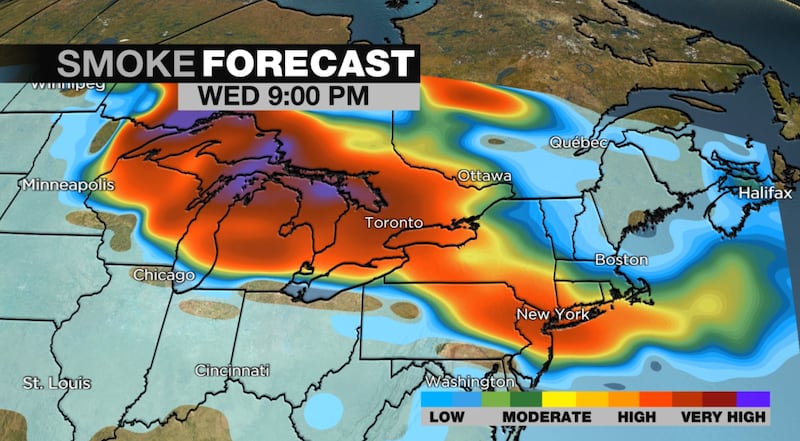
“As smoke levels increase, health risks increase. Limit time outdoors. Consider reducing or rescheduling outdoor sports, activities and events.”
The national weather said smoke may cause mild symptoms, such as eye, nose, and throat irritation, headaches or a mild cough.
“More serious but less common symptoms include wheezing, chest pains or severe cough. If you think you are having a medical emergency, seek immediate medical assistance,” Environment Canada said in its advisory.
Those at greater risk of health issues related to poor air quality include people over the age of 65, pregnant people, infants and young children, and people with existing illness or chronic health conditions.
8:15 a.m.- Heat alert remains in effect
A heat alert remains in effect for Toronto today with the mercury rising to 33 C today, feeling closer to 36 with humidity.
“We are still under that heat dome that stretches from southern portions of Saskatchewan through Manitoba, almost the entire province of Ontario, and into Quebec as well,” Smith said.
Environment Canada notes that the heat and humidity are exacerbating issues with air quality.
“Hot and humid air can also bring deteriorating air quality and can result in the Air Quality Health Index approaching the high-risk category,” the national weather agency said.
“Watch for the early signs of heat exhaustion in yourself and others. Signs may include headache, nausea, dizziness, thirst, dark urine and intense fatigue. Stop your activity and drink water.”
8 a.m.- Toronto air quality ranked worst in the world
As of about 8 a.m. on Wednesday, Toronto’s air quality was ranked the worst in the world, according to IQAir, which tracks global air quality data.
“We have a very smoky start to the day. I know it may look like fog but we are contending with wildfire smoke,” CP24 Weather Specialist Jess Smith said on Wednesday morning.
“It doesn’t get better throughout the day today, unfortunately.”
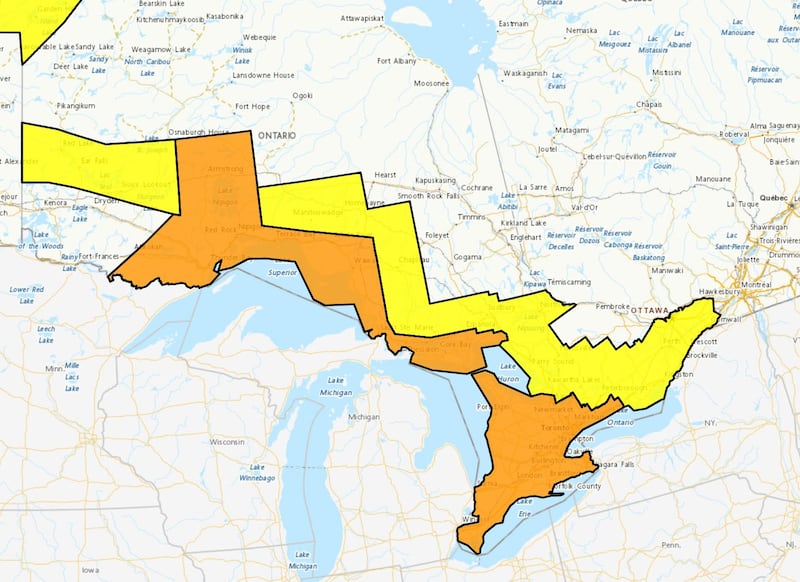
Environment Canada said conditions may improve on Friday.
Share your photos of the wildfire smoke with us by emailing torontonews@bellmedia.ca.

