


The battle over bike lanes in Toronto has emerged as a dividing line between Olivia Chow and Brad Bradford supporters leading into this month’s municipal election, exclusive polling shows.
The revelation was made in a new Nanos Research survey conducted on behalf of CP24 and CTV News about traffic and transportation in Toronto ahead of the municipal election.
Nanos Research surveyed 757 randomly selected Toronto residents between Oct. 8 and Oct. 10 and asked them what the “biggest transportation issue facing Toronto” is.
It found that 46 per cent of respondents see traffic congestion as the city’s greatest inconvenience. That view was shared among Chow and Bradford supporters, as well as across respondents of every borough, gender, and age surveyed.
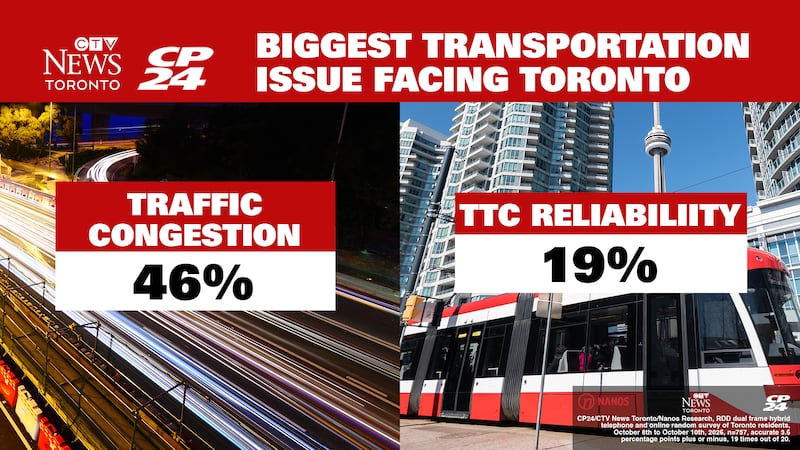
The second-biggest pain point when it comes to getting around Toronto was TTC reliability at 19 per cent. In Scarborough, roughly 23 per cent of respondents identified transit as an issue, the highest share of any borough. Transportation in the east-end district has become a focal point this election cycle, with Chow touting the opening of the Scarborough busway and Bradford pledging to do away with some “redundant” priority bus lanes.
Both Chow and Bradford supporters agreed on transit reliability as the second-place transportation issue facing the city, but a roughly 8.5 per cent gap exists between the two groups, with the former placing a higher emphasis on the issue.
Nine per cent of all respondents said there were too many bike lanes and bike paths, making it the third-biggest problem for people getting around Toronto, according to Nanos Research. However, Chow and Bradford voters remain split on the issue.
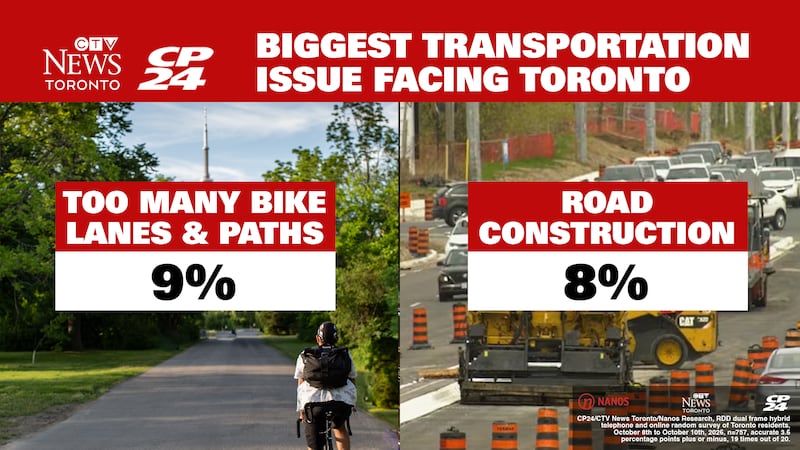
“Bike-lane expansion divides them: 74 per cent of Chow voters support or somewhat support it, while 74 per cent of Bradford voters oppose or somewhat oppose it,” Nik Nanos, Nanos Research chief data scientist, said in a statement.
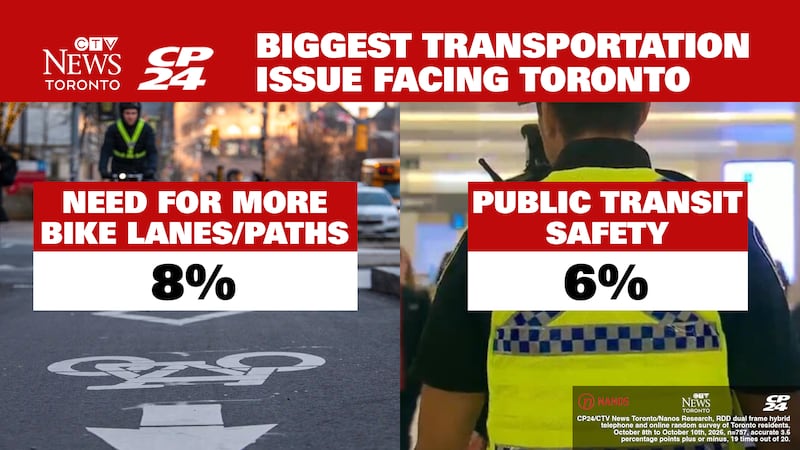
The data also shows that eight per cent of those surveyed said there was a need for more bike lanes and paths, making it the fifth-ranked traffic issue behind road construction.
- How to set CP24 as your preferred source on Google
- How to set CTV News as your preferred source on Google
Respondents were asked who should have the “final say” on bike lane installation in Toronto. A plurality said transportation experts and city staff should be the authority on the file, at 45 per cent. At least 29 per cent said that responsibility should fall to Toronto City Council, while 13 per cent said the Province of Ontario.
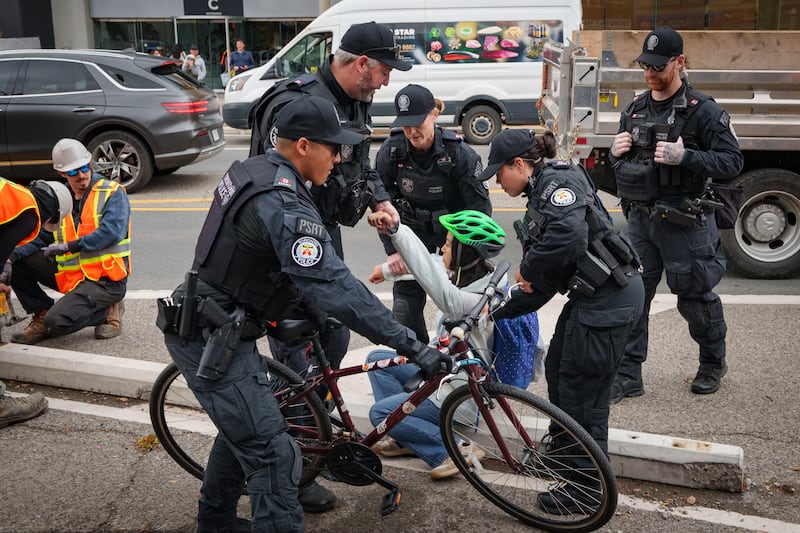
On Tuesday, the province was set to begin tearing out bike lanes on a stretch of Bloor Street West in Etobicoke after an August decision by Ontario’s Court of Appeal ruled that the removal (which also includes bike lanes on Yonge Street and University Avenue) was not a violation of Charter rights, as a lower court previously ruled. However, the province said that work was “halted” by protesters. Those backing the case have now asked the Supreme Court of Canada to weigh in.
Bike lane removal work resumed on Wednesday. Toronto police said two people were arrested at a demonstration protesting the removal.
Chow and Bradford have differing positions on the bike lane file. Bradford has promised to rip out the lanes on Bloor Street West between South Kingsway and Resurrection Road, and redirect cycle traffic to other residential streets and auxiliary roads.
In her capacity as mayor, Chow has continued to expand Toronto’s cycling network but opted to do so by narrowing some existing lanes of traffic rather than removing them outright, as per the legislation passed by the province in 2024 that prohibited municipalities from removing lanes of traffic to install new bike lanes without the approval of the government.
Respondents were also asked what the top priority for transportation investment should be, with 32 per cent of all those surveyed saying the city should fund congestion reduction measures first.
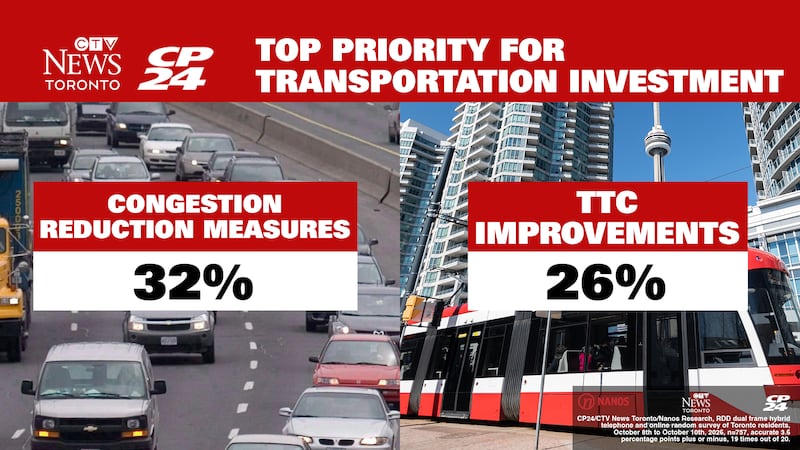
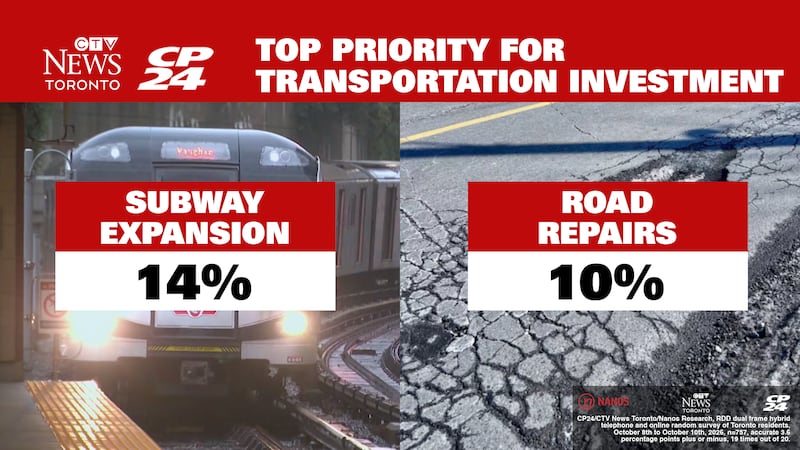
TTC improvements were listed as the second-place priority for transportation investment at 26 per cent, followed by subway expansion and road repairs at 14 per cent and 10 per cent, respectively. For Chow voters, TTC investment is the number one priority at 32 per cent, while Bradford voters favour congestion relief at 37 per cent.
When asked what the city’s top transportation priority should be, 54 per cent said all should be equal priorities and 29 per cent said reducing traffic congestion.
Methodology
The Nanos Research survey was conducted exclusively for CP24 and CTV News Toronto between Oct. 8 and Oct. 10. The survey included 757 randomly selected individuals. Interviews were completed online and by telephone. The survey has a margin of error of plus or minus 3.6 percentage points, 19 times out of 20.
With files from CP24’s Codi Wilson and CTV News Toronto’s Joshua McGinnis

