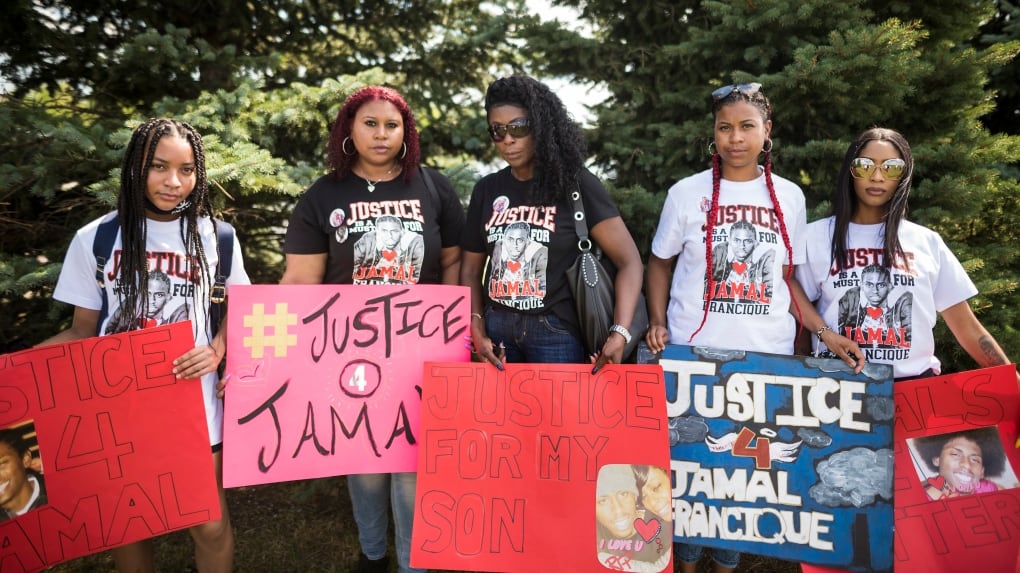
A police officer who shot a Black man in the head during an attempted arrest in Mississauga, Ont., nearly seven years ago told a coroner’s inquest Tuesday that he did not make a conscious decision to open fire but instead acted out of a ‘fight-or-flight’ instinct.
Peel regional police Const. Milan Ivkovic was part of a team of plainclothes officers in unmarked vehicles who sought to arrest Jamal Francique near his home on the evening of Jan. 7, 2020, over an alleged breach of bail conditions.
The inquest has heard officers planned to arrest Francique before he got to his car, but he moved more quickly than expected, and the officer meant to block his car was late.
Francique reversed out of his parking spot and briefly came to a stop, Ivkovic testified. Meanwhile, an unmarked police car pulled up, putting its nose to the vehicle’s bumper, he said.
Ivkovic got out of his car and walked toward Francique’s vehicle, which was still stationary, he said. In that time, another unmarked police car came up behind Francique’s car, and the officer could hear people shouting commands, he said.
As he stepped up onto the curb, Ivkovic saw Francique’s car suddenly reverse and lurch forward, accelerating toward him, he said. The officer said he fired his gun four times “in the area of where a driver would be,” though he couldn’t see a figure inside.
Under cross-examination, a lawyer representing Francique’s father suggested Ivkovic should have known it was “prudent” to move out of the car’s way.
Officers aren’t trained on jumping out of the way, the officer said.
“So there was no decision at that point that I made in my head, there was no moment where I had some deep thoughts and calculations about what the best course of action was. The vehicle lurched towards me and my reaction was a fight-or-flight one,” he said.
Lawyer Sabrina Shillingford noted that Peel police policies prohibit officers from shooting at people in a moving vehicle unless there is an immediate threat of death or grievous bodily harm to police or the public “by means other than the vehicle.”
“That’s information that, given your training, the public would expect you to know, fair?” she asked.
“I don’t know what the public would expect me to know — this is news to me, to be honest with you, that that is in the directive,” Ivkovic replied.
The constable rejected Shillingford’s suggestion that he drew his gun before Francique’s car moved toward him. When Shillingford pointed out that he’d previously testified he couldn’t remember when he took out his gun, Ivkovic said he knew he didn’t have it in hand when he left his car, and the rest played out in a matter of seconds.
“I’m going to suggest to you, sir, that you had other options, including staying in your car until you knew that the Acura that Mr. Francique occupied was off and all movement from the vehicle was contained. Would you agree?” the lawyer asked.
“There’s lots of options that we could have done and ... had I known this was going to transpire, I would not have gotten out of my car,” he said.
“There’s an innumerable number of what-ifs ... I thought Mr. Francique was done. He gave no indication that he was going to put that vehicle in motion until at the very end when he did.”
Francique’s car mounted the curb, narrowly missing Ivkovic, before it made a sharp turn and crashed into a garage, the officer said during his examination in chief. Based on that manoeuvre, he immediately knew the driver was most likely “not OK,” he said.
Jurors have heard Francique, 28, did not receive medical attention until after a police tactical unit arrived and pulled him out the car about 20 minutes later. He died in hospital days later.
The forensic pathologist who conducted the autopsy previously told the inquest the crash did not contribute to Francique’s death, which was caused by a gunshot wound to the head.
Dr. Ashwyn Rajagopalan said he was surprised Francique survived as long as he did, given the severity of his injury.
Ivkovic offered condolences to Francique’s grieving family Tuesday, saying that if he had a magic wand, “none of us would be here today.”
Also on Tuesday, the inquest heard a summary of the evidence of another officer, Const. Carly Houlihan, who said she jumped out of the way of Francique’s car as it drove toward her. When she heard gunshots, Houlihan believed Francique was the one firing, but she learned soon after it was her colleague, the summary said.
Police had been secretly surveilling Francique for days before they tried to arrest him, the inquest has heard. A tip had come in through Crime Stoppers that Francique had a gun and was trafficking drugs, but officers found no evidence to corroborate the tip during their surveillance, so they decided to instead arrest him for allegedly violating house arrest.
Ontario’s police watchdog, the Special Investigations Unit, later cleared the officers of criminal wrongdoing in Francique’s death.
Coroner’s inquests do not assign legal responsibility, though jurors may make recommendations aimed at preventing similar deaths.
This report by The Canadian Press was first published Nov. 24, 2026.
Paola Loriggio, The Canadian Press

