Paul MacMillan scoured Airbnb listings to help his daughter find the right accommodations for her upcoming weekend trip to Toronto, where she would spend a few nights reconnecting with friends she made while studying abroad in Australia.
He came across one room that he said looked like a nice spot to stay somewhere near her friend’s place downtown, in the area of Spadina Avenue and Dundas Street West.
“I looked at the photos, and they looked amazing,” MacMillan, of Ottawa, said in an interview with CTV News Toronto.
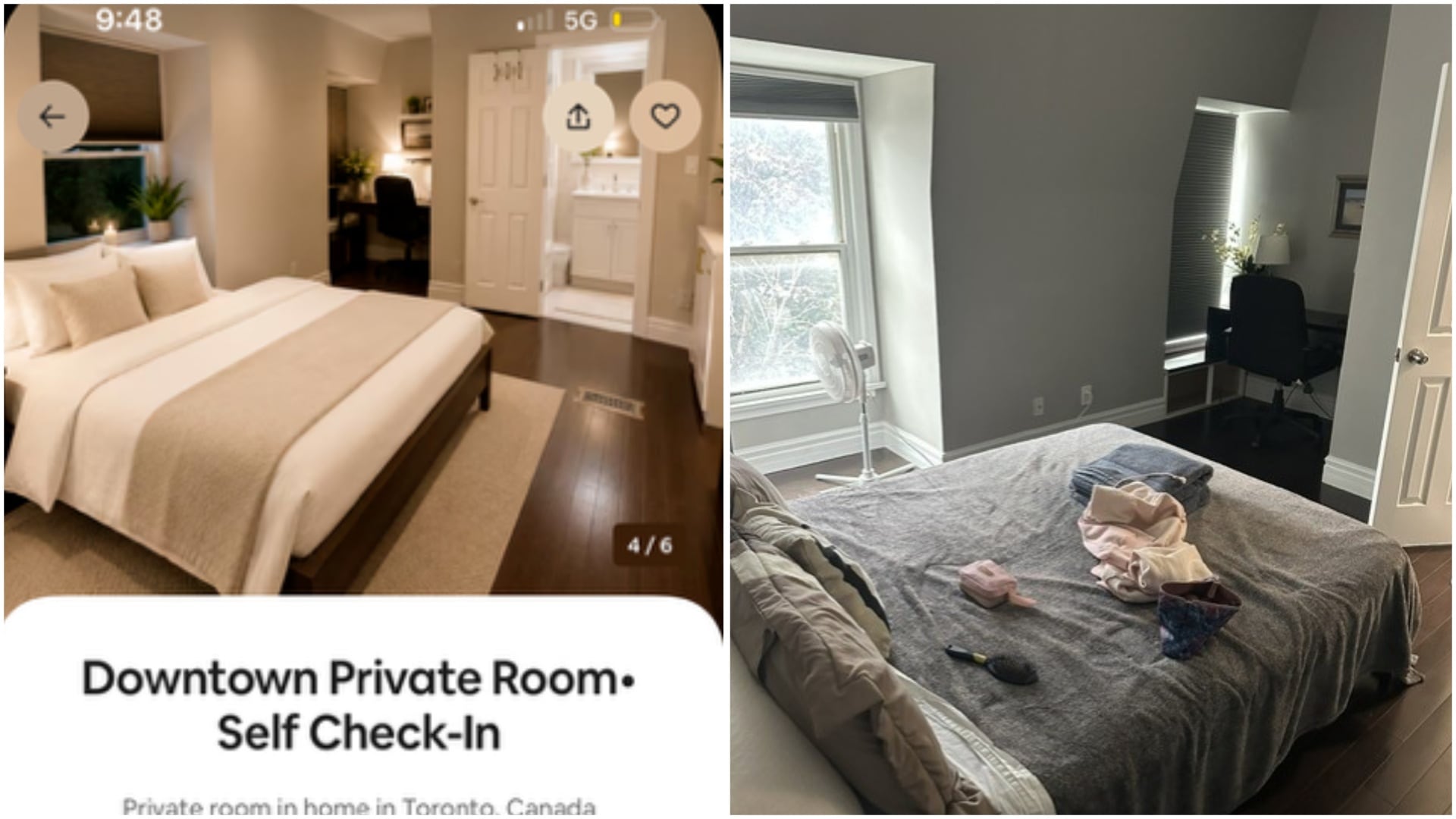
In images reviewed by CTV News, the photos posted on Airbnb displayed a room filled with warm lighting and houseplants. What appeared to be a full-sized bed was made with crisp new linens and an assortment of decorative pillows and a grey Persian rug underneath, covering the dark wooden floor. The bathroom also appeared modern with brushed brass or golden fixtures and an illuminated mirror.
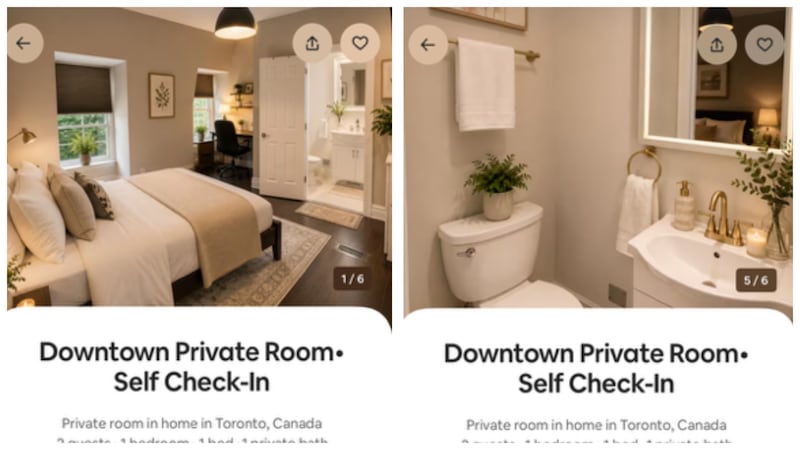
“It looked like it had just been renovated and someone had put some good money into it,” Christine MacMillan, Paul’s wife, said.
Their daughter agreed and she booked the unit for herself for a three-night stay starting June 15. It cost $616 in total, which was far below the average seen in Toronto during the height of the 2026 FIFA World Cup.
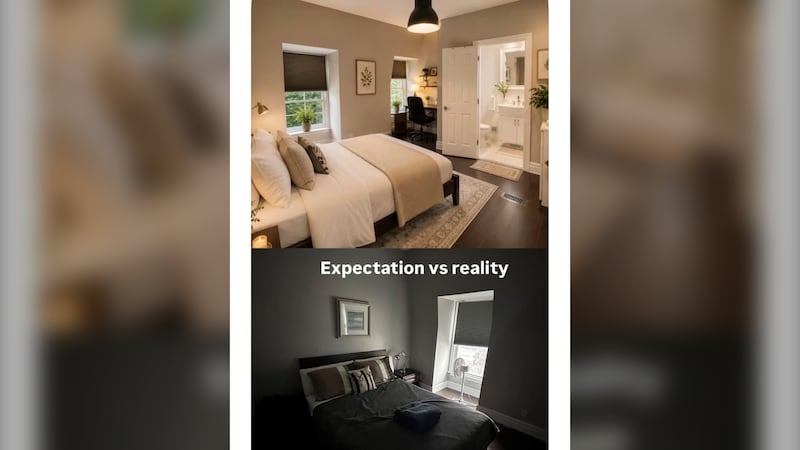
When their daughter arrived, however, the MacMillans said her expectation of what the room would look like did not meet the reality of what it actually was. She sent them photos of the room almost immediately.
“We thought she was joking,” he said.
“These pictures don’t depict at all what we … booked on Airbnb. So, we’re pretty well sure these were AI-generated photos.”
The photographs the MacMillans shared with CTV News Toronto reveal a different version of the room they thought they had booked.
Some of the differences could be chalked up to redecorating the room since the photos were taken—like the removal of the rug, all the plants and botanical artwork—but the bathroom was notably different. Instead of the golden-hued sink, there was a flag silver faucet with twistable translucent handles.
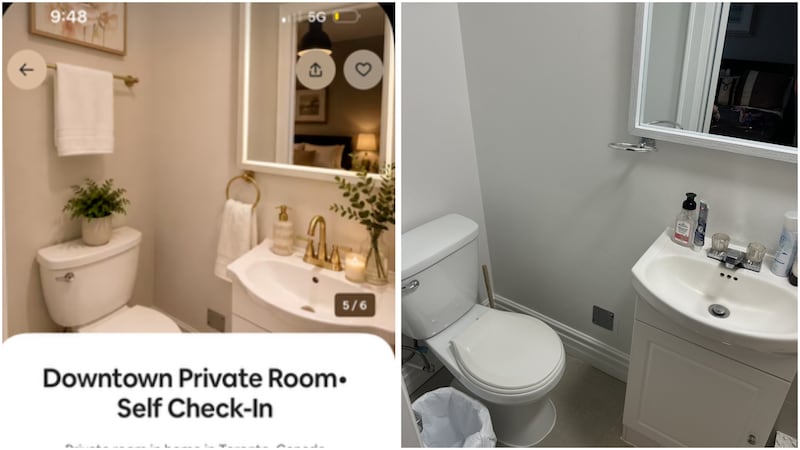
“The bathroom, well … they’ve done what real estate agents do when they sell an empty house, but they will AI-generate what a room can look like,” Christine MacMillan said.
Realtor weights in
Shion Guha, an assistant professor in the faculty of information at the University of Toronto and director of the Human-Centered Data Science Lab, said there are discernable differences between the two sets of images of the listing.
“The lighting looks perfect, almost as if somebody had set up a little studio light that’s just out of sight of the camera,” Guha said of the images that were posted in the Airbnb ad, commenting how the reflection of the light from the bedside table’s lamp casts a strange shadow.
This kind of shadow could happen in reality, Guha said, but noted how artificial intelligence tends to create “studio perfect” images.
“You can tell from the images that you shared that there do have appeared some types of touch-ups. Now, whether that’s AI or not AI, that’s hard to say, but it could very well be,” he said.
While the room’s aesthetics paled miserably to the MacMillans’ expectations, they said it also did not uphold safety standards.
Their daughter stayed in one room of many that was available to rent, they said, and one night the key to her room’s door got jammed in the lock, prompting her to leave it sticking out of the outer door’s handle overnight.
Complaint filed with Airbnb
They say they waited until their daughter returned home to file a complaint with Airbnb. Partly because the MacMillans couldn’t file the complaint themselves since they weren’t the ones who booked the place, and partly because their daughter wanted to wait until she was home.
When they did contact the booking platform, Christine MacMillan said Airbnb did not express any concern.
“Are you not concerned that there’s these AI images out there,” she said.
“They’re your client, you’re using them to advertise to your Airbnb customers … It was no concern for that.”
When reached for comment, a spokesperson for Airbnb confirmed they noticed the images from the listing did not match what the unit actually looked like. However, the platform did not definitively say whether AI was used in anyway to enhance the photographs.
Airbnb’s policies require hosts to provide photos and a description that accurately represent the space provided to their guests. In its policies, the booking platform says it will ask hosts to remove content if AI (or other digital technology) had been used to edit flaws, hide damage, or add anything that is not part of the listing that could otherwise misrepresent what the unit looks like.
“While this type of experience is rare, we understand how frustrating it can be when a listing does not meet expectations, and we have fully refunded the guest for their booking and suspended the listing while it is reviewed,” the Airbnb spokesperson said in an emailed statement.
The MacMillans said they eventually received their full refund of $616, contrary to being told they wouldn’t be compensated for service fees and taxes.
“Very pleased with the refund but again, a shame that they were not too concerned originally with a customer being misled by AI images provided by one of their hosts and took going to the media to receive a refund,” Christine MacMillan said.
How to spot AI
More and more industries are incorporating artificial intelligence in their work, and Guha says the real estate industry is one of them.
Realtors tend to use AI-generated furniture to virtually stage homes, he says, noting how they will typically disclose its use.
But artificial intelligence is reaching a point where it is becoming more challenging for the average person to discern, Guha says.
“There are legitimate uses, but what has happened is that generative AI tools have kind of crossed the line from being expensive and skilled to cheap and effortless,” he said.
“Somebody who’s wanting to scam other people on Airbnb can now make a very convincingly misleading photo with absolutely no skill at all.”
Kaushar Mahetaji, a PhD candidate at the Faculty of Information at the University of Toronto, says it can be challenging to detect if artificial intelligence is used, but there are some methods that can work.
Mahetaji says to inspect the photos for potential signs of warped edges, stairs that don’t lead anywhere, lights or reflections that are off, or incorrect details, like misspelled text on books or power outlets that are incorrect for the region. Since hosts tend to upload several photos for their listing, She says checking for consistency among photos could help too.
“Airbnb strips away a lot of metadata, but usually with images it would tell you … that this image was taken with this particular camera,” Mahetaji said.
Guha, meanwhile, recommends looking at how the listing itself, analyzing how it was written, considering how many reviews there are and how long the Airbnb has been operational. The biggest red flag, in Guha’s view, is whether the host lists their name or not.
“Most of the times, like in the picture that you shared, it says Downtown Private Toronto Self-Check-In. Now, self check-in is not rare in the Airbnb world, but these are the types of things that I would be very, very careful about, especially if you look at who’s hosting it,” he said.
In the MacMillans’ listing, it said Warm Downtown Suite was hosting the unit. Guha says that is more of a placeholder.
“Most Airbnbs actually put their real names there and you can look at years of reviews and other things, but if I was looking at this on a mobile phone screen and I saw this was hosted by Warm Downtown Suite, immediately alarm bells would go off in my mind,” he said.
Lack of regulations
Guha says the use of AI does not need to be banned outright, but that regulations need to be in place to prevent misrepresentation in the marketplace.
“Platform regulation is really important, this type of governance regime has not been set up in Canada and the problem is structural,” he said. “Why is it an individual’s problem?”
In Guha’s view, there should be governance over the disclosure of AI use.
“The problem is that the undisclosed versions and the text is used to misrepresent the real space, so we need to kind of fix those disclosures, like it’s really the governance that’s an issue,” he said.
California recently introduced a consumer protection bill that requires realtors, landlords and brokers to disclose if any image attached to a property has been digitally altered in any way as a measure to prevent prospective renters and buyers from being misled.
“Deceptive advertising in Canada generally falls under the Competition Act and the Competition Bureau,” Stephen Thiele, a partner at Gardiner Roberts LLP, said in an interview.
“There’s no doubt that (when) you enter into an agreement, when you make a booking, you’ve got a contract, and if the property isn’t what has been described on the Airbnb site ... you’ve got a breach of contract claim.”
While Canada has the Competition Act, which contains provisions over the use of deepfake technology for deceptive marketing, Thiele says regulations like the ones in California specifically should be explored locally.
“I’m not aware of Ontario’s Consumer Protection Act covering this kind of trade practice, but certainly somebody that uses AI to show photographs that misrepresent the property or misrepresent the unit ... I think there’s room to cover that in consumer protection statutes,” he said.

