


The smoke-choked skies blanketing Toronto this week may be a glimpse of what’s to come, as experts say warmer weather and drier forests are making wildfire smoke a more frequent visitor, though the conditions may differ each summer.
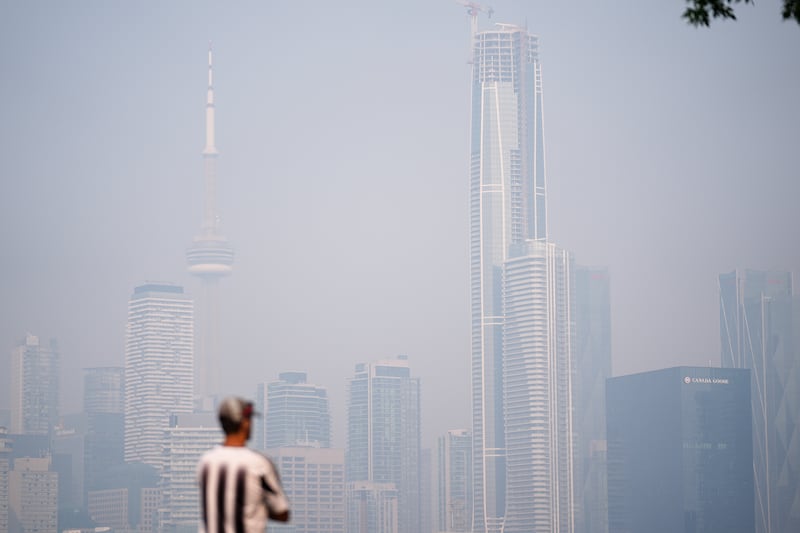
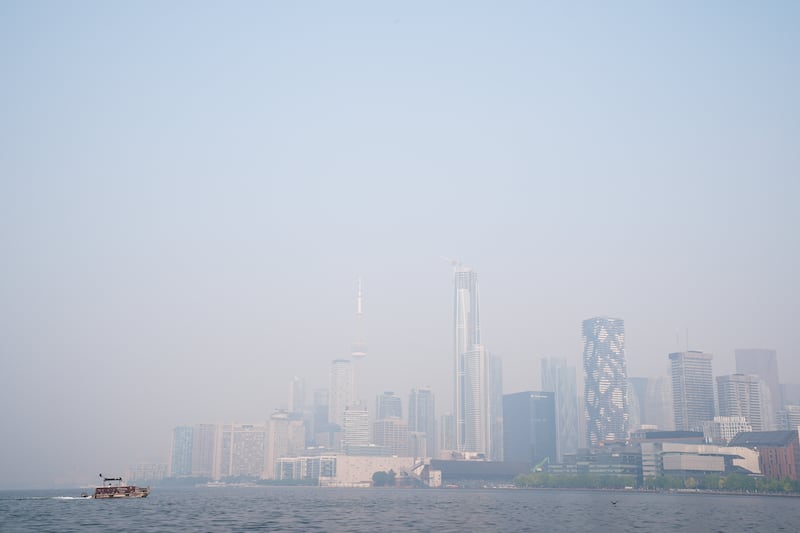
Dozens of wildfires are actively blazing through northern Ontario, with flames and smoke forcing many locals to evacuate their homes. The smoke billowed south this week, tinging Toronto’s skies with a yellowish hue and deteriorating the city’s air quality to a point where it was one of the most polluted in the world.
It wasn’t the first time in recent years where Toronto briefly recorded the world’s worst air quality, as last year’s wildfires in northern Ontario and the Prairies pushed Environment Canada to classify the city’s air quality index as “high risk” then.
Climate change to blame for hazy skies: scientist
Mike Wotton, a research scientist with the Canadian Forest Service, says Toronto has seen more hazy skies in the last five years due to forest fires than in the previous 20 years.
When asked why the city sees smoggier skies every summer, Wotton says it is what was predicted with climate change.
“There’s probably multiple facets in terms of answering that, but we are seeing warmer summers overall, and I think you see that on the news globally. You see that we keep breaking global temperature records,” he said in an interview.
Just this past week Toronto broke a temperature record, where Tuesday saw a high of 35.9 C near Pearson airport, feeling more like 45 with the humidity. The hottest July 14 on record was more than 30 years ago in 1995, when the temperature rose to 36.8 C.
“The warmer you are, the drier your forest fuels are getting, essentially,” Wotton said.
Forest fuels are all burnable materials, from underground roots to treetop branches.
The drying effects from a drought can carry over from year to year, he explains, so when there is a lack of moisture, the forest fuels can burn, produce more smoke or create fires that are harder to suppress. Wotton pointed to the fast-spreading forest fires that engulfed parts of the Kawartha Lakes last year as an example, where 27 hectares (about the size of 50 football fields) of land burned following damage from a winter ice storm.
“That was unusual,” Wotton said.
“There was an area of drought there in this part of southern Ontario that carried over through the winter, actually, and so coming into the spring, it was like, ‘Oh, there’s still this pocket of drought here.’”
‘Becoming more normal’
In Greg Evans’s view, summer wildfires are “becoming more normal” and more Canadians across the country are seeing how climate change is increasing the number of wildfires.
“We’re also becoming familiar with the increased incidence of extreme temperatures and how this is linked to climate change,” Evans, an engineering professor at the University of Toronto and director of the Southern Ontario Centre for Atmospheric Aerosol Research, said in an interview with CTV News Toronto.
“This, to my recollection, is the first time we’ve had them occur simultaneously and give us a double whammy or one-two punch, which (has) really raised awareness of how prepared we are to deal with these types of incidents in the future.”
Tanzina Mohsin, an associate professor of climatology at the University of Toronto, says it cannot be said for certain whether this will be Toronto’s new normal as the severity of wildfire season depends on several variables, pointing to the temperature and the direction the wind blows as a couple of factors.
“I can say that Toronto and much of Ontario should prepare for wildfire, smoke, and hazy skies that could be recurring this summer,” she said in an interview.
“This does not mean every summer will resemble the same situation, however. Wildfire seasons usually tend to last longer when you have warmer weather and all those other factors or mechanisms.”
It’s a question, Mohsin says, she considers every forest fire season: is it going to last longer? The professor says a warmer spring would cause the snow to melt earlier, drying the vegetation sooner.
Looking at what happens in the springtime can help gauge what kind of wildfire season is coming
“These are the things that we have to keep monitoring, and these are the things that would give us information about how to take preventive measures for coming years, or even a next fire coming in this summer event,” she said.
What are the health impacts?
With the amount of particulate matter seen in Toronto’s air this week, Evans says even with buildings with proper insulation and good filtration systems, the pollution can still seep in.
A warning preparedness meteorologist with Environment Canada told CTV News Toronto that Thursday saw a measurement of PM 2.5 (fine particulate matter) at 296 micrograms per metre cubed, which was about five times worse than what was seen in the city on Wednesday.
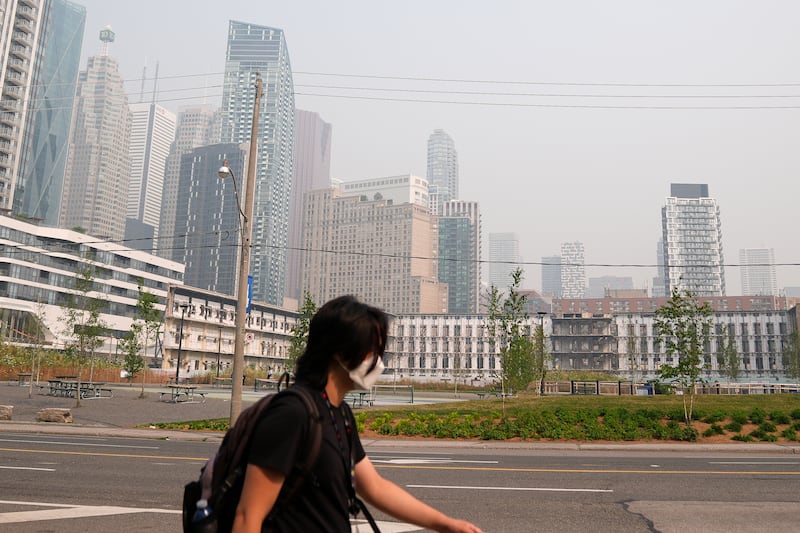
Evans says about a third of that particulate matter could seep into well-ventilated buildings, which is why he recommends keeping all windows and doors closed, and even masking indoors. Mohsin says wearing a mask like an N-95 is best, and advises staying up to date with Environment Canada’s AQHI index.
“Other tips are that if you happen to have a central heat and air conditioning system, there’s a filter in there, and if you turn your fan on to run continuously, that’ll make the best use of that filter,” he said.
When the concentration of particulate matter is too high, Evans says a person’s defence system gets overwhelmed, and it can lead to inflammation.
“When we take a deep breath, we inhale a number of particles. These particles get onto the surface of our lungs. There, our body’s immune system cuts in, and antioxidants try to fight off the oxidative potential of these particles,” Evans aid.
Prolonged exposure to high concentrations of air pollution can impact a person’s respiratory and cardiac systems, creating neurodegenerative and cognitive side effects. He adds that the more people are exposed to fine particulate matter, the more vulnerable they become to illness.
“That’s not as applicable for a day like (Thursday) or the few days we’re having, where it’s very high for a short amount of time,” Evans said. Looking at this week, he says there is a higher risk of seeing acute effects like asthma attacks, strokes, or heart attacks.
With files from CTV News Toronto’s Phil Tsekouras

