Toronto is seeing the return of summer’s least-welcome visitors: mosquitoes.
As their unwelcome buzz hums again in the city, so do concerns about West Nile virus, after Toronto Public Health reported its first confirmed case of the year.
Earlier this week, TPH reported the first human case of the mosquito-borne illness this year. Health officials did not say when exactly the infected person contracted West Nile but noted that the virus is transmitted through an infected bug’s bite.
West Nile Virus originated from a region of the same name in Uganda, with the first reported case in 1937. Migratory birds, notably crows, ravens, jays, and magpies brought the virus to Canada in the early 2000s.
“(West Nile) is transmitted through mosquito bites, but mosquitoes we know can bite multiple species and what happens is typically the virus is carried, or can be carried, in birds, or is often amplified in birds,” infectious diseases specialist Dr. Isaac Bogoch said in an interview on Thursday.
Reported cases of West Nile Virus start being seen around mid-to-late July, he said, and can go on through September, though it can vary year after year.
Dr. Fiona Hunter, a professor in the department of biological sciences at Brock University, says this year’s season is starting at what she calls “a normal pace.”
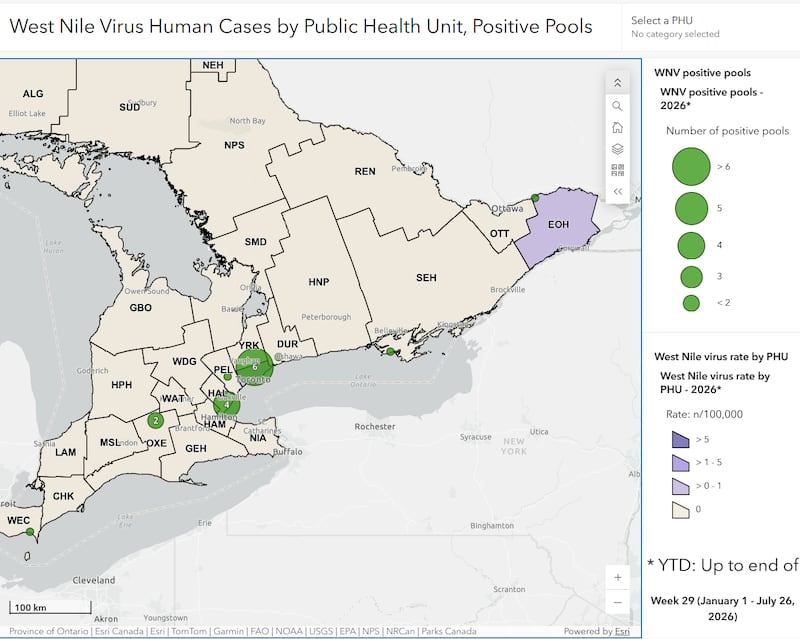
“There have been several pools of mosquitoes that we have found that are positive for the virus across southern Ontario, but the numbers are not exceptional,” Hunter said.
“What I do worry about, though, is that with all the rain we’ve been having, the mosquitoes are still breeding.”
As of July 26, which is the latest data available from Public Health Ontario, there are 17 pools of mosquitoes that have tested positive for West Nile Virus.
Are there more mosquitoes?
Alice Sinia, an entomologist and pest control expert at Orkin Canada, says they have not yet conducted their internal data on mosquito populations this year but notes the number of calls they have been receiving indicate a rise.
“I would say there is an increase in mosquito population,” she told CTV News, adding that populations reach their peak in August.
It is hard to pinpoint what exact factor causes an influx of mosquitoes, as Sinia says there are several components that contribute to its population. However, she says the biggest driver for more mosquitoes is rainfall as they breed in standing water.
Toronto saw a rainy June, with Environment Canada logging a total of 96.3 millimetres of precipitation for the entire month. July, so far, has logged nearly 78 millimetres of precipitation.
Sinia also pointed to the kind of winter Toronto had this year and the amount of snow that blanketed the city.
“That now actually helps pest populations because it creates this insulation,” Sinia said.
“For any mosquito species that overwinters as eggs or as adults, it protected them.”
What to know about West Nile Virus
The number of reported cases fluctuates each year.
In Toronto last year, the city reported 26 cases of West Nile. The year before that, there were 14 confirmed cases.
About 70 to 80 per cent of people sick with the mosquito-borne illness won’t display any symptoms, according to the Public Health Agency of Canada.
If someone is symptomatic, the signs will start to appear within two to 15 days of infection, with mild symptoms including fever, headache, body aches and swollen lymph glands.
“This will last for a few days and then it resolves on their own,” Bogoch said.
“And, in fact, most of those cases will bever even make it to medical attention because people will feel unwell, they’ll think it’s something else, they’ll recover in the comfort of their own home and that’s that.”
But there is a small percentage of cases that can lead to neuroinvasive disease, he says, which impacts the central nervous system. In more serious cases, Bogoch says it can cause meningitis or encephalitis, which is inflammation of the brain.
Dr. Howard Shapiro, associate medical officer of health at Toronto Public Health, says about one per cent of people will display these severe symptoms that require hospitalization.
“Even more rarely, fortunately, about one in 1,000 people that are infected will actually die as a result of it,” Shapiro said in an interview with CP24, adding that those who are over the age of 65 or have an existing immunocompromising condition are more at risk.
How to protect yourself
Toronto Public Health says the risk of becoming infected with West Nile is low, but there are still some precautions you can take to protect yourself.
“I am still a strong proponent of people protecting themselves from being bitten by covering up when mosquitoes are active,” Hunter said.
TPH, meanwhile, advises wearing light-coloured, long-sleeved pants and shirts when outdoors.
The health unit also recommends taking extra care in the daytime hours when mosquitoes are most active, removing any standing water from your property, and ensuring the screens on your windows and doors are tight fitting.
“Bug spray is really helpful,” Bogoch added, pointing to repellants that contain 30 per cent DEET or 20 per cent Icaridin.
“There’s a lot of products that work, but those ones kind of work a bit better.”

