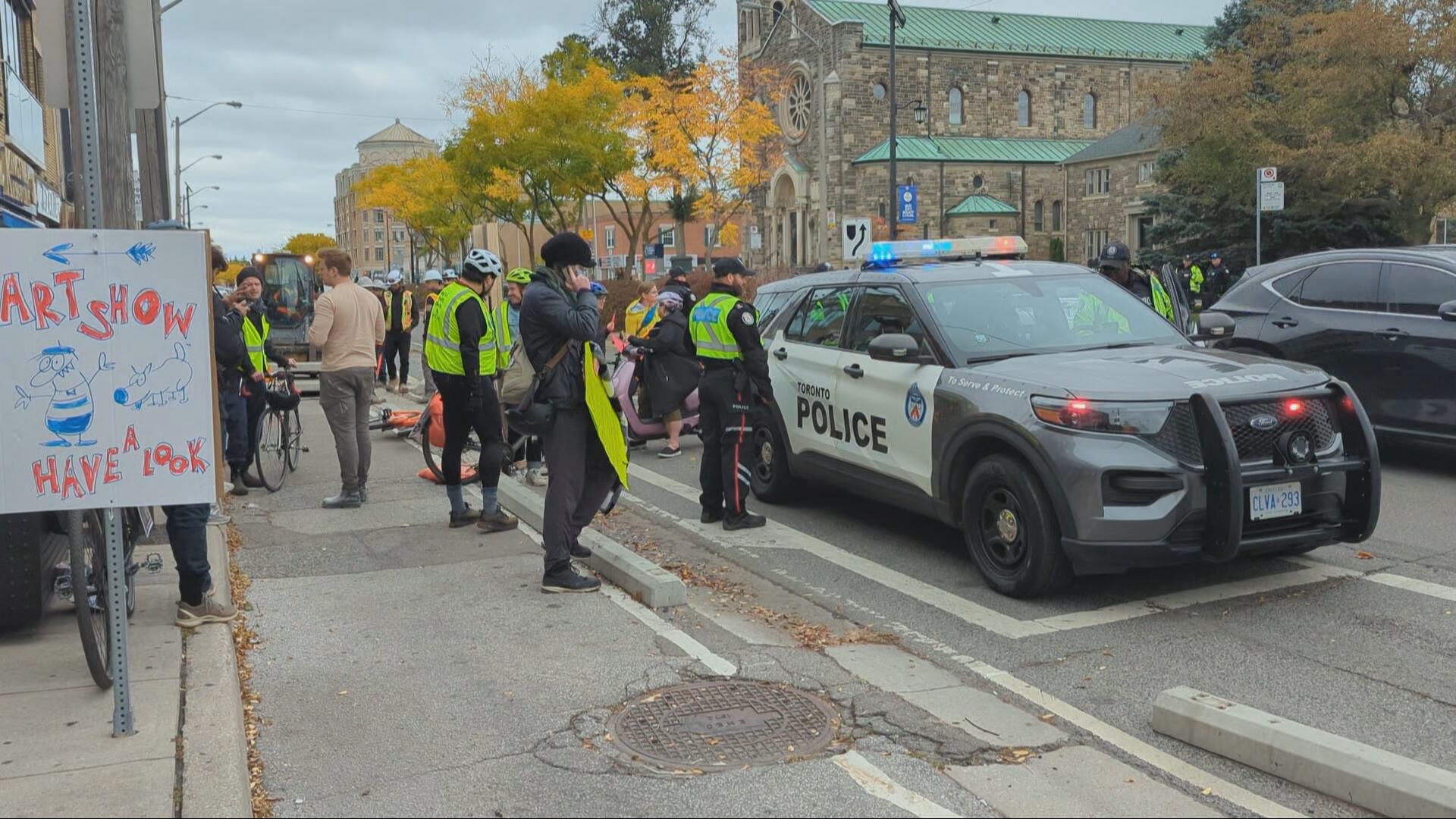
Toronto police have arrested a third person at a demonstration against the removal of bike lanes along a stretch of Bloor Street West in Etobicoke.
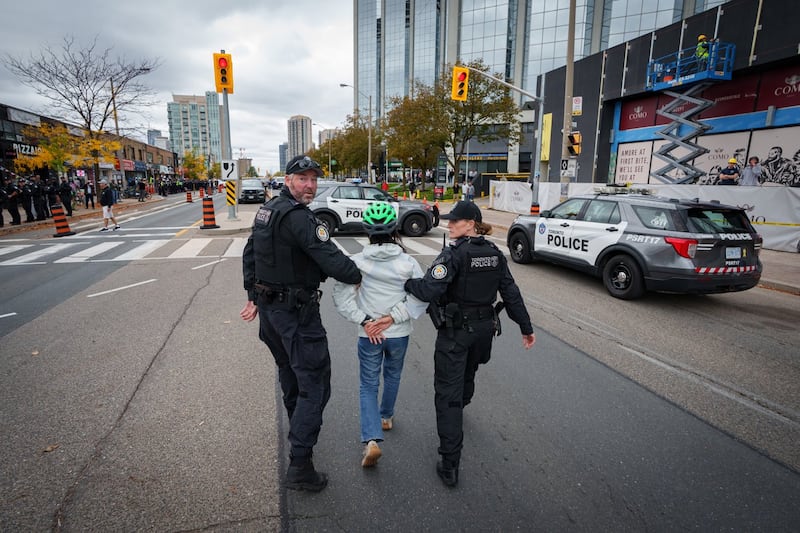
Police said a woman was arrested near the intersection of Bloor Street West & Lothian Avenue for mischief and obstructing police.
It is the third arrest since the Ford government moved ahead with its plan to remove a roughly one-kilometre stretch of bike lanes along Bloor Street West between Islington Avenue and Royal York Road.
- How to set CP24 as your preferred source on Google
- How to set CTV News as your preferred source on Google
On Tuesday, construction crews began the process of removing the bike lanes after the Ford government announced it would be moving forward with the plan.
The decision drew out demonstrators protesting their removal, and work was halted after demonstrators blocked entrance to the area.
The next day crews continued with removal plans, resulting in continued protests and a large presence of uniformed police officers.
On Wednesday, a 25-year-old woman from Hamilton was arrested and charged with mischief and obstructing a peace officer.
Hours later, shortly before 8:00 p.m., police allege that another suspect, who was part of the demonstrations, removed municipal signage and attempted to leave the area before being stopped.
Khoa Thanh Phan, 20, of Toronto, was charged with mischief, interfere with lawful use of property and theft under $5,000, police said in a news release.
The charges have not been proven in court.
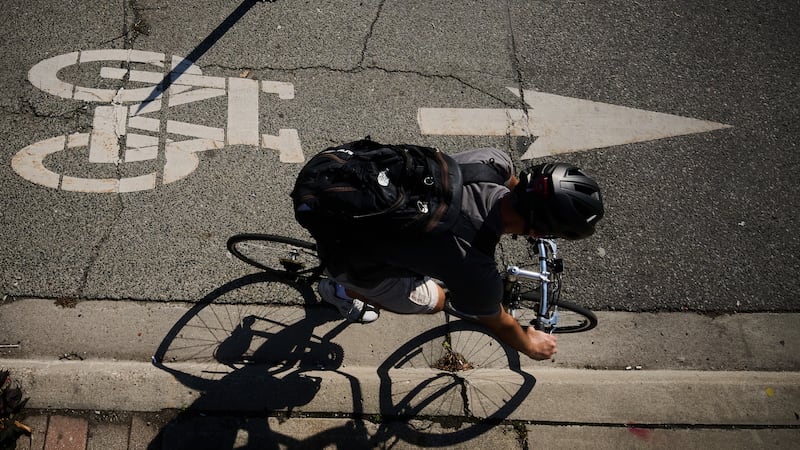
Critics of the provincial government`s decision to remove the lanes say it will make the area unsafe for cyclists and are concerned with provincial overreach.
The province cited concerns about traffic congestion in the area as reasoning to remove the lanes.
In a statement Tuesday, Ontario Transportation Minister Prabmeet Sankaria said “Make no mistake: these bike lanes are coming out. We have a clear mandate and we will deliver.” After work to removal the bike lanes was temporally halted.
In 2024, the provincial government passed legislation to granting itself the authority to remove the lanes.
The Ontario Superior Court of Justice temporarily blocked the move, but the Ontario Court of Appeals overruled the lower courts decision, paving the way for the provincial government to move forward with its mandate.
An engineering report that was previously commission by the province found that bike lane removal might increase vehicle capacity, but the actual alleviation of congestion may be negligible or short-lived.
According to the city of Toronto, the cost of removal is expected to reach an estimated $48 million, which also included plans to remove bike lanes along stretches of Yonge Street and University Avenue.
Ford previously said the near $50 million estimation is “a bunch of hogwash”, and said that “We’re going to show them how to do it for a lot less and get traffic moving.”
Toronto voters split over bike lane removals
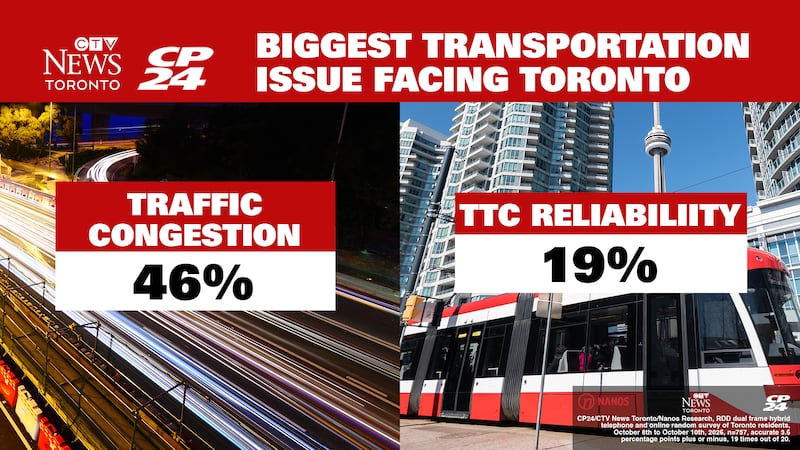
In a recent Nanos research poll, which surveyed 757 Toronto residents, researchers found that 46 per cent of respondents see traffic congestion as the city’s greatest inconvenience.
Nine per cent of all respondents said there were too many bike lanes and bike paths, making it the third-biggest problem for people getting around Toronto, according to Nanos Research
The topic has also recently become a polarizing issue for Toronto’s Oct. 26 mayoral election. Supports for incumbent Mayor Olivia Chow and front runner Brad Bradford appear divided on the issue.
It found that 74 per cent of Chow voters support or somewhat support it, while 74 per cent of Bradford voters oppose or somewhat oppose it,” Nik Nanos, Nanos Research chief data scientist, said in a statement.
The data also shows that eight per cent of those surveyed said there was a need for more bike lanes and paths.
The construction between Islington and Royal York was expected to run through Nov. 17, according to a notice on the city’s website.
With files from the Canadian Press and CTV News’ Phil Tsekourous

