Editor’s note: This is the second of a two-part series profiling Toronto’s leading mayoral candidates ahead of the Oct. 26 election. Read more about Brad Bradford here.
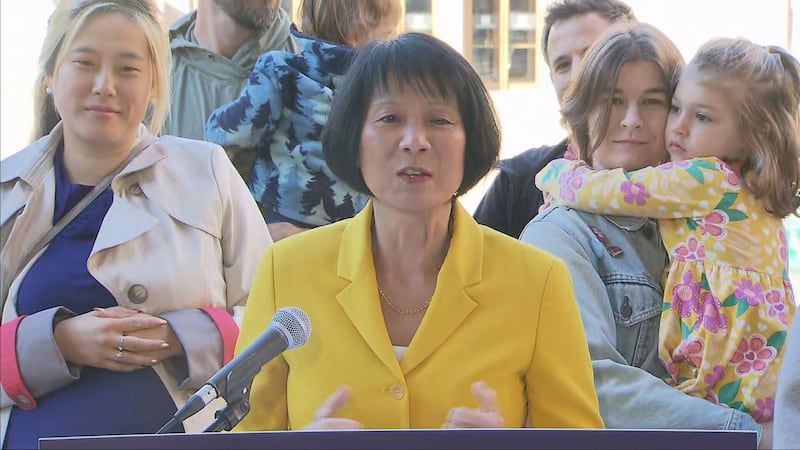
Olivia Chow stood in front of a podium on Thursday with the words “More Affordable” spelled out in giant letters as she doubled down on the topic that has been at the centre of her re-election campaign – Toronto’s cost of living.
“My mom was a hotel maid. She worked hard to build a life here. It wasn’t easy. But our city worked for us and I won’t stop fighting until it works for you too,” Chow told supporters outside a restaurant in Toronto’s bustling Chinatown neighbourhood.
Chow, 69, came to power three years ago in a special byelection to replace former mayor John Tory following his resignation over an affair with a staffer. Promising to build a “more caring city,” Chow eked out a win over Tory-backed candidate Ana Bailao.
She is the first woman of Asian descent to lead the city. An immigrant who came to Toronto at 13 from Hong Kong with her parents, she studied sculpting, religion and philosophy before becoming an activist and politician.
Chow got her start in politics in 1985 when she was first elected as a TDSB trustee and later served four terms as a Toronto city councillor. She eventually moved onto federal politics as an NDP MP for the downtown riding of Trinity-Spadina, a role she held for four terms.
She was also the wife of popular former federal NDP leader Jack Layton, who passed away in 2011.
As mayor, she is frequently seen cycling around Toronto and each August is spotted reveling in full costume at the city’s annual Caribbean Carnival, where she is a longtime fixture.
Political watchers point out she’s had a number of achievements in her first term, most notably a new deal with Ontario that saves the city billions of dollars in costs uploaded to the province for the maintenance of the Gardiner Expressway and Don Valley Parkway.
She also introduced a fare cap for frequent TTC riders, brought in a renoviction bylaw to make it tougher to boot tenants just to jack up the rent, and added a school nutrition program that she is promising to expand if re-elected.
In a televised interview with CP24 Breakfast on Friday, Chow said that she works hard “to make life more affordable for the voters” but she said that moving the city forward requires a team effort and that includes building better relationships with other levels of government.
“It is not just the mayor. It is that together we are stronger. If you believe that, let’s do it together and I have very good cooperation with the federal and provincial governments,” she said. “I have been able to upload the Gardiner and DVP and get the funds to build more housing and to fix the TTC, the infrastructure is old. So it really takes all of us coming together to create a more caring, more affordable and safer city.”
Recent polling conducted exclusively for CP24 and CTV News Toronto by Nanos Research showed that 18 per cent of respondents identify housing costs as the “single biggest issue” impacting the city, trailing only congestion (26 per cent). Property taxes (12 per cent) and the cost of groceries (9 per cent) were also among the top issues identified.
As part of her platform, Chow has promised to tackle rising grocery prices by cutting property taxes for independent grocery stores and introducing an outright ban on surveillance pricing.
She also wants to expand an existing school nutrition program to provide lunch, something she said will help parents save money,
“I love Toronto, I love this city and I want life to be more affordable for everyone,” she told CP24 Breakfast on Friday. “Let’s go together rather than going backwards to the days of cuts and upheaval. That is not what this city needs. “
Rising cost of living
Chow has largely run a campaign focused on her record over the last three years, with most announcements coming back to affordability in one form or another.
Her focus on affordability comes against the backdrop of a turbulent three years in the Canadian economy, with runaway inflation, soaring food prices and a housing downturn that has erased tens of thousands of dollars in value from many people’s homes.
Toronto residents have also seen significant increases to their property tax bills since Chow took office.
In 2024 the city saw the introduction of the biggest property tax increase since amalgamation.
Chow was criticized by mayoral opponents during her 2023 campaign for for not disclosing how much she’d raise taxes, saying she’d have to assess the needs of the city first. Those who were worried had some of their fears validated. Property owners were hit with a 9.5 per cent property tax hike in Chow’s first budget, followed by a 6.9 per cent increase in 2025 and a more modest 2.2 per cent this year, which was around the rate of inflation.
In all, that 18.6 per cent increase over three years amounts to around $643 more for an average Toronto property owner than they would have been paying in 2023. That’s like each average household buying city hall a new iPad every year in addition to what they were previously paying.
Chow, for her part, has defended the tax increases as necessary given the deficit the city was facing coming out of the COVID-19 pandemic.
“It is like your house. Your roof is leaking you have to fix it. If you don’t fix it then it it going to get much worse later so yes it was hard (raising taxes). You think I want to do it? But I had to,” Chow told NewsTalk 1010 on Friday.
In her interview with CP24 Breakfast on Friday, Chow said that if re-elected she will keep property tax increases to around the rate of inflation. She also slammed her mayoral opponent Brad Bradford for suggesting he would freeze property taxes entirely in 2027.
“Going forward it (property taxes) would be around the rate of inflation. That is reasonable because all the costs, the gasoline prices and everything have gone up, salaries have gone up so we have to be straight up and say this is just what it is,” she said.
Myer Siemiatycki, a retired professor of politics and public administration at Toronto Metropolitan University, said it’s unlikely that Premier Doug Ford would have struck the new deal with the city had it not done its part to increase revenue.
“I think the increased property taxes that were introduced, especially in the first two years, were key to securing from the province massive amounts of funding and lower interest rates on the amount that the City of Toronto would have to borrow for its major capital construction and infrastructure spending,” he said, pointing out the city’s credit rating has improved under Chow.
While some groups have lauded the tax bump as necessary to help make up for years of inadequate increases, others have balked at the size of the increases. The right-leaning Canadian Taxpayers’ Federation has repeatedly called on the city to cut spending instead of raising taxes.
York Centre Coun. James Pasternak said for many seniors on a fixed income who are trying to stay in their homes, the property tax increases have been “crushing.”
Ahead of the latest budget this year, Chow implemented a line-by-line review she said saved $135 million and ordered a hiring freeze on non-essential staff to save money. Ultimately, she was able to address an opening $1.3 billion budget shortfall without a significant tax hike.
But her main opponent in the mayoral race, Brad Bradford, has accused Chow of not doing enough to look for savings in the budget.
“I think she’s done a good job with emergency services and I credit her for giving the police the funding they need to do their job, but apart from that I’m not sure that the increase in property tax is being reflected in the improvements in the city as (much) it as it could be,” said Coun. Jon Burnside, who represents Don Valley East.
Ahead of the latest budget this year, Chow implemented a line-by-line review she said saved $135 million and ordered a hiring freeze on non-essential staff to save money. Ultimately, she was able to address an opening $1.3 billion budget shortfall without a significant tax hike.
‘She has not stood up for us’
Chow has also faced criticism for her response to the rise in hate crimes targeting Toronto’s Jewish community on the heels of the Israel-Hamas war.
In 2024, she skipped a Jewish community event attended by some 20,000 people to mark the first anniversary of the Oct. 7 massacre.
At the time she said that her absence was because she had to attend a meeting about bike lanes and suggested that her office may have lost the email invitation. Organizers said they had tried to get her response multiple times, to no avail.
The Centre for Israel and Jewish Affairs (CIJA) later slammed Chow’s explanations as “embarrassing exercises in avoiding accountability.”
Chow eventually apologized, saying “I really regret not being able to be there.”
At the start of the latest campaign, Chow also skipped a mayoral debate on rising antisemitism, saying she couldn’t attend because she was only officially launching her campaign the day after the debate.
“I don’t think she has risen to the occasion. She has not stood up for us,” says Pasternak, who represents an area with a large Jewish population and is himself Jewish.
Pasternak, who has endorsed Brad Bradford in the mayoral race, says Chow has demonstrated “very poor leadership,” on the issue, particularly when it comes to weekly protests targeting the Jewish community in his North York ward.
“Our leaders must protect all minorities, and we can’t be sucked into a world conflict zone that is 10,000 kilometers away,” he says.
Some pragmatic deals, but a ‘weak bench’
When it comes to assessing how effective Chow has been at governing, observers that CTV News spoke with for this story say her record is mixed.
Burnside suggested that Chow has put some people into leadership positions at city hall who weren’t ready.
“I think her biggest challenge has been her bench, and now she’s losing strong people like (retiring city councillors) Gord Perks and Paula Fletcher,” Coun. Burnside said, adding some people elevated by Chow “really weren’t ready for prime time.”
In particular, he points to reliability and safety on the TTC as an issue.
“I think the city has fallen well short on that,” Burnside says.
Others, however, say Chow has been more adept at handling other levels of government than her predecessors.
Earlier in the campaign, Ford spoke of his “phenomenal” relationship with Chow, who he said was doing an “incredible job” as mayor. He told reporters that they should “read between the lines” of his comments, hinting at a potential endorsement but later clarified that he had no plans to formally endorse anyone in Toronto’s mayoral race.
“I think when you look at Olivia Chow’s time as mayor, you are driven to look at her not in terms of the lasting structural changes she has made to the city and its future, but rather to her political accomplishments, her navigation of the council, her management of other levels of government,” CTV Political Analyst Scott Reid said.
“I would also point at things like the perhaps surprising success she’s had at working with Doug Ford. Not just in grudging obligatory partnership with Doug Ford, but they appear to have pursued a sincerely enthusiastic relationship, and I don’t think that was something that people would have guessed.”
That relationship has shown its limits at times, however, like when Ford decided most recently to rip up some bike lanes against the wishes of the city, or when he decided to proceed with an island airport expansion (ultimately quashed by the feds) that Chow was against.
Communicating the wins
Chow says she has made progress on building affordable housing during her mayoral tenure, securing billions in federal funding and seeing ground broken on 5,271 new city-owned units. Though in a live debate on CP24 on Thursday night, Bradford pointed out that at the current pace of completion, it would take 115 years to reach the goal she set in the last election of building 65,000 units by 2030.
She has campaigned on starting construction on 10,000 new units in 2027 if re-elected.
“For too many people, a home here is slipping out of reach. That’s not acceptable to me. I believe if you’re a nurse, a teacher, a construction worker, a PSW, you should be able to afford to live here. Full stop. That’s why housing has been my focus. We are getting housing built,” Chow said at a campaign stop earlier this month.
Even those who feel the mayor has had a solid list of accomplishments over the past few years say they don’t think she and her team have necessarily done a good job of telegraphing those wins.
“I think she’s done a lot,” Siemiatycki said, citing Chow’s efforts to crackdown on problem landlords in particular. “Those are very tangible affordability kind of commitments that the mayor has undertaken that I don’t think has kind of been highlighted or gotten through to the public in this campaign.”
According to Reid, that could be part of the reason Bradford has continued to build momentum through the campaign.
“You also want to be able to turn on the wattage. You want to be able to grab the camera and use your ability to communicate and to connect. And she’s just never really been that kind of political leader,” Reid said.
He said he’s been surprised to see her wider lead over Bradford evaporate as the election draws closer.
“The fact that it’s tightened forces me to reconsider her time as mayor, and I think the critical issue is she has been all about the transactional process of managing council and managing votes and cutting political deals and maneuvering here and maneuvering there. And it is, when pressed, not a terribly inspiring program, and it’s not littered with big accomplishments, and it’s not littered with big new ideas about two years from now, as opposed to two years ago,” he said.
Speaking herself at another announcement recently, Chow framed the election as “a choice” between moving forward with her agenda or giving up progress.
“This election is a simple choice,” Chow told a crowd in Bradford’s ward of Beaches East York. “Do we choose to keep moving forward together to make our city safer, or do we go backwards, backwards with cuts to the services that keep us safe, and to the libraries and to the TTC? Do we put our progress at risk and stop moving forward? I don’t think that’s what Toronto wants.”
Her announcement was about reopening 54 Division, an item included in this year’s budget.
Burnside concedes Chow has done a good job improving emergency services. But while he said he likes her personally, there is still a sense the city could do with a stronger guiding hand.
“I’d probably give her a C-plus, B-minus (overall), which is better than I did in university,” jokes Burnside, who is not formally endorsing any mayoral candidate in this campaign. “But you know maybe we need a mayor that can do a bit better.”

